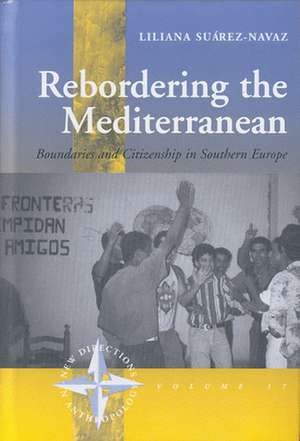
Rebordering the Mediterranean
Autor Liliana Suárez-Navazen Limba Engleză Paperback – 21 noi 2005
Preț: 224.70 lei
Puncte Express: 337
Carte tipărită la comandă
Livrare economică 25 noiembrie-09 decembrie
Livrare prin curier în România Termenul estimat este afișat lângă disponibilitate.
Transport gratuit de la 400.00 lei Plată online sau ramburs, în funcție de opțiunile comenzii.
Retur gratuit în 14 zile Comandă securizată și suport în română.
Specificații
ISBN-13: 9781845450434
ISBN-10: 1845450434
Pagini: 280
Ilustrații: 1
Dimensiuni: 152 x 229 x 16 mm
Greutate: 0.41 kg
Editura: BERGHAHN BOOKS
ISBN-10: 1845450434
Pagini: 280
Ilustrații: 1
Dimensiuni: 152 x 229 x 16 mm
Greutate: 0.41 kg
Editura: BERGHAHN BOOKS
V-ar putea interesa
-
 Humans and Other AnimalsJohn Dupré-12%Preț: 372.52 lei421.74 lei
 -
 Culture EvolvesAndrew Whiten-31%Preț: 923.98 lei1336.84 lei
 -
 Faulkner's GambitM. WainwrightPreț: 389.10 lei
 -
 IndographyJ. Harris-15%Preț: 666.80 lei784.47 lei
 -
 Preț: 155.76 lei
 -
 Distinction: A Social Critique of the Judgement of TastePierre BourdieuPreț: 224.33 lei
 -
 Race and Ethnicity: The BasicsPeter KivistoPreț: 202.41 lei
 -
 StuffDaniel MillerPreț: 138.73 lei
 -
 Ethnic Identity in Tang ChinaMarc S Abramson-11%Preț: 476.37 lei535.24 lei
 -
 Techniques of PleasureMargot WeissPreț: 212.49 lei
 -
 Saltwater SocialityKatharina Schneider-23%Preț: 761.29 lei988.70 lei
 -
 Images of Power and the Power of ImagesJudith KapfererPreț: 223.64 lei
 -
 Landscape EthnoecologyLeslie Main JohnsonPreț: 269.29 lei
 -
 Plants, Health and HealingElisabeth HsuPreț: 262.28 lei
 -
 When God Comes to TownRik PinxtenPreț: 199.69 lei
 -
 Braving the StreetIrene GlasserPreț: 219.57 lei
 -
 Places of PainHariz HalilovichPreț: 235.06 lei
 -
 Changing Identifications and Alliances in North-east AfricaGünther Schlee-23%Preț: 758.94 lei985.64 lei
 -
 Beyond Writing CultureOlaf Zenker-23%Preț: 761.77 lei989.31 lei
 -
 Empire and AfterGraham MacpheePreț: 261.34 lei
 -
 Arab Cultural Studies: Mapping the FieldTarik Sabry-23%Preț: 196.70 lei255.70 lei
Notă biografică
Liliana Suárez-Navaz is Professor in the Social Anthropology Department at Autónoma University of Madrid.
Cuprins
Acknowledgments
Introduction
Glossary
References
Index
Introduction
- Identities and Citizenship in the Andalusian Borderland
- Modernity in the Making: The Reinscription of Difference in a Legally Bounded Space
- Culture and Gender in Ethnographic Work
- Peasants in Francoist Times
- Rights and the Experience of Emigration
- Irrigation, Intensive Labor, and the Autonomous Entrepreneur
- Politics of Change: The Social Vision of the Village
- The Price of Modernization: Loss of Autonomía in a Global Space
- A New Relationship with the State
- Alfaya in the Narratives of the Past: Inclusive versus Exclusive Criteria of Belonging
- Summary and Preliminary Conclusions
- Crossing Boundaries
- The Making of a European Spain and Southern Immigrants
- Enactment of the Alien Law
- Andalusia's Muslim Imagery
- "Outsider" into "Foreigner": The First Case of Enforcement of the LOE and Collective Resistance
- Act 1: Hailing and Resistance
- Act 2: Resistance to Expulsion and Nationalism That "Goes without Saying,"
- Landscapes of Inequality
- Africans in Alfaya: "No Place to Stay,"
- Sheltering the Homeless: Immigrants' Place as a Right and an Arena for Consciousness-Building
- Putting Immigrants in Their (Social) Place
- Naturalizing Difference
- Salir a la Luz: The 1991 Regularization Process
- Immigrants as Administered Subjects and the Fetishism of Papers
- Integration: The Imagining of Cultural Antagonism and Multicultural Consent
- Local Implementation of Social Programs in the Summer of 1994
- The Politics of Invisibility: A Racial Geography of Labor Relations
- The Forging of a Modern National Tradition in Senegal: Black Islam, Peripheral State, and Global Capitalism
- Tradition and Cosmopolitanism in Emigration: Reproduction and Change in Senegalese Society
- Community in the Diaspora: The Construction of Granada as a Senegalese Place (1980-1995)
- Strategies of Belonging and Structures of Power: The Challenge of a Transnational Social Space
- Convivencia and Citizenship from an Anthropological Perspective
- Convivencia at Home: The Case of Zoheir and the Blanco Family
- Work and Leisure: Rights as Workers, Respect as People
- Immigrants as Collective Subjects in the Public Social Space: A New Convivencia in Granada?
Glossary
References
Index