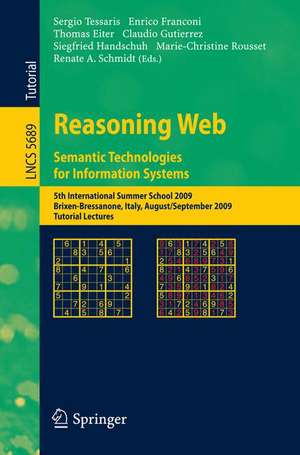
Reasoning Web. Semantic Technologies for Information Systems
Editat de Sergio Tessaris, Enrico Franconi, Thomas Eiter, Claudio Gutierrez, Siegfried Handschuh, Marie- Christine Rousset, Renate Schmidten Limba Engleză Paperback – 17 aug 2009
Preț: 325.63 lei
Preț vechi: 407.04 lei
-20%
Puncte Express: 488
Preț estimativ în valută:
57.58€ • 66.03$ • 49.77£
57.58€ • 66.03$ • 49.77£
Carte tipărită la comandă
Livrare economică 27 aprilie-11 mai
Specificații
ISBN-13: 9783642037535
ISBN-10: 3642037534
Pagini: 368
Ilustrații: VII, 357 p.
Dimensiuni: 155 x 235 x 20 mm
Greutate: 0.56 kg
Ediția:2009
Editura: Springer
Locul publicării:Berlin, Heidelberg, Germany
ISBN-10: 3642037534
Pagini: 368
Ilustrații: VII, 357 p.
Dimensiuni: 155 x 235 x 20 mm
Greutate: 0.56 kg
Ediția:2009
Editura: Springer
Locul publicării:Berlin, Heidelberg, Germany
V-ar putea interesa
-
 Database and Application SecurityR Sarma Danturthi-20%Preț: 279.50 lei349.37 lei
 -
 Introduction to Formal LogicRussell Marcus-23%Preț: 573.56 lei744.88 lei
 -
 Deitel, H: Internet & World Wide Web: How to ProgramAbbey Deitel-13%Preț: 583.92 lei671.17 lei
 -
 Modern Information RetrievalRicardo Baeza-Yates-13%Preț: 598.37 lei687.78 lei
 -
 HTML & CSSJon Duckett-20%Preț: 247.44 lei309.30 lei
 -
 Database SystemsRamez Elmasri-20%Preț: 531.56 lei664.45 lei
 -
 Artificial Intelligence: A Guide to Intelligent SystemsMichael Negnevitsky-20%Preț: 509.26 lei636.57 lei
 -
 SQL Essentials for DummiesRichard Blum-20%Preț: 73.24 lei91.55 lei
 -
 Handbook of Metadata, Semantics and OntologiesSaurabh Pal-18%Preț: 967.46 lei1179.83 lei
 -
 The Semantic Web: ESWC 2022 Satellite EventsPaul Groth-20%Preț: 495.58 lei619.48 lei
 -
 The Semantic Web - ISWC 2023Terry R. Payne-20%Preț: 535.97 lei669.96 lei
 -
 The Semantic WebAlbert Meroño Peñuela-20%Preț: 437.83 lei547.29 lei
 -
 Database and Expert Systems ApplicationsChristine Strauß-20%Preț: 377.46 lei471.82 lei
 -
 Engineering Information Systems with Large Language ModelsFrancesca de Luzi-24%Preț: 916.62 lei1206.07 lei
 -
 The Semantic Web: Research and ApplicationsLora Aroyo-20%Preț: 330.75 lei413.43 lei
 -
 -20%Preț: 322.61 lei403.26 lei
 -
 -20%Preț: 321.17 lei401.46 lei
 -
 -20%Preț: 334.49 lei418.11 lei
 -
 -20%Preț: 321.03 lei401.30 lei
 -
 Web Information Systems and TechnologiesJoaquim Filipe-20%Preț: 398.36 lei497.95 lei
Public țintă
ResearchCuprins
Description Logics.- Answer Set Programming: A Primer.- Logical Foundations of XML and XQuery.- Foundations of RDF Databases.- Database Technologies for RDF.- Technologies for the Social Semantic Desktop.- Ontologies and Databases: The DL-Lite Approach.
Textul de pe ultima copertă
This book contains a collection of seven thoroughly revised tutorial papers based on lectures given by leading researchers at the 5th International Summer School on the Reasoning Web, held in Brixen-Bressanone, Italy, from August 30 to September 4, 2009. The objective of the book is to provide a coherent introduction to semantic web methods and research issues with a particular emphasis on reasoning.
The focus of this year’s event was on the use of semantic technologies to enhance data access on the web. Topics covered include design and analysis of reasoning procedures for description logics; answer set programming basics, its modeling methodology and its principal extensions tailored for semantic web applications; languages for constraining and querying XML data; RDF database theory and efficient and scalable support for RDF/OWL data storage, loading, inferencing and querying; tractable description logics and their use for ontology-based data access; and the social semantic desktop, which defines a user’s personal information environment as a source and end-point of the semantic web.
The focus of this year’s event was on the use of semantic technologies to enhance data access on the web. Topics covered include design and analysis of reasoning procedures for description logics; answer set programming basics, its modeling methodology and its principal extensions tailored for semantic web applications; languages for constraining and querying XML data; RDF database theory and efficient and scalable support for RDF/OWL data storage, loading, inferencing and querying; tractable description logics and their use for ontology-based data access; and the social semantic desktop, which defines a user’s personal information environment as a source and end-point of the semantic web.