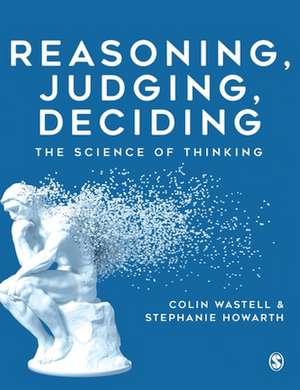
Reasoning, Judging, Deciding: The Science of Thinking
Autor Colin Wastell, Stephanie Howarthen Limba Engleză Paperback – 17 noi 2021
Observăm că, deși literatura academică abundă în studii fragmentate despre procesele cognitive, volumul Reasoning, Judging, Deciding de Colin Wastell și Stephanie Howarth vine să completeze o lacună critică: lipsa unei sinteze care să unească teoriile clasice ale raționalității cu provocările informaționale ale secolului XXI. Această apariție editorială de la SAGE Publications nu se limitează la prezentarea mecanismelor abstracte, ci integrează direct în discursul academic fenomene precum știrile false și teoriile conspirației.
Suntem de părere că forța acestui text rezidă în structura sa progresivă și cuprinzătoare. Autorii încep prin a ancora gândirea în moștenirea Iluminismului și în Revoluția Cognitivă, trecând apoi rapid către modelele matematice și psihologice ale deciziei, precum Expected Utility Theory și Prospect Theory. Subliniem importanța includerii unor capitole dedicate raționalității ecologice și modelelor de procesare duală, care oferă studenților un cadru teoretic solid înainte de a explora aplicații complexe precum expertiza, raționamentul moral sau chiar știința cognitivă a religiei.
Ediția de față completează perspectiva oferită de Thinking – Psychological Perspectives on Reasoning, Judgment and Decision Making de D Hardman, adăugând o analiză a modului în care mintea umană interacționează cu mediul digital și cu structurile sociale moderne, elemente mai puțin explorate în manualele tradiționale. Față de abordările de tip „basics” ale lui S. Ian Robertson, acest volum oferă o profunzime analitică superioară, fiind conceput special pentru curriculumul universitar. Prin utilizarea studiilor de caz și a întrebărilor de reflecție, autorii reușesc să transforme teoriile despre bias-uri euristice și arhitectura minții în instrumente de înțelegere a comportamentului uman cotidian.
Preț: 491.05 lei
Carte disponibilă
Livrare economică 07-21 mai
Livrare express 23-29 aprilie pentru 73.15 lei
Specificații
ISBN-10: 1526491079
Pagini: 432
Dimensiuni: 186 x 232 x 30 mm
Greutate: 1.21 kg
Ediția:1
Editura: SAGE Publications
Colecția Sage Publications Ltd
Locul publicării:London, United Kingdom
De ce să citești această carte
Recomandăm această carte oricărui student la psihologie sau științe sociale care dorește să înțeleagă nu doar cum gândim, ci și de ce suntem susceptibili la erori de judecată în era informației. Cititorul câștigă o viziune de ansamblu asupra științei cognitive, de la deducție și inducție până la influența subtilă a strategiilor de tip „nudge”. Este un instrument esențial pentru dezvoltarea gândirii critice aplicate în contexte reale, de la decizii economice la dileme morale.
Despre autor
Colin Wastell și Stephanie Howarth sunt specialiști recunoscuți în domeniul psihologiei cognitive și al proceselor de luare a deciziilor. Deși datele biografice furnizate se concentrează parțial pe alți cercetători din domeniu, contribuția lor în cadrul SAGE Publications evidențiază o preocupare constantă pentru educația academică de înalt nivel. Lucrarea lor se distinge prin rigoarea metodologică și prin capacitatea de a aduce teorii complexe, precum cele legate de inteligența artificială și neuroștiința religiei, într-un format accesibil și bine structurat pentru mediul universitar.
Descriere scurtă
Recenzii
"A very engaging book that gives a comprehensive overview of the topics in thinking. I like in particular the theory centred approach endorsed, and that the authors show how arguments shape theories and how theories develop and progress over time."
Cuprins
Chapter 2. A Cognitive Revolution? When the mind began to matter!
Chapter 3. Thinking Under Uncertainty: Expected Utility Theory
Chapter 4. Prospect Theory: Heuristics and some biases
Chapter 5. Ecological Rationality: Are humans effective thinkers?
Chapter 6. Dual Process Models: Is the mind made up of two components?
Chapter 7. Mind: Modular and Extended: Is the mind made up of many components, internal and external?
Chapter 8. Deduction, Induction, Abduction: Reasoning formal and speculative
Chapter 9. Problem Solving Including Analogical Reasoning: Learning to answer the question that is asked!
Chapter 10. Imagination: The play space of the mind
Chapter 11. Nudge: Making good outcomes more common
Chapter 12. Expertise: How do experts think?
Chapter 13. Moral Reasoning: How do people decide on what is right?
Chapter 14. Cognitive Science of Religion: What can models of the mind tell us about belief in the supernatural?
Chapter 15. Artificial Intelligence: Computer thinking: What kind of thinking can computers really do?
Chapter 16. Argumentative Theory: Is the construction of arguments central to human thinking?
Chapter 17. Three Thinking Illusions: How much of our thinking is done alone?
Chapter 18. Thinking and Uncertainty: What effect does not knowing for certain have on our thinking?
Chapter 19. Thinking Scientifically: Easy or hard?
Chapter 20. Conspiratorial Thinking: Why are people so suspicious of governments and big business?
Chapter 21. Sceptical Thinking: How to avoid being duped by fake news!