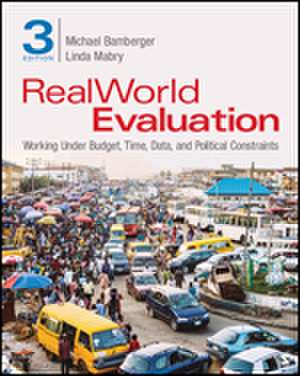
RealWorld Evaluation
Autor J. Michael Bamberger, Linda S. Mabryen Limba Engleză Paperback – 27 sep 2019
Găsim în RealWorld Evaluation o resursă fundamentală care depășește granițele metodologiei clasice, propunând o abordare profund interdisciplinară. Lucrarea integrează concepte din sociologie, economie, știința datelor și studii de gen, fiind concepută pentru a naviga prin labirintul constrângerilor de buget, timp și presiuni politice care definesc mediul profesional autentic. Suntem de părere că această a treia ediție revizuită reprezintă un salt necesar de la teorie la execuție, oferind instrumente pentru evaluatori care trebuie să livreze rezultate riguroase în condiții imperfecte. Comparabil cu The Evaluation Handbook de Debra Rog în rigurozitate, RealWorld Evaluation se diferențiază prin actualizarea sa pentru era digitală și prin accentul pus pe tehnologia datelor. În timp ce manualul lui Rog oferă o bază solidă a competențelor, textul semnat de J. Michael Bamberger și Linda S. Mabry este recalibrat pentru a răspunde provocărilor moderne precum complexitatea emergentă și echitatea socială. Cartea este structurată în jurul modelului original în șapte pași creat de autori, ghidând cititorul de la clarificarea scopului și modelarea teoriei programului, până la selectarea designului de evaluare optim sub presiunea limitărilor materiale. Putem afirma că volumul se poziționează ca o extensie firească a lucrării anterioare a lui J. Michael Bamberger, Dealing With Complexity in Development Evaluation. Dacă acea lucrare se concentra pe fundamentul teoretic al complexității, titlul de față operationalizează aceste concepte, oferind o metodologie structurată pentru implementarea lor. Capitolele noi despre egalitatea de gen și responsabilitatea în utilizarea datelor reflectă o adaptare precisă la noile cerințe ale curriculumului internațional în politici publice și dezvoltare.
Preț: 886.96 lei
Preț vechi: 1137.12 lei
-22%
Carte disponibilă
Livrare economică 16-30 noiembrie
Livrare express 30 octombrie-05 noiembrie pentru 57.07 lei
Specificații
ISBN-10: 1544318782
Pagini: 568
Dimensiuni: 202 x 254 x 27 mm
Greutate: 1.11 kg
Ediția:3 Revised edition
Editura: Sage Publications, Inc
Locul publicării:Thousand Oaks, United States
V-ar putea interesa
-
 On the EdgeNate SilverPreț: 109.29 lei
 -
 Program Evaluation: Alternative Approaches and Practical GuidelinesJody L. Fitzpatrick-23%Preț: 1248.11 lei1620.92 lei
 -
 Impact Evaluation in Firms and OrganizationsMartin HuberPreț: 322.42 lei
 -
 Designing Small Evaluation StudiesElizabeth Tipton-18%Preț: 500.82 lei610.76 lei
 -
 Evaluating Public and Community Health ProgramsMuriel J Harris-5%Preț: 680.54 lei716.36 lei
 -
 Preț: 474.06 lei
 -
 -25%Preț: 91.69 lei122.59 lei
 -
 -8%Preț: 590.44 lei641.79 lei
 -
 -15%Preț: 637.68 lei750.22 lei
 -
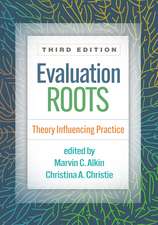 Evaluation Roots, Third Edition: Theory Influencing PracticeMarvin C. AlkinPreț: 443.28 lei
 -
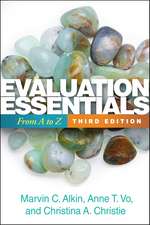 Evaluation Essentials, Third Edition: From A to ZMarvin C. AlkinPreț: 426.74 lei
 -
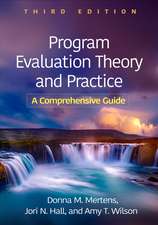 -15%Preț: 566.85 lei666.89 lei
 -
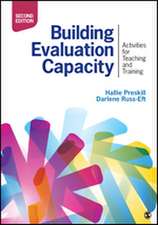 Building Evaluation CapacityDarlene Russ-Eft-23%Preț: 659.38 lei856.34 lei
 -
 Evaluation - International Student EditionPeter H. Rossi-22%Preț: 895.70 lei1148.34 lei
 -
 -8%Preț: 348.83 lei377.84 lei
 -
 -22%Preț: 881.99 lei1130.77 lei
 -
 Collaborative Methods: Participatory Data Analysis in Feminist ResearchKaylan C. SchwarzPreț: 236.20 lei
 -
 -5%Preț: 440.88 lei464.08 lei
De ce să citești această carte
Recomandăm această carte profesioniștilor și studenților care au nevoie de o metodologie de lucru adaptată realității, nu doar teoriei de laborator. Cititorul câștigă un set concret de instrumente (modelul în 7 pași) pentru a gestiona proiecte sub presiunea lipsei de date sau a bugetelor reduse. Este o lectură esențială pentru a înțelege cum pot fi integrate etica digitală și echitatea de gen în evaluarea impactului social modern.
Despre autor
J. Michael Bamberger are o experiență de peste 40 de ani în evaluarea dezvoltării internaționale, lucrând în peste 50 de țări. A ocupat poziții cheie în cadrul Băncii Mondiale, unde a coordonat metodologii de monitorizare și evaluare. Linda S. Mabry este profesor emerit, specializată în metodologii de evaluare calitativă și mixtă, cu un accent deosebit pe etică și validitate în cercetare. Împreună, autorii combină expertiza academică cu practica de teren, oferind o perspectivă rară asupra modului în care evaluările pot influența deciziile politice și alocarea resurselor în sectorul public.
Descriere scurtă
New to this edition:
- A new chapter focusing on gender equality and women’s empowerment provides an overview of approaches for assessing program impacts and helping readers achieve a conceptual understanding of these issues.
- Coverage of Digital technology and Data science is now included to explore the opportunities and challenges in building bridges between data scientists and development evaluators and offer insights on ethical and responsible data practices.
- Increased coverage of themes regarding complexity, emergence, issue of agency, and implications of equity has been added throughout.
- Equity issues are discussed throughout to emphasize the need for a complexity-focused evaluation methodology and expand readers’ knowledge of these programs.
Recenzii
“This is one of the most practical textbooks in the field of evaluation that I have encountered. Its recognition of the limitations that affect program evaluation provides students with a realistic understanding of the difficulties in conducting evaluations and how to overcome these difficulties.”
“RealWorld Evaluation moves forward from where other evaluation textbooks stop. RWE challenges the evaluator to ask the difficult questions that can impact the design, implementation, and utilization of the evaluation. RWE then leads the reader through how to find efficient solutions to minimize these constraints.”
“RealWorld Evaluation is a must-read for students of program evaluation-the framework and emphasis on practical constraints makes it an invaluable tool for learning the art and science of public policy.
“This is an invaluable resource for both novice and experienced evaluators. It contains a variety of tools and recommendations to successfully design and implement effective evaluations for any size and type of program.”
“Any research class focusing on real-world evaluation should start with this text; it is comprehensive, well-organized, well-written, and thoroughly practical.”
Cuprins
List of Appendices
Foreword by Jim Rugh
Preface
Acknowledgments
About the Authors
PART I • THE SEVEN STEPS OF THE REALWORLD EVALUATION APPROACH
Chapter 1 • Overview: RealWorld Evaluation and the Contexts in Which It Is Used
1. Welcome to RealWorld Evaluation
2. The RealWorld Evaluation Context
3. The Four Types of Constraints Addressed by the RealWorld Approach
4. Additional Organizational and Administrative Challenges
5. The RealWorld Approach to Evaluation Challenges
6. Who Uses RealWorld Evaluation, for What Purposes, and When?
Summary
Further Reading
Chapter 2 • First Clarify the Purpose: Scoping the Evaluation
1. Stakeholder Expectations of Impact Evaluations
2. Understanding Information Needs
3. Developing the Program Theory Model
4. Identifying the Constraints to Be Addressed by RWE and Determining the Appropriate Evaluation Design
5. Developing Designs Suitable for RealWorld Evaluation Conditions
Summary
Further Reading
Chapter 3 • Not Enough Money: Addressing Budget Constraints
1. Simplifying the Evaluation Design
2. Clarifying Client Information Needs
3. Using Existing Data
4. Reducing Costs by Reducing Sample Size
5. Reducing Costs of Data Collection and Analysis
6. Assessing the Feasibility and Utility of Using New Information Technology (NIT) to Reduce the Costs of Data Collection
7. Threats to Validity of Budget Constraints
Summary
Further Reading
Chapter 4 • Not Enough Time: Addressing Scheduling and Other Time Constraints
1. Similarities and Differences Between Time and Budget Constraints
2. Simplifying the Evaluation Design
3. Clarifying Client Information Needs and Deadlines
4. Using Existing Documentary Data
5. Reducing Sample Size
6. Rapid Data-Collection Methods
7. Reducing Time Pressure on Outside Consultants
8. Hiring More Resource People
9. Building Outcome Indicators Into Project Records
10. New Information Technology for Data Collection and Analysis
11. Common Threats to Adequacy and Validity Relating to Time Constraints
Summary
Further Reading
Chapter 5 • Critical Information Is Missing or Difficult to Collect: Addressing Data Constraints
1. Data Issues Facing RealWorld Evaluators
2. Reconstructing Baseline Data
3. Special Issues Reconstructing Baseline Data for Project Populations and Comparison Groups
4. Collecting Data on Sensitive Topics or From Difficult-to-Reach Groups
5. Common Threats to Adequacy and Validity of an Evaluation Relating to Data Constraints
Summary
Further Reading
Chapter 6 • Political Constraints
1. Values, Ethics, and Politics
2. Societal Politics and Evaluation
3. Stakeholder Politics
4. Professional Politics
5. Political Issues in the Design Phase
6. Political Issues in the Conduct of an Evaluation
7. Political Issues in Evaluation Reporting and Use
8. Advocacy
Summary
Further Reading
Chapter 7 • Strengthening the Evaluation Design and the Validity of the Conclusions
1. Validity in Evaluation
2. Factors Affecting Adequacy and Validity
3. A Framework for Assessing the Validity and Adequacy of QUANT, QUAL, and Mixed-Method Designs
4. Assessing and Addressing Threats to Validity for Quantitative Impact Evaluations
5. Assessing Adequacy and Validity for Qualitative Impact Evaluations
6. Assessing Validity for Mixed-Method (MM) Evaluations
7. Using the Threats-to-Validity Worksheets
Summary
Further Reading
Chapter 8 • Making It Useful: Helping Clients and Other Stakeholders Utilize the Evaluation
1. What Do We Mean by Influential Evaluations and Useful Evaluations?
2. The Underutilization of Evaluation Studies
3. Strategies for Promoting the Utilization of Evaluation Findings and Recommendations
Summary
Further Reading
PART II • A REVIEW OF EVALUATION METHODS AND APPROACHES AND THEIR APPLICATION IN REALWORLD EVALUATION: FOR THOSE WHO WOULD LIKE TO DIG DEEPER
Chapter 9 • Standards and Ethics
1. Standards of Competence
2. Professional Standards
3. Ethical Codes of Conduct
4. Issues
Summary
Further Reading
Chapter 10 • Theory-Based Evaluation and Theory of Change
1. Theory-Based Evaluation (TBE) and Theory of Change (TOC)
2. Applications of Program Theory in Program Evaluation
3. Using TOC in Program Evaluation
4. Designing a Theory of Change Evaluation Framework
5. Integrating a Theory of Change Into the Program Management, Monitoring, and Evaluation Cycle
6. Program Theory Evaluation and Causality
Summary
Further Reading
Chapter 11 • Evaluation Designs: The RWE Strategy for Selecting the Appropriate Evaluation Design to Respond to the Purpose and Context of Each Evaluation
1. Different Approaches to the Classification of Evaluation Designs
2. Assessing Causality Attribution and Contribution
3. The RWE Approach to the Selection of the Appropriate Impact Evaluation Design
4. Tools and Techniques for Strengthening the Basic Evaluation Designs
5. Selecting the Best Design for RealWorld Evaluation Scenarios
Summary
Further Reading
Chapter 12 • Quantitative Evaluation Methods
1. Quantitative Evaluation Methodologies
2. Experimental and Quasi-Experimental Designs
3. Strengths and Weaknesses of Quantitative Evaluation Methodologies
4. Applications of Quantitative Methodologies in Program Evaluation
5. Quantitative Methods for Data Collection
6. The Management of Data Collection for Quantitative Studies
7. Data Analysis
Summary
Further Reading
Chapter 13 • Qualitative Evaluation Methods
1. Design
2. Data Collection
3. Data Analysis
4. Reporting
5. Real-World Constraints
Summary
Further Reading
Chapter 14 • Mixed-Method Evaluation
1. The Mixed-Method Approach
2. Rationale for Mixed-Method Approaches
3. Approaches to the Use of Mixed Methods
4. Mixed-Method Strategies
5. Implementing a Mixed-Method Design
6. Using Mixed Methods to Tell a More Compelling Story of What a Program Has Achieved
7. Case Studies Illustrating the Use of Mixed Methods
Summary
Further Reading
Chapter 15 • Sampling Strategies for RealWorld Evaluation
1. The Importance of Sampling for RealWorld Evaluation
2. Purposive Sampling
3. Probability (Random) Sampling
4. Using Power Analysis and Effect Size for Estimating the Appropriate Sample Size for an Impact Evaluation
5. The Contribution of Meta-Analysis
6. Sampling Issues for Mixed-Method Evaluations
7. Sampling Issues for RealWorld Evaluation
Summary
Further Reading
Chapter 16 • Evaluating Complex Projects, Programs, and Policies
1. The Move Toward Complex, Country-Level Development Programming
2. Defining Complexity in Development Programs and Evaluations
3. A Framework for the Evaluation of Complex Development Programs
Summary
Further Reading
Chapter 17 • Gender Evaluation: Integrating Gender Analysis Into Evaluations
1. Why a Gender Focus Is Critical
2. Gender Issues in Evaluations
3. Designing a Gender Evaluation
4. Gender Evaluations With Different Scopes
5. The Tools of Gender Evaluation
Summary
Further Reading
Chapter 18 • Evaluation in the Age of Big Data
1. Introducing Big Data and Data Science
2. Increasing Application of Big Data in the Development Context
3. The Tools of Data Science
4. Potential Applications of Data Science in Development Evaluation
5. Building Bridges Between Data Science and Evaluation
Summary
Further Reading
PART III • MANAGING EVALUATIONS
Chapter 19 • Managing Evaluations
1. Organizational and Political Issues Affecting the Design, Implementation, and Use of Evaluations
2. Planning and Managing the Evaluation
3. Institutionalizing Impact Evaluation Systems at the Country and Sector Levels
4. Evaluating Capacity Development
Summary
Further Reading
Chapter 20 • The Road Ahead
1. Conclusions
2. Recommendations
Glossary of Terms and Acronyms
References
Author Index
Subject Index