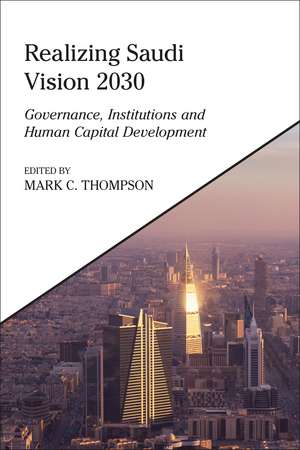
Realizing Saudi Vision 2030: Governance, Institutions and Human Capital Development: King Faisal Center for Research and Islamic Studies Series
Editat de Mark C. Thompsonen Limba Engleză Hardback – 19 feb 2026
The ebook editions of this book are available open access under a CC BY-NC-ND 4.0 licence on bloomsburycollections.com. Open access was funded by the King Faisal Center for Research and Islamic Studies.

Preț: 585.61 lei
Preț vechi: 868.66 lei
-33%
Puncte Express: 878
Carte disponibilă
Livrare economică 27 octombrie-10 noiembrie
Livrare prin curier în România Termenul estimat este afișat lângă disponibilitate.
Transport gratuit pentru acest produs Plată online sau ramburs, în funcție de opțiunile comenzii.
Retur gratuit în 14 zile Comandă securizată și suport în română.
Specificații
ISBN-13: 9780755656288
ISBN-10: 0755656288
Pagini: 328
Dimensiuni: 158 x 236 x 28 mm
Greutate: 0.64 kg
Editura: Bloomsbury Publishing
Colecția I.B.Tauris
Seria King Faisal Center for Research and Islamic Studies Series
Locul publicării:London, United Kingdom
ISBN-10: 0755656288
Pagini: 328
Dimensiuni: 158 x 236 x 28 mm
Greutate: 0.64 kg
Editura: Bloomsbury Publishing
Colecția I.B.Tauris
Seria King Faisal Center for Research and Islamic Studies Series
Locul publicării:London, United Kingdom
Cuprins
Introduction: Realizing The Vision: The Saudi Perspective, Mark C. Thompson (King Faisal Center for Research and Islamic Studies, Saudi Arabia)
PART I
PROCESSES AND REFORMS
Chapter 1: Cogs and Masters: The Evolving Landscape of Inclusive Governance in Saudi Arabia's Center of Government Khulood Basha (Confidential, Saudi Arabia)
Chapter 2: New Institutions and Opportunities for Transformation, Abdullah Almuqren (University of Lancaster, UK)
Chapter 3: Vision 2030, Human Capability Development, and Evidence-Informed Policymaking: Navigating Labor Market Transformation in the Fourth Industrial Revolution', Abdullah Alabdulkarim & Adam Daoud (Saudi Logistics Academy, Saudi Arabia)
Chapter 4: Saudi Public Sector Human Capital: An Analysis of the Distinct Strengths, Capabilities and Characteristics of Government Employees within Saudi Arabia, David Jones, Radhika Punshi & Gupta Gauri (The Talent Enterprise, Saudi Arabia/Dubai)
PART II
CASE STUDIES: KEY DEVELOPMENTS
Chapter 5: The Role Of Management Consulting Firms in Vision 2030: The Saudi Way May Bin Baz (Confidential, Saudi Arabia)
Chapter 6: Graduate Development Programs in Saudi Arabia: Their Rise, Impact, Challenges, and Role in Vision 2030 and National Talent Transformation Saleh AlNashwan (ROSHN Company, Saudi Arabia)
Chapter 7: The Elevation of Youth Culinary Tourism Skills: How Vision 2030 is Re-shaping the Vocational Training Sector in Saudi Arabia, Hanaa Almoaibed (Visiting Research Fellow, LSE, UK)
Chapter 8: Transforming the Ministry of Energy, Neil Quilliam (Saudi Media Research Group Think, Saudi Arabia)
Chapter 9: The Challenge and Promise of Saudi Defense Reform, Dave DesRoches (National Defense University, USA)
Afterword, Mark C. Thompson (King Faisal Center for Research and Islamic Studies, Saudi Arabia)
Bibliography
Index
PART I
PROCESSES AND REFORMS
Chapter 1: Cogs and Masters: The Evolving Landscape of Inclusive Governance in Saudi Arabia's Center of Government Khulood Basha (Confidential, Saudi Arabia)
Chapter 2: New Institutions and Opportunities for Transformation, Abdullah Almuqren (University of Lancaster, UK)
Chapter 3: Vision 2030, Human Capability Development, and Evidence-Informed Policymaking: Navigating Labor Market Transformation in the Fourth Industrial Revolution', Abdullah Alabdulkarim & Adam Daoud (Saudi Logistics Academy, Saudi Arabia)
Chapter 4: Saudi Public Sector Human Capital: An Analysis of the Distinct Strengths, Capabilities and Characteristics of Government Employees within Saudi Arabia, David Jones, Radhika Punshi & Gupta Gauri (The Talent Enterprise, Saudi Arabia/Dubai)
PART II
CASE STUDIES: KEY DEVELOPMENTS
Chapter 5: The Role Of Management Consulting Firms in Vision 2030: The Saudi Way May Bin Baz (Confidential, Saudi Arabia)
Chapter 6: Graduate Development Programs in Saudi Arabia: Their Rise, Impact, Challenges, and Role in Vision 2030 and National Talent Transformation Saleh AlNashwan (ROSHN Company, Saudi Arabia)
Chapter 7: The Elevation of Youth Culinary Tourism Skills: How Vision 2030 is Re-shaping the Vocational Training Sector in Saudi Arabia, Hanaa Almoaibed (Visiting Research Fellow, LSE, UK)
Chapter 8: Transforming the Ministry of Energy, Neil Quilliam (Saudi Media Research Group Think, Saudi Arabia)
Chapter 9: The Challenge and Promise of Saudi Defense Reform, Dave DesRoches (National Defense University, USA)
Afterword, Mark C. Thompson (King Faisal Center for Research and Islamic Studies, Saudi Arabia)
Bibliography
Index
Recenzii
An insightful exploration of Saudi Vision 2030, this manuscript bridges theory and practice, highlighting institutional transformation and human capital development while offering invaluable lessons for global audiences navigating socio-economic reforms.
Vision 2030 promises to fundamentally reshape economics and governance in Saudi Arabia and this timely volume of essays provides important new insight and local perspectives as the process of change reaches its halfway point.
Vision 2030 promises to fundamentally reshape economics and governance in Saudi Arabia and this timely volume of essays provides important new insight and local perspectives as the process of change reaches its halfway point.