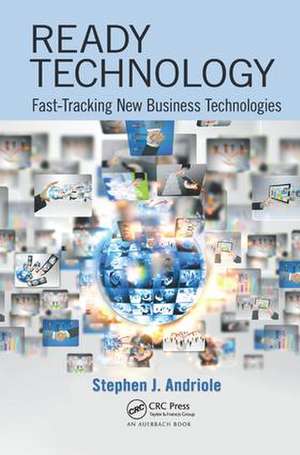
Ready Technology: Fast-Tracking New Business Technologies
Autor Stephen J. Andrioleen Limba Engleză Hardback – 27 iul 2017
Preț: 1420.39 lei
Preț vechi: 1775.49 lei
-20%
Puncte Express: 2131
Carte tipărită la comandă
Livrare economică 18 noiembrie-02 decembrie
Livrare prin curier în România Termenul estimat este afișat lângă disponibilitate.
Transport gratuit pentru acest produs Plată online sau ramburs, în funcție de opțiunile comenzii.
Retur gratuit în 14 zile Comandă securizată și suport în română.
Specificații
ISBN-13: 9781138440272
ISBN-10: 1138440272
Pagini: 172
Dimensiuni: 156 x 234 x 14 mm
Greutate: 0.48 kg
Ediția:1
Editura: CRC Press
Colecția Auerbach Publications
ISBN-10: 1138440272
Pagini: 172
Dimensiuni: 156 x 234 x 14 mm
Greutate: 0.48 kg
Ediția:1
Editura: CRC Press
Colecția Auerbach Publications
V-ar putea interesa
-
 Preț: 141.45 lei
 -
 Writing to Make a DifferenceDalya F. MassachiPreț: 250.11 lei
 -
 Preț: 366.91 lei
 -
 Best Practices in Business Technology ManagementStephen J. Andriole-20%Preț: 1062.51 lei1328.14 lei
 -
 -20%Preț: 594.53 lei743.16 lei
 -
 -20%Preț: 683.02 lei853.77 lei
 -
 -11%Preț: 648.11 lei728.20 lei
 -
 Case Studies in Strategic PlanningHakan Butuner-20%Preț: 623.05 lei778.82 lei
 -
 The 2nd Digital RevolutionStephen J. Andriole-15%Preț: 454.71 lei534.95 lei
 -
 Technology Due DiligenceStephen J. Andriole-18%Preț: 939.12 lei1145.26 lei
 -
 Richards, C: BTEC Level 3 National Business Student Book 2Catherine RichardsPreț: 278.77 lei
 -
 Preț: 107.16 lei
 -
 Preț: 96.07 lei
 -
 Ferdinand PiëchRita Stiens-15%Preț: 528.42 lei621.67 lei
Public țintă
Professional Practice & DevelopmentCuprins
Ready Opportunities. Ready Technology Trends. Ready Processes. Ready Companies. Ready Industry Pilots. Conclusions.
Notă biografică
Stephen J. Andriole is the Thomas G. Labrecque Professor of Business Technology at Villanova University, Pennsylvania, where he teaches and conducts applied research in business technology management. He is formerly a professor of Information Systems and Electrical and Computer Engineering at Drexel University, Philadelphia, Pennsylvania, and the George Mason Institute Professor of the Department of Information Systems and Systems Engineering at George Mason University, Fairfax, Virginia. Dr. Andriole was the director of the Cybernetics Technology Office of the Defense Advanced Research Projects Agency (DARPA). He was also the chief technology officer and senior vice president of Safeguard Scientifics, Inc., and the chief technology officer and senior vice president for Technology Strategy at Cigna Corporation. Some of Dr. Andriole's books include Interactive Computer- Based Systems Design and Development (Petrocelli Books, 1983); Microcomputer Decision Support Systems (QED Information Sciences, 1985); Applications in Artificial Intelligence (Petrocelli Books, 1986); Information System Design Principles for the 90s (AFCEA International Press, 1990); Sourcebook of Applied Artificial Intelligence (McGraw- Hill, 1992); Cognitive Systems Engineering (coauthored with Len Adelman) on user interface technology (Lawrence Erlbaum Associates, 1995); Managing Systems Requirements Methods, Tools and Cases (McGraw-Hill, 1996); The 2nd Digital Revolution (IGI Press, 2005); Technology Due Diligence (IGI Press, 2009); Best Practices in Business Technology Management (Auerbach, 2009); and IT's All About the People (Auerbach, 2011). He is also the coauthor of Social Business Intelligence (Ascendigm Press, 2013) and Avoiding #Fail (Ascendigm Press, 2013). Dr. Andriole has published articles in the Cutter IT Journal, Software Development, IEEE Software, the Communications of the ACM, the Communications of the AIS, IEEE IT Professional, and the Journal of Informatio
Descriere
Projects are risky undertakings, and modern approaches to managing projects recognise the central need to manage the risk as an integral part of the project management discipline. Managing Risk in Projects places risk management in its proper context in the world of project management and beyond, and emphasises the central concepts that are essential in order to understand why and how risk management should be implemented on all projects of all types and sizes, in all industries and in all countries. The generic approach detailed by David Hillson is consistent with current international best practice and guidelines (including 'A Guide to the Project Management Body of Knowledge' (PMBoK) and the 'Project Risk Management Practice Standard' from PMI, the 'APM Body of Knowledge' and 'Project Risk Analysis & Management (PRAM) Guide' from APM, 'Management of Risk: Guidance for Practitioners' from OGC, and the forthcoming risk standard from ISO) but David also introduces key developments in the risk management field, ensuring readers are aware of recent thinking, focusing on their relevance to practical application. Throughout, the goal is to offer a concise description of current best practice in project risk management whilst introducing the latest relevant developments, to enable project managers, project sponsors and others responsible for managing risk in projects to do just that - effectively.