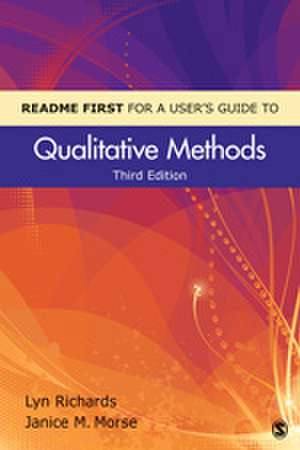
README FIRST for a User's Guide to Qualitative Methods
Autor Lyn Richards, Janice M. Morseen Limba Engleză Paperback – 24 apr 2012
Observăm în această a treia ediție a README FIRST for a User's Guide to Qualitative Methods o rafinare a procesului de inițiere în cercetarea calitativă, punând accent nu doar pe execuție, ci mai ales pe rigoarea gândirii prealabile. Lucrarea semnată de Lyn Richards și Janice M. Morse se distinge prin actualizarea conținutului privind coerența metodologică și prin integrarea unor resurse noi în secțiunile de final, precum ghidul pentru software-ul de analiză și strategiile pentru obținerea finanțării. Remarcăm o structură logică, organizată în patru părți esențiale: de la fundamentarea teoretică și alegerea metodei potrivite, până la procesele tehnice de codificare și abstractizare. Capitolele dedicate integrității cercetării și designului experimental oferă o bază solidă pentru studenții aflați la început de drum, eliminând confuziile frecvente între diversele școli de gândire calitativă. Comparabil cu Qualitative Research from Start to Finish, Second Edition de Robert K. Yin în rigurozitate, volumul de față este însă mai bine ancorat în nevoile practice ale cercetătorului debutant, oferind un flux de lucru mai direct și mai puțin abstract. Descoperim aici o progresie pedagogică clară, unde capitolul despre „congruența metodologică” devine punctul pivot între colectarea datelor și analiza lor finală. Stilul direct și prietenos al autoarelor transformă o materie complexă într-un parcurs gestionabil, facilitând trecerea de la simpla curiozitate academică la scrierea unor rezultate validate și publicabile.
Preț: 675.18 lei
Preț vechi: 758.63 lei
-11%
Carte disponibilă
Livrare economică 02-16 noiembrie
Specificații
ISBN-10: 1412998069
Pagini: 336
Dimensiuni: 152 x 229 x 18 mm
Greutate: 0.49 kg
Ediția:3. Auflage
Editura: Sage Publications, Inc
Locul publicării:Thousand Oaks, United States
V-ar putea interesa
-
 Education and Development: Measuring the Social BenefitsWalter W. McMahon-28%Preț: 393.13 lei547.97 lei
 -
 Unequal Lives: Health and Socioeconomic InequalitiesHilary Graham-28%Preț: 188.61 lei262.98 lei
 -
 -28%Preț: 191.95 lei264.80 lei
 -
 -15%Preț: 457.31 lei538.01 lei
 -
 Measuring the Real WorldThiessen-9%Preț: 857.62 lei942.43 lei
 -
 Research Methods for Cultural StudiesMichael Pickering-17%Preț: 180.55 lei217.12 lei
 -
 The Life Story InterviewRobert AtkinsonPreț: 321.69 lei
 -
 Collaborative Inquiry in PracticeJohn N. Bray-18%Preț: 791.16 lei964.83 lei
 -
 The Qualitative Researcher's CompanionMichael Huberman-18%Preț: 804.16 lei980.69 lei
 -
 Interaction Effects in Multiple RegressionJames JaccardPreț: 319.31 lei
 -
 Interviewing for Social ScientistsHilary Arksey-18%Preț: 684.35 lei834.58 lei
 -
 Quantitative GeographyA Stewart Fotheringham-18%Preț: 786.14 lei958.70 lei
 -
 The Foundations of Social ResearchMichael J CrottyPreț: 448.54 lei
 -
 Using Nvivo in Qualitative ResearchLyn Richards-18%Preț: 693.53 lei845.76 lei
 -
 Understanding Qualitative Research and EthnomethodologyPaul Ten Have-8%Preț: 425.80 lei462.83 lei
 -
 Practitioner ResearcherJarvisPreț: 299.66 lei
 -
 Systematic Reviews in the Social SciencesHelen RobertsPreț: 445.68 lei
De ce să citești această carte
Această carte este ghidul esențial pentru oricine dorește să înceapă un proiect de cercetare calitativă fără a se pierde în jargon academic. Cititorul câștigă o metodologie clară de la design la publicare, învățând cum să potrivească întrebările de cercetare cu metodele corecte. Este recomandată studenților și cercetătorilor care au nevoie de un parcurs structurat, incluzând sfaturi practice despre software-ul de analiză și finanțare.
Recenzii
“The key strength of this text is the discussion and presentation of how to think about qualitative research. This is the only text that discusses the process of thinking before doing at any stage of the research project from the general idea to the writing up and submitting for publication. This kind of discussion is extremely helpful for novice or experienced researchers as it helps them to take a step back in the middle of the research process, rethink clearly and improve the project.”
“This book combines the basics of qualitative research methods (why we choose qualitative over quantitative when we are trying to answer specific questions about human behavior) and the nuts and bolts of how to actually do qualitative research. I like that it explains qualitative research from conceptualization to writing up the results. Not a lot of textbooks accomplish this – they allude to a lot, but they don’t include the necessary information that this textbook includes.”
“The text is very clear and well organized, and accessible for new students. In comparison to many other introductory texts, it really brings to the fore the need for theoretical and methodological coherence.”
“An invaluable introduction to qualitative inquiry that emphasizes several points that I rarely find in other texts and, although somewhat subtle, they are extremely important for doing rigorous research.”
Cuprins
About the Authors
1. Why Readme First?
Part I. Thinking Research
2. The Integrity of Qualitative Research
3. Choosing a Method
4. Qualitative Research Design
Part II. Inside Analysis
5. Making Data
6. Coding
7. Abstracting
8. From Method to Analysis: Revisiting Methodological Congruence
Part III. Getting It Right
9. On Getting It Right and Knowing if It's Wrong
10. Writing It Up
Part IV. Beginning Your Project
11. Groundwork for Beginning Your Project
12. Getting Started
Appendix 1. Qualitative Software: Where to Go Next
Appendix 2. Applying for Funding
References
Author Index
Subject Index