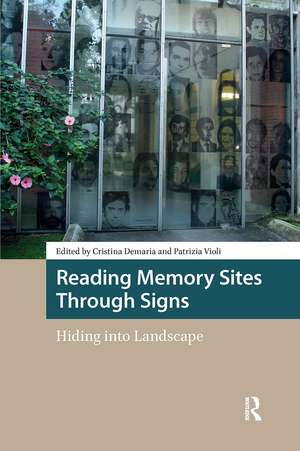
Reading Memory Sites Through Signs: Hiding into Landscape: Heritage and Memory Studies
Editat de Cristina Demaria, Patrizia Violien Limba Engleză Paperback – dec 2025
Din seria Heritage and Memory Studies
- 14%
 Preț: 1051.30 lei
 - 18%
 Preț: 900.57 lei
 -
 Preț: 434.52 lei
 -
 Preț: 403.35 lei
 -
 Preț: 415.71 lei
 -
 Preț: 438.36 lei
 -
 Preț: 439.64 lei
 -
 Preț: 437.93 lei
 -
 Preț: 474.77 lei
 - 18%
 Preț: 960.41 lei
 - 18%
 Preț: 1066.67 lei
 - 18%
 Preț: 1007.70 lei
 -
 Preț: 443.03 lei
 - 18%
 Preț: 785.07 lei
 - 18%
 Preț: 898.49 lei
 - 18%
 Preț: 793.77 lei
 -
 Preț: 431.12 lei
 -
 Preț: 441.32 lei
 -
 Preț: 403.78 lei
 -
 Preț: 438.78 lei
 -
 Preț: 419.21 lei
 -
 Preț: 402.93 lei
 -
 Preț: 408.88 lei
 -
 Preț: 435.38 lei
 - 23%
 Preț: 1218.47 lei
 - 51%
 Preț: 622.53 lei
 - 52%
 Preț: 716.67 lei
Preț: 439.64 lei
Puncte Express: 659
Carte tipărită la comandă
Livrare economică 07-21 decembrie
Livrare prin curier în România Termenul estimat este afișat lângă disponibilitate.
Transport gratuit pentru acest produs Plată online sau ramburs, în funcție de opțiunile comenzii.
Retur gratuit în 14 zile Comandă securizată și suport în română.
Specificații
ISBN-13: 9781041184881
ISBN-10: 1041184883
Pagini: 322
Dimensiuni: 156 x 234 x 17 mm
Greutate: 0.5 kg
Ediția:1
Editura: Taylor & Francis
Colecția Routledge
Seria Heritage and Memory Studies
Locul publicării:Oxford, United Kingdom
ISBN-10: 1041184883
Pagini: 322
Dimensiuni: 156 x 234 x 17 mm
Greutate: 0.5 kg
Ediția:1
Editura: Taylor & Francis
Colecția Routledge
Seria Heritage and Memory Studies
Locul publicării:Oxford, United Kingdom
Public țintă
AcademicNotă biografică
Cristina Demaria is Professor of Semiotics at the Department of the Arts of the University of Bologna, where she teaches semiotics of conflict, gender studies and semiotics of social sciences. She has worked extensively on traumatic memories and their representation, on visual culture and documentary films, and on gender studies and post-feminism. Her latest publications include Post-Conflict Cultures. A Reader (2021), and Reading Memory Sites Through Signs: Hiding into Landscape (2023). Patrizia Violi is an Alma Mater Professor at the University of Bologna and the founder of ‘TraMe - Centre for the Semiotic Study of Memory’ at the same university. She was director of the ‘Centro Internazionale di Studi Umberto Eco’ and PI of various European funded projects on trauma and urban space. She has published internationally on the relationship between trauma and memory, with a specific focus on Chile, Argentina and Colombia. Her latest publications include Landscapes of Memory: Trauma, Space, History (2017), and Reading Memory Sites Through Signs: Hiding into Landscape (2023).
Cuprins
1 Stories that Shape Spatialities,Lieu and Milieu de Mémoire through the Lens of Narrativity (Daniele Salerno), 2 Interpretation and Use of Memory, How Practices Can Change the Meanings of Monuments (Mario Panico), 3 Uncomfortable Memories of Fascist Italy: The Case of Bigio of Brescia (Anna Maria Lorusso), 4 What Does Fascist Architecture Still Have to Tell Us? Preservation of Contested Heritage as a Strategy of Re-Enunciation and 'Voice Remodulation' (Francesco Mazzucchelli), 5 Berlin, the Jewish Museum and the Holocaust Memorial (Isabella Pezzini), 6 Making Space for Memory, Collective Enunciation in the Provincial Memory Archive of Córdoba, Argentina (Paola Sozzi), 7 Ruins of War, The Green Sea and the Mysterious Island (Gianfranco Marrone), 8 Turning Spaces of Memory into Memoryscapes, Cinema as Counter Monument in Jonathan Perel's El Predio and Tabula Rasa (Cristina Demaria), 9 Voices from the Past: Memories in a Digital Space, The Case of AppRecuerdos in Santiago, Chile (Patrizia Violi), 10 500,000 Dirhams in Scandinavia, from Mobile Silver to Land Rent, A Semiotic Analysis ( Manar Hammad), Index, Index of names.
Descriere
The book describes the main semiotic concepts that can be used to analyse space, illustrating them with carefully chosen case studies of memory spaces – monuments, museums, post-war urban restoration, filmed and virtual space – in order to show the applicability and efficacy of a semiotic methodology.