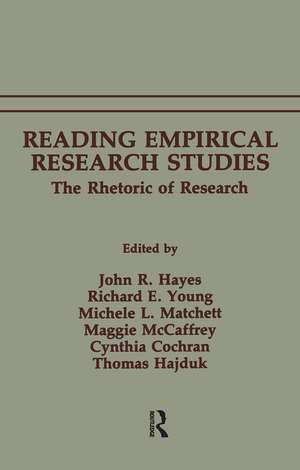
Reading Empirical Research Studies
Editat de Jr Hayes, Richard E. Young, Michele L. Matchett, Maggie McCaffrey, Cynthia Cochranen Limba Engleză Paperback – 11 iun 1992
* to provide models and critical methods designed to improve the reading of scientific discourse
* to provide models of effective research designs and projects appropriate to those learning to do empirical research in rhetoric.
Aiming to cultivate new attitudes toward empirical research, this volume encourages an appreciation of the rhetorical tradition that informs the production and critical reading of empirical studies. The book should also reinforce a slowly growing realization in English studies that empirical methods are not inherently alien to the humanities, rather that methods extend the power of humanist researchers trying to solve the problems of their discipline.
Preț: 438.51 lei
Nou
Puncte Express: 658
Preț estimativ în valută:
77.60€ • 90.99$ • 68.15£
77.60€ • 90.99$ • 68.15£
Carte tipărită la comandă
Livrare economică 14-28 februarie
Preluare comenzi: 021 569.72.76
Specificații
ISBN-13: 9780805810318
ISBN-10: 0805810315
Pagini: 584
Ilustrații: illustrations
Dimensiuni: 152 x 229 mm
Greutate: 0.76 kg
Ediția:New.
Editura: Routledge
ISBN-10: 0805810315
Pagini: 584
Ilustrații: illustrations
Dimensiuni: 152 x 229 mm
Greutate: 0.76 kg
Ediția:New.
Editura: Routledge
Cuprins
Contents: Introduction to Empirical Research and Rhetoric: Reading in a Developing Tradition. Reading Research Reports. R.A. Hunt, Reading Literature. R.L. Enos, Archeology of Literacy. J. Nelson, Writing in the Academy: What Really Happens. C. Haas, J.L. Funk, Communication in Cross Cultural Contexts. M. Floriak, Communicating with Low-Literate Adults. S.B. Heath, C. ThomasBedtime Stories in the Piedmont. R. Braddock, The Elusive Topic Sentence. J.F. Bauman, J.K. Serra, Replicating Braddock. G. Shumacher, J.G. Nash, B.T. Scott, M.K. Brezin, D.A. Lampert, S.E. Stein, Reporting on Journalists. W.L. Smith, Teaching Experience and Placement Skill. S.W. Freedman, Writing for Different Professional Audiences: Telling Teachers and Researchers About Text Evaluation. D.L. Wallace, J.R. Hayes, Defining Writing Tasks for Students. A.M. O'Donnell, D.F. Dansereau, T. Rocklin, J.G. Lambiotte, V.I. Hythecker, C.O. Larson, The Impact of Cooperative Writing. R. Beach, L. Wendler, Development of Literary Awareness. G. Hillocks, Jr., Experimenting in Schools. R.J. Bracewell, Metacognition in Writing. N.N. Spivey, Writing from Sources. M. Palmquist, R.E Young, Is Writing a Gift? The Impact on Students Who Believe It Is.