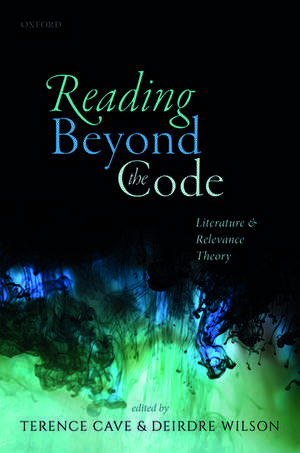
Reading Beyond the Code: Literature and Relevance Theory
Editat de Terence Cave, Deirdre Wilsonen Limba Engleză Hardback – 29 mai 2018
Preț: 662.81 lei
Preț vechi: 945.53 lei
-30%
Puncte Express: 994
Carte tipărită la comandă
Livrare economică 10-16 decembrie
Livrare prin curier în România Termenul estimat este afișat lângă disponibilitate.
Transport gratuit pentru acest produs Plată online sau ramburs, în funcție de opțiunile comenzii.
Retur gratuit în 14 zile Comandă securizată și suport în română.
Specificații
ISBN-13: 9780198794776
ISBN-10: 0198794770
Pagini: 244
Dimensiuni: 164 x 238 x 19 mm
Greutate: 0.58 kg
Editura: OUP OXFORD
Colecția OUP Oxford
Locul publicării:Oxford, United Kingdom
ISBN-10: 0198794770
Pagini: 244
Dimensiuni: 164 x 238 x 19 mm
Greutate: 0.58 kg
Editura: OUP OXFORD
Colecția OUP Oxford
Locul publicării:Oxford, United Kingdom
Recenzii
...the important contribution this volume makes to the understanding of relevance theory and its relation to literary interpretation. It shows explicitly what relevance theory shares with other cognitive approaches and how it differs. In respecting the power of literary language as ostensive performance, it invites rather than imposes interpretative strategies that inform the best of literary criticism.
To what extent do the principles of a theory of spontaneous face-to-face communication carry over to the interpretation of carefully crafted literary texts (novels, plays, poems)? That is the central question addressed by this book. The literary studies presented here are deeply informed by Relevance Theory's cognitive-inferential account of communication while remaining acutely alert to the sensorimotor, kinesic, affective and other non-propositional effects that a work of literature may have on a receptive reader. This engaging set of essays is for students of literature, communication theorists, and anyone who has ever marvelled at the rich experience of reading fiction.
Dan Sperber and Deirdre Wilson's Relevance: Communication and Cognition (1986) revolutionized the understanding of communication: they showed it to depend not simply on decoding, but on selecting optimally relevant results. Reading Beyond the Code, edited by Terence Cave and Deirdre Wilson, now takes up the same relevance theory and applies it to literature. Again the outcome is an important contribution.
The relevance of 'Relevance' to literary understanding was clear from Sperber and Wilson's inauguration of the concept. After literary theory's long wanderings in the wilderness, it brought literary studies back to the conditions of everyday life and thought. Its claims have since been strengthened by interaction with cognitive science and a three-year Balzan research programme. As a sequel, the present essay collection shows how subtly the central idea has been developed and how fruitfully it can be applied to a wide range of texts and genres.
To what extent do the principles of a theory of spontaneous face-to-face communication carry over to the interpretation of carefully crafted literary texts (novels, plays, poems)? That is the central question addressed by this book. The literary studies presented here are deeply informed by Relevance Theory's cognitive-inferential account of communication while remaining acutely alert to the sensorimotor, kinesic, affective and other non-propositional effects that a work of literature may have on a receptive reader. This engaging set of essays is for students of literature, communication theorists, and anyone who has ever marvelled at the rich experience of reading fiction.
Dan Sperber and Deirdre Wilson's Relevance: Communication and Cognition (1986) revolutionized the understanding of communication: they showed it to depend not simply on decoding, but on selecting optimally relevant results. Reading Beyond the Code, edited by Terence Cave and Deirdre Wilson, now takes up the same relevance theory and applies it to literature. Again the outcome is an important contribution.
The relevance of 'Relevance' to literary understanding was clear from Sperber and Wilson's inauguration of the concept. After literary theory's long wanderings in the wilderness, it brought literary studies back to the conditions of everyday life and thought. Its claims have since been strengthened by interaction with cognitive science and a three-year Balzan research programme. As a sequel, the present essay collection shows how subtly the central idea has been developed and how fruitfully it can be applied to a wide range of texts and genres.
Notă biografică
Terence Cave CBE FBA is Emeritus Professor of French Literature, University of Oxford, Emeritus Research Fellow of St John's College, Oxford, and Honorary Fellow of Gonville and Caius College, Cambridge. He holds an honorary doctorate at Royal Holloway University of London. and is Chevalier dans l'Ordre National du Mérite (France). He is recognized as a leading specialist in French Renaissance literature, but has also made landmark contributions to comparative literature and the history of poetics. In 2009, he won the Balzan Prize for literature since 1500 and subsequently directed the Balzan project 'Literature as an Object of Knowledge' (2010-14). His most recent work focuses on cognitive approaches to literature.Deirdre Wilson is Emeritus Professor of Linguistics at UCL and co-director of the Linguistic Agency project at the Centre for the Study of Mind in Nature, University of Oslo. Her book Relevance: Communication and Cognition, co-written with Dan Sperber, was described in the London Review of Books as 'nothing less than the makings of a radically new theory of communication, the first since Aristotle's' and in Rhetoric Society Quarterly as 'probably the best book you'll ever read on communication.' Translated into twelve languages (including Japanese, Chinese, Korean, Malay, Indonesian, and Arabic), it has had a lasting influence in philosophy, psychology, and linguistics and is now regarded as a classic.