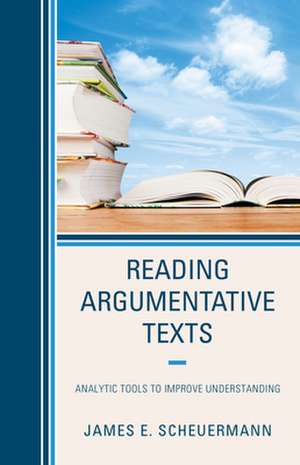
Reading Argumentative Texts: Analytic Tools to Improve Understanding
Autor James E. Scheuermannen Limba Engleză Paperback – 31 oct 2021
Preț: 218.77 lei
Preț vechi: 291.84 lei
-25%
Puncte Express: 328
Carte tipărită la comandă
Livrare economică 20 noiembrie-04 decembrie
Livrare prin curier în România Termenul estimat este afișat lângă disponibilitate.
Transport gratuit de la 400.00 lei Plată online sau ramburs, în funcție de opțiunile comenzii.
Retur gratuit în 14 zile Comandă securizată și suport în română.
Specificații
ISBN-13: 9781475864533
ISBN-10: 1475864531
Pagini: 160
Dimensiuni: 156 x 218 x 12 mm
Greutate: 0.25 kg
Editura: Bloomsbury Publishing
Colecția Rowman & Littlefield
Locul publicării:New York, United States
ISBN-10: 1475864531
Pagini: 160
Dimensiuni: 156 x 218 x 12 mm
Greutate: 0.25 kg
Editura: Bloomsbury Publishing
Colecția Rowman & Littlefield
Locul publicării:New York, United States
Cuprins
Preface
Acknowledgments
Chapter 1. Introduction
Chapter 2. Reading Is Not a Spectator Sport
Chapter 3. Why Are You Reading?
Chapter 4. Arguments: A Closer Look
Chapter 5. Every Person Has a Skeleton, Every Argument Has a Structure
Chapter 6. What Does the Skeleton Look Like? Outlines and Summaries
Chapter 7. Ambiguity and Nonliteral Uses of Language
Chapter 8. Context Imparts Meaning
Chapter 9. The ABC's of Logic
Chapter 10. Conclusion
Appendix A. Frankie Thomas, "Study Latin if you want to talk like a supervillain"
Appendix B. Nancy Deutsch, "Ayanna Pressley Is Right: 16-Year-Olds Deserve the Right to Vote"
Index
About the Author
Acknowledgments
Chapter 1. Introduction
Chapter 2. Reading Is Not a Spectator Sport
Chapter 3. Why Are You Reading?
Chapter 4. Arguments: A Closer Look
Chapter 5. Every Person Has a Skeleton, Every Argument Has a Structure
Chapter 6. What Does the Skeleton Look Like? Outlines and Summaries
Chapter 7. Ambiguity and Nonliteral Uses of Language
Chapter 8. Context Imparts Meaning
Chapter 9. The ABC's of Logic
Chapter 10. Conclusion
Appendix A. Frankie Thomas, "Study Latin if you want to talk like a supervillain"
Appendix B. Nancy Deutsch, "Ayanna Pressley Is Right: 16-Year-Olds Deserve the Right to Vote"
Index
About the Author
Recenzii
James Scheuermann's Reading Argumentative Texts is an unusually clear, engaging, and well-organized textbook that should be of considerable value to teachers and students in undergraduate courses in critical thinking, rhetoric, informal logic, and philosophy. The book does a very fine job of introducing students to essential skills involved in interpreting and evaluating arguments, and uses well-chosen sample arguments drawn from a wide range of popular media, nontechnical writing in various fields of scholarly inquiry, and other accessible materials. Of particular note are the excellent discussions regarding uncovering the meaning(s) of texts and the structure(s) of arguments, understanding different kinds of arguments and the various aims of reading and writing, as well as creating outlines and summaries of arguments. Instructors teaching courses on more narrowly focused topics or within particular disciplines can readily combine the valuable material in
Reading Argumentative Texts with arguments, inquiries, and texts specific to their courses.
A lawyer's systematic approach to argumentation is evident in James Scheuerman's new textbook, Reading Argumentative Texts: Tools for Better Understanding. The book is designed for adaptation to various undergraduate academic settings including courses in critical thinking, rhetoric, and writing. Based in syllogistic analysis, Reading demonstrates the ways that seemingly extraneous material in an argumentative text--material that does not directly address the argument--often supports the argument indirectly. The book is rich with concrete, relatable examples and case studies that illustrate the author's points, and it covers a breadth of topics such as purposes for reading, the logical structure of arguments, various strategies to introduce a topic, the ways readers' values and contexts impact the meaning of texts, and many more. Reading includes an appendix with readings referred to through the text; a supplementary workbook is also available.
When I first began teaching college writing twenty-four years ago, my students needed
instruction on how to find sources. Over the past decade or so as the proliferation of both
print and online arguments have exceeded anyone's epxectations, that need has swelled to
include instruction in how to read sources. In Reading Argumentative Texts: Analytic Tools
to Improve Understanding, James E. Scheuermann takes this process one step further by
helping students learn how to analyze and truly understand the arguments they encounter
in everyday life and in their research.
Scheuermann's approach urges students to avoid seeing reading as "a spectator sport."
Instead, he encourages them to see reading as a dialogue that requires active
engagement. His text leads students through the steps necessary to do that kind of
engaged work through in-depth explorations of fallacies and other tools used by writers to
both illuminate and obfuscate meaning in arguments.
I highly recommend this textbook to anyone seeking a methodical path for understanding
and interpreting non-fiction texts. In its pages readers will find all of the tools necessary to
tackle even the trickiest arguments.
Reading Argumentative Texts with arguments, inquiries, and texts specific to their courses.
A lawyer's systematic approach to argumentation is evident in James Scheuerman's new textbook, Reading Argumentative Texts: Tools for Better Understanding. The book is designed for adaptation to various undergraduate academic settings including courses in critical thinking, rhetoric, and writing. Based in syllogistic analysis, Reading demonstrates the ways that seemingly extraneous material in an argumentative text--material that does not directly address the argument--often supports the argument indirectly. The book is rich with concrete, relatable examples and case studies that illustrate the author's points, and it covers a breadth of topics such as purposes for reading, the logical structure of arguments, various strategies to introduce a topic, the ways readers' values and contexts impact the meaning of texts, and many more. Reading includes an appendix with readings referred to through the text; a supplementary workbook is also available.
When I first began teaching college writing twenty-four years ago, my students needed
instruction on how to find sources. Over the past decade or so as the proliferation of both
print and online arguments have exceeded anyone's epxectations, that need has swelled to
include instruction in how to read sources. In Reading Argumentative Texts: Analytic Tools
to Improve Understanding, James E. Scheuermann takes this process one step further by
helping students learn how to analyze and truly understand the arguments they encounter
in everyday life and in their research.
Scheuermann's approach urges students to avoid seeing reading as "a spectator sport."
Instead, he encourages them to see reading as a dialogue that requires active
engagement. His text leads students through the steps necessary to do that kind of
engaged work through in-depth explorations of fallacies and other tools used by writers to
both illuminate and obfuscate meaning in arguments.
I highly recommend this textbook to anyone seeking a methodical path for understanding
and interpreting non-fiction texts. In its pages readers will find all of the tools necessary to
tackle even the trickiest arguments.