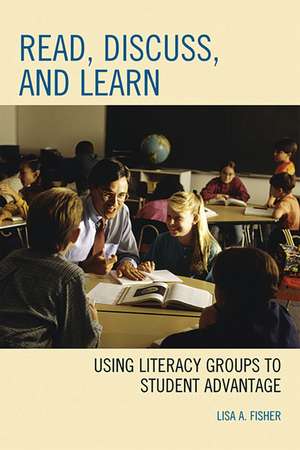
Read, Discuss, and Learn: Using Literacy Groups to Student Advantage
Autor Lisa A. Fisheren Limba Engleză Paperback – 16 aug 2010
Preț: 268.64 lei
Preț vechi: 351.56 lei
-24%
Puncte Express: 403
Carte tipărită la comandă
Livrare economică 08-22 decembrie
Livrare prin curier în România Termenul estimat este afișat lângă disponibilitate.
Transport gratuit de la 400.00 lei Plată online sau ramburs, în funcție de opțiunile comenzii.
Retur gratuit în 14 zile Comandă securizată și suport în română.
Specificații
ISBN-13: 9781607094296
ISBN-10: 1607094290
Pagini: 131
Dimensiuni: 154 x 232 x 9 mm
Greutate: 0.25 kg
Editura: Bloomsbury Publishing
Colecția R&L Education
Locul publicării:New York, United States
ISBN-10: 1607094290
Pagini: 131
Dimensiuni: 154 x 232 x 9 mm
Greutate: 0.25 kg
Editura: Bloomsbury Publishing
Colecția R&L Education
Locul publicării:New York, United States
Cuprins
Chapter 1 Foreword
Chapter 2 Preface
Chapter 3 Prologue
Chapter 4 Students' Voices Create Model Literacy Groups
Chapter 5 Understanding Literacy Groups
Chapter 6 Designing Literacy Groups
Chapter 7 Student and Teacher Accountability
Chapter 8 Differentiated Assessment
Chapter 9 Getting the Last Word In
Chapter 2 Preface
Chapter 3 Prologue
Chapter 4 Students' Voices Create Model Literacy Groups
Chapter 5 Understanding Literacy Groups
Chapter 6 Designing Literacy Groups
Chapter 7 Student and Teacher Accountability
Chapter 8 Differentiated Assessment
Chapter 9 Getting the Last Word In
Recenzii
This book is very interesting and would be very helpful to beginning teachers or anyone who is interested in using literature circles in their classroom. It is easy to read and held my attention. This use of actual student dialogues is stimulating and very informative. The author's enthusiasm for literature circles is contagious. The research was presented in a meaningful way without being tiresome. It is also full of useful resources. It would be impossible for any educator to read this book and not become excited about literature circles.
Lisa Fisher understands that choice drives engagement. She appreciates that giving students time to talk about their reading not only improves comprehension but also builds life-long readers.
Whether it's your first year teaching or your twentieth year, this text is the perfect guide to enhance your literacy instruction. Read, Discuss, and Learn includes the essential information you need for differentiated instruction and for meeting your students' needs through literacy groups. In addition to the fundamentals of literacy groups, it includes cooperative learning techniques, criteria on appropriate text selection, ELL and ESE modifications, cross curriculum suggestions, and assessments fostering student growth. Read, Discuss, and Learn is a must-have for all teachers everywhere!
Here is a book written in a style that makes readers feel as though they are sitting at a coffee table with their peers and discussing how to teach literacy. It is conversational in tone, includes developmental steps, and focuses on practical applications. Fisher (adjunct instructor, Pasco-Hernando Community College) presents a systematic approach for introducing and sequencing the progress of literacy groups. She supports this approach with research and personal experience and promotes the use of literacy groups in all content areas and as tools for student motivation, teamwork, role responsibility, and learning. Student motivation often partners with the desire to interact socially while learning new things. Teamwork develops when students learn to cooperate with positive interaction skills and rely on one another to successfully complete assigned roles. Instructors can then use strategies outlined in the appendices to teach the necessary reading skills and concepts to assist students in becoming successful, independent critical readers. Assessment activities are included to assist teachers in evaluating student learning. Fisher's book on literacy group instruction will assist student learning in any content area. Summing Up: Recommended.
Lisa Fisher understands that choice drives engagement. She appreciates that giving students time to talk about their reading not only improves comprehension but also builds life-long readers.
Whether it's your first year teaching or your twentieth year, this text is the perfect guide to enhance your literacy instruction. Read, Discuss, and Learn includes the essential information you need for differentiated instruction and for meeting your students' needs through literacy groups. In addition to the fundamentals of literacy groups, it includes cooperative learning techniques, criteria on appropriate text selection, ELL and ESE modifications, cross curriculum suggestions, and assessments fostering student growth. Read, Discuss, and Learn is a must-have for all teachers everywhere!
Here is a book written in a style that makes readers feel as though they are sitting at a coffee table with their peers and discussing how to teach literacy. It is conversational in tone, includes developmental steps, and focuses on practical applications. Fisher (adjunct instructor, Pasco-Hernando Community College) presents a systematic approach for introducing and sequencing the progress of literacy groups. She supports this approach with research and personal experience and promotes the use of literacy groups in all content areas and as tools for student motivation, teamwork, role responsibility, and learning. Student motivation often partners with the desire to interact socially while learning new things. Teamwork develops when students learn to cooperate with positive interaction skills and rely on one another to successfully complete assigned roles. Instructors can then use strategies outlined in the appendices to teach the necessary reading skills and concepts to assist students in becoming successful, independent critical readers. Assessment activities are included to assist teachers in evaluating student learning. Fisher's book on literacy group instruction will assist student learning in any content area. Summing Up: Recommended.