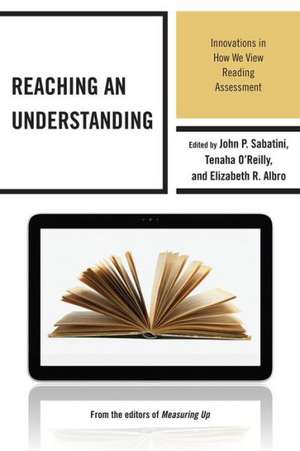
Reaching an Understanding: Innovations in How We View Reading Assessment
Autor John Sabatini, Elizabeth Albro, Tenaha O'Reillyen Limba Engleză Paperback – 14 aug 2012
Preț: 282.04 lei
Preț vechi: 371.32 lei
-24%
Puncte Express: 423
Carte tipărită la comandă
Livrare economică 07-21 noiembrie
Livrare prin curier în România Termenul estimat este afișat lângă disponibilitate.
Transport gratuit de la 400.00 lei Plată online sau ramburs, în funcție de opțiunile comenzii.
Retur gratuit în 14 zile Comandă securizată și suport în română.
Specificații
ISBN-13: 9781475801019
ISBN-10: 1475801017
Pagini: 189
Dimensiuni: 152 x 227 x 16 mm
Greutate: 0.33 kg
Editura: Bloomsbury Publishing
Colecția R&L Education
Locul publicării:New York, United States
ISBN-10: 1475801017
Pagini: 189
Dimensiuni: 152 x 227 x 16 mm
Greutate: 0.33 kg
Editura: Bloomsbury Publishing
Colecția R&L Education
Locul publicării:New York, United States
V-ar putea interesa
-
 Assessment for LearningPaul Black-27%Preț: 198.12 lei272.55 lei
 -
 Preț: 396.43 lei
 -
 Preț: 340.45 lei
 -
 Assessment in Early Childhood SettingsMargaret CarrPreț: 405.08 lei
 -
 AssessmentHoward Tanner-45%Preț: 79.72 lei145.00 lei
 -
 101 Essential Lists on AssessmentTabatha Rayment-42%Preț: 69.94 lei119.74 lei
 -
 Preț: 60.95 lei
 -
 Succeeding with Your DoctorateJerry Wellington-15%Preț: 602.82 lei709.20 lei
 -
 Standard SettingGregory J. Cizek-18%Preț: 799.92 lei975.51 lei
 -
 Assessment of LearningWynne Harlen-15%Preț: 614.74 lei723.22 lei
 -
 Multiple Assessments for Multiple IntelligencesJames BellancaPreț: 348.72 lei
Cuprins
Section I: Assessment, Learning, and Instruction: Connecting Text, Task, and Reader/ Learner
1. Assessing Multiple Source Comprehension Through Evidence Centered Design
Kimberly A. Lawless, Susan R. Goldman, Kimberly Gomez, Flori Manning, and Jason Braasch
2. The Case for Scenario-Based Assessments of Reading Competency
Kathleen M. Sheehan and Tenaha O'Reilly
3. Assessing Comprehension Processes During Reading
Keith Millis and Joseph Magliano
4. Searching for Supplementary Screening Measures to Identify Children at High Risk for Developing Later Reading Problems
Donald L. Compton, Amy M. Elleman, and Hugh W. Catts
5. Assessment and Instruction Connections: The Impact of Teachers' Access and Use of Assessment-to-Instruction Software
Carol McDonald Connor, Frederick J. Morrison, Barry Fishman, and Christopher Schatschneider
6. Multiple Bases for Comprehension Difficulties: The Potential of Cognitive and Neurobiological Profiling for Validation of Subtypes and Development of Assessments
Laurie E. Cutting and Hollis S. Scarborough
7. NLP Methods for Supporting Vocabulary Analysis
Paul Deane
Section II: How to Build for the Future
1. An Explanative Modeling Approach to Measurement of Reading Comprehension
Mark Wilson and Stephen Moore
2. Cognitive Psychometric Models as a Tool for Reading Assessment Engineering
Joanna Gorin and Dubravka Svetina
1. Assessing Multiple Source Comprehension Through Evidence Centered Design
Kimberly A. Lawless, Susan R. Goldman, Kimberly Gomez, Flori Manning, and Jason Braasch
2. The Case for Scenario-Based Assessments of Reading Competency
Kathleen M. Sheehan and Tenaha O'Reilly
3. Assessing Comprehension Processes During Reading
Keith Millis and Joseph Magliano
4. Searching for Supplementary Screening Measures to Identify Children at High Risk for Developing Later Reading Problems
Donald L. Compton, Amy M. Elleman, and Hugh W. Catts
5. Assessment and Instruction Connections: The Impact of Teachers' Access and Use of Assessment-to-Instruction Software
Carol McDonald Connor, Frederick J. Morrison, Barry Fishman, and Christopher Schatschneider
6. Multiple Bases for Comprehension Difficulties: The Potential of Cognitive and Neurobiological Profiling for Validation of Subtypes and Development of Assessments
Laurie E. Cutting and Hollis S. Scarborough
7. NLP Methods for Supporting Vocabulary Analysis
Paul Deane
Section II: How to Build for the Future
1. An Explanative Modeling Approach to Measurement of Reading Comprehension
Mark Wilson and Stephen Moore
2. Cognitive Psychometric Models as a Tool for Reading Assessment Engineering
Joanna Gorin and Dubravka Svetina
Recenzii
Reading comprehension research exploded in the 1980s based on advances in cognitive psychology. The field seems on the verge of another set of major advances. The stress on 'close reading' in the Common Core Standards forces a careful examination of what we mean by reading for understanding and new ways of looking at comprehension. This volume provides many fine ideas for new ways of understanding comprehension, measuring understanding and beginning to understand how to screen students for reading disabilities in a fashion that takes comprehension into account.
Reaching an Understanding: Innovations in How We View Reading Assessment builds upon the editors previous book Measuring Up: Advances in How We Assess Reading Ability by representing some early attempts to apply theory to help guide the development of new assessments and measurement models. Reaching an Understanding is divided into two sections: "assessment, learning, and instruction: connecting text, task, and reader/ learner" and "how to build for the future." These sections identify ways to assess students reading comprehension through multiple text sources, purpose readings, and assessment while a student is reading in order to determine deficits. In light of federal legislation towards common core standards and assessments, as well as significant national investments in reading and literacy education, it is a critical and opportune time to bring together the research and measurement community to address fundamental issues of measuring reading comprehension, in theory and in practice.
Reaching an Understanding: Innovations in How We View Reading Assessment builds upon the editors previous book Measuring Up: Advances in How We Assess Reading Ability by representing some early attempts to apply theory to help guide the development of new assessments and measurement models. Reaching an Understanding is divided into two sections: "assessment, learning, and instruction: connecting text, task, and reader/ learner" and "how to build for the future." These sections identify ways to assess students reading comprehension through multiple text sources, purpose readings, and assessment while a student is reading in order to determine deficits. In light of federal legislation towards common core standards and assessments, as well as significant national investments in reading and literacy education, it is a critical and opportune time to bring together the research and measurement community to address fundamental issues of measuring reading comprehension, in theory and in practice.