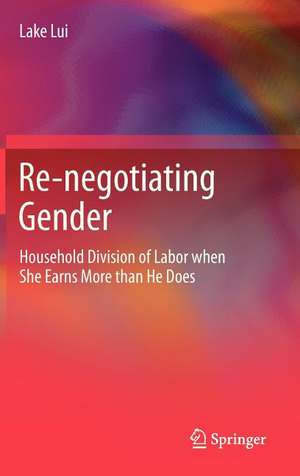
Re-negotiating Gender: Household Division of Labor when She Earns More than He Does
Autor Lake Luien Limba Engleză Hardback – 4 sep 2012
| Toate formatele și edițiile | Preț | Express |
|---|---|---|
| Paperback (1) | 609.53 lei 43-57 zile | |
| SPRINGER NETHERLANDS – 15 oct 2014 | 609.53 lei 43-57 zile | |
| Hardback (1) | 615.52 lei 43-57 zile | |
| SPRINGER NETHERLANDS – 4 sep 2012 | 615.52 lei 43-57 zile |
Preț: 615.52 lei
Preț vechi: 724.14 lei
-15%
Puncte Express: 923
Preț estimativ în valută:
108.79€ • 127.99$ • 94.96£
108.79€ • 127.99$ • 94.96£
Carte tipărită la comandă
Livrare economică 06-20 aprilie
Specificații
ISBN-13: 9789400748477
ISBN-10: 9400748477
Pagini: 166
Ilustrații: X, 154 p.
Dimensiuni: 155 x 235 x 20 mm
Greutate: 0.41 kg
Ediția:2013
Editura: SPRINGER NETHERLANDS
Colecția Springer
Locul publicării:Dordrecht, Netherlands
ISBN-10: 9400748477
Pagini: 166
Ilustrații: X, 154 p.
Dimensiuni: 155 x 235 x 20 mm
Greutate: 0.41 kg
Ediția:2013
Editura: SPRINGER NETHERLANDS
Colecția Springer
Locul publicării:Dordrecht, Netherlands
V-ar putea interesa
-
 -5%Preț: 83.42 lei87.81 lei
 -
 Sexuality: A Very Short IntroductionV. Eronique Mottier-22%Preț: 52.63 lei67.42 lei
 -
 Understanding SuicideB. FinchamPreț: 374.03 lei
 -
 Key Issues in Childhood and Youth StudiesElizabeth TaylorPreț: 353.79 lei
 -
 Marriage and MoralsBertrand RussellPreț: 134.50 lei
 -
 -15%Preț: 417.85 lei491.59 lei
 -
 The BlessingGary SmalleyPreț: 57.02 lei
 -
 I'd Change My Life If I Had More TimeDoreen VirtuePreț: 101.47 lei
 -
 The Shelter of Each Other: Rebuilding Our FamiliesPhD Pipher, MaryPreț: 133.08 lei
 -
 Mainstreaming Sex: The Sexualisation of Western CultureFeona Attwood-21%Preț: 163.25 lei207.24 lei
 -
 Childminder's Guide to Child DevelopmentAllison Lee-42%Preț: 82.42 lei142.37 lei
 -
 Preț: 253.64 lei
 -
 Understanding Families: A Global IntroductionLinda McKiePreț: 401.63 lei
 -
 Contemporary fatheringBrigid FeatherstonePreț: 254.70 lei
 -
 Dreams and Other Ailments / Suenos y otros achaquesTeresa BevinPreț: 108.59 lei
 -
 Preț: 113.71 lei
Public țintă
ResearchCuprins
Chapter 1: Introduction.- Chapter 2: Literature Review.- Chapter 3: Research Methodology.- Chapter 4: Conceptualizing Housework and Who Does What?.- Chapter 5: The Changing Gender Ideology of Contemporary Hong Kong.- Chapter 6: Housework Battles and Gender Strategies.- Chapter 7: Children, In-laws and "Doing Gender" of Couples.- Chapter 8: Undoing or Redoing Gender.- Chapter 9: Conclusion.- References.
Textul de pe ultima copertă
In Chinese societies where both “money” and “gender” confer power, can a woman’s economic success relative to her husband’s bring about a more equal division of household labor? Lui’s qualitative study of “status-reversed” Hong Kong families, wherein wives earn more than their husbands, examines how couples re-negotiate household labor in ways that perpetuate male dominance within the family even when the traditional gender expectation that “men rule outside, women rule inside” (nanzhuwai, nuzhunei) is challenged. Going beyond the dyadic negotiation of household labor, this important study also explores the role of “third parties,” namely the couples’ children and parents, who actively encourage couples to conform to traditional gender norms, thereby reproducing an unequal division of household labor. Based upon the experiences of families with stay-at-home dads, Lui further identifies a new mechanism of deconstructing gender, by which couples concertedly construct new norms of "work" and "gender" that they maintain through daily interactions to fit their atypical relative earnings. As a result, there are sparks of hope that both men and women can be liberated from a set of traditional social norms. Re-negotiating Gender: Household Division of Labor When She Earns More than He Does is essential reading in the fields of family and gender studies, sociology, psychology, and East Asian studies.
Caracteristici
Insightful analysis of gender inequality in families Rich and colourful real-life stories Timely reflections of current social trends in Chinese societies