Cantitate/Preț
Produs
Re-Making Kozarac: Agency, Reconciliation and Contested Return in Post-War BosniaSebina Sivac-Bryant

Re-Making Kozarac: Agency, Reconciliation and Contested Return in Post-War Bosnia Palgrave Studies in Compromise after Conflict

36805 lei
  • Economic11-25 ianuarie 27 36805 lei
Adaugă în listă552 Puncte Express
  • Livrare prin curier de la 1699 lei, gratuită de la 400 lei
  • Plată online sau ramburs
  • Retur gratuit în 14 zile

Despre carte

This book explores agency, reconciliation and minority return within the context of ethnic cleansing in Bosnia. It focuses on a community in North-West Bosnia, which successfully reversed the worst episode of ethnic cleansing prior to Srebrenica by fighting for return, and then establishing one of the only successful examples of contested minority return in the town of Kozarac. The book is a result of a longitudinal, decade-long study of a group of people who discovered a remarkable level of agency and resilience, largely without external support, and despite many of the people and institutions who were responsible for their violent expulsion remaining in place. 

Re-Making Kozarac considers how a community's traumatic experiences were utilised as a motivational vehicle for return, and contrasts their pragmatic approach to local compromise with the ill-informed and largely unsuccessful international projects that try to cast them as powerless victims. Importantly, the book offers critical reflections on the interventions of the trauma and reconciliation industries, which can be more harmful than is currently realised. It will be of great interest to scholars of criminology, anthropology and international relations.

Din seria Palgrave Studies in Compromise after Conflict

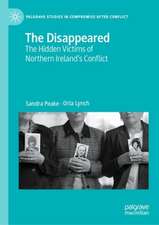
  • The Disappeared
    32772 lei
  • Ex-Combatants, Gender and Peace in Northern Ireland
    75422 lei -18% 91979 lei
  • Beyond Social Capital
    37471 lei
  • Media and Peace in the Middle East
    36858 lei
  • Re-Making Kozarac
    40100 lei
  • Ex-Combatants, Religion, and Peace in Northern Ireland
    62797 lei -15% 73879 lei
  • Religion and Post-Conflict Statebuilding
    39396 lei
  • State and Politics in Religious Peacebuilding
    66032 lei -15% 77684 lei
  • War, Denial and Nation-Building in Sri Lanka
    98556 lei -18% 120190 lei
  • Managing Transitional Justice
    81107 lei -18% 98910 lei
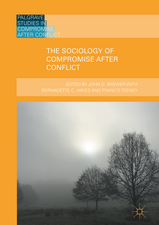
  • The Sociology of Compromise after Conflict
    75602 lei -18% 92198 lei
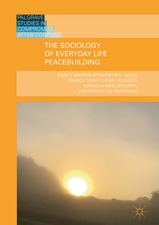
  • The Sociology of Everyday Life Peacebuilding
    75640 lei -18% 92243 lei
  • The Legacy of the Good Friday Agreement
    81288 lei -18% 99131 lei
  • Identity Change after Conflict
    60748 lei -15% 71468 lei
  • The Order of Victimhood
    54575 lei -15% 64207 lei
  • Reconciliation and Building a Sustainable Peace
    72139 lei -15% 84869 lei
  • Rebuilding Lives After Genocide
    54594 lei -15% 64229 lei
  • The International Criminal Court and Peace Processes
    60418 lei -15% 71081 lei
  • Post-Conflict Hauntings
    129152 lei -5% 135949 lei
  • Compromises in Democracy
    61541 lei -15% 72401 lei
  • Ex-Combatants' Voices
    78558 lei -18% 95803 lei
  • Punctuated Peace in Nigeria's Oil Region
    61332 lei -15% 72156 lei
  • Policing the Mexican Past
    75823 lei -18% 92467 lei
  • EU Peacebuilding Missions
    30971 lei
  • Everyday Life Peacebuilding and Family
    78181 lei -9% 85913 lei
  • The EU's Approach to Conflict Analysis in Integrated Conflict Interventions
    84663 lei -9% 93036 lei

Detalii

ISBN-13
9781349954643
ISBN-10
1349954640
Editura
Palgrave Macmillan UK
Colecția
Palgrave Macmillan
Seria
Palgrave Studies in Compromise after Conflict
Ediția
Softcover reprint of the original 1st ed. 2016
Pagini
214
Ilustrații
XVII, 214 p. 19 illus. in color.
Dimensiuni
148 x 210 mm
Greutate
0.29 kg
Locul publicării
London, United Kingdom

Cuprins

Introduction.- Chapter 1. The Army of the Dispossessed.- Chapter 2. Return.- Chapter 3. A Community of Mourners: Collective and Personal Rituals of Loss.- Chapter 4. Omarska.- Chapter 5. KOZARAC.BA: Online Community as a Network Bridge.- Chapter 6. Economic Sustainability in a Land of Corruption.- Conclusion. On Return as Redress.

Recenzii din presă

“Re-Making Kozarac fills a significant gap in the scholarship about post-war Bosnia-Herzegovina where, despite the profusion of academic studies about the political system, reconciliation and victimhood, case studies focusing on the grass-roots community level remain scarce. … it offers valuable lessons for researchers as well as practitioners in the fields of post-conflict peacebuilding and transitional justice as it shakes ingrained assumptions about victimhood, trauma and reconciliation.” (Sarah Correia, LSE Review of Books, blogs.lse.ac.uk, February, 2017)

“Sebina Sivac-Bryant’s anthropological study focuses on the postconflict society in Bosnia and Herzegovina. Specifically, the author reconstructsthe return process of Bosniaks to their former hometown Kozarac. … Sivac-Bryant makes an important contribution to the understanding of postconflict societies. … she has succeeded in compiling a very relevant work on postconflict societies.” (Manuela Brenner, Südosteuropa, Vol. 65 (4), 2017)

Notă biografică

Sebina Sivac-Bryant is an anthropologist specialising in human responses to challenging situations. Born in Kozarac, Bosnia-Hercegovina, she lived in Zagreb, Limerick and London after being expelled from her home town in 1992. She holds a PhD in Social Anthropology from University College London, UK.

Textul de pe ultima copertă

This book explores agency, reconciliation and minority return within the context of ethnic cleansing in Bosnia. It focuses on a community in North-West Bosnia, which successfully reversed the worst episode of ethnic cleansing prior to Srebrenica by fighting for return, and then establishing one of the only successful examples of contested minority return in the town of Kozarac. The book is a result of a longitudinal, decade-long study of a group of people who discovered a remarkable level of agency and resilience, largely without external support, and despite many of the people and institutions who were responsible for their violent expulsion remaining in place. 

Re-Making Kozarac considers how a community's traumatic experiences were utilised as a motivational vehicle for return, and contrasts their pragmatic approach to local compromise with the ill-informed and largely unsuccessful international projects that try to cast them as powerless victims. Importantly, the book offers critical reflections on the interventions of the trauma and reconciliation industries, which can be more harmful than is currently realised. It will be of great interest to scholars of criminology, anthropology and international relations.