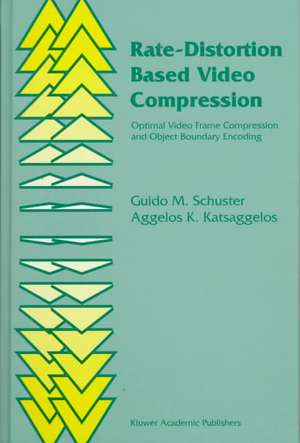
Rate-Distortion Based Video Compression
Autor Aggelos Katsaggelos, Guido M. Schusteren Limba Engleză Hardback – 31 dec 1996
Preț: 1024.77 lei
Preț vechi: 1280.96 lei
-20%
Puncte Express: 1537
Carte tipărită la comandă
Livrare economică 21 noiembrie-05 decembrie
Livrare prin curier în România Termenul estimat este afișat lângă disponibilitate.
Transport gratuit pentru acest produs Plată online sau ramburs, în funcție de opțiunile comenzii.
Retur gratuit în 14 zile Comandă securizată și suport în română.
Specificații
ISBN-13: 9780792398509
ISBN-10: 0792398505
Pagini: 312
Ilustrații: XX, 288 p.
Dimensiuni: 160 x 241 x 22 mm
Greutate: 0.58 kg
Ediția:1997
Editura: Springer Us
Locul publicării:New York, NY, United States
ISBN-10: 0792398505
Pagini: 312
Ilustrații: XX, 288 p.
Dimensiuni: 160 x 241 x 22 mm
Greutate: 0.58 kg
Ediția:1997
Editura: Springer Us
Locul publicării:New York, NY, United States
V-ar putea interesa
-
 Understanding TelevisionAndrew GoodwinPreț: 400.93 lei
 -
 MPEG-2 Systemsvan der Meer-8%Preț: 576.84 lei627.01 lei
 -
 Preț: 386.48 lei
 -
 Signal Recovery Techniques for Image and Video Compression and TransmissionAggelos Katsaggelos-20%Preț: 998.52 lei1248.15 lei
 -
 -20%Preț: 669.06 lei836.33 lei
 -
 Video CodingMurat Kunt-20%Preț: 1326.15 lei1657.69 lei
 -
 -20%Preț: 1016.17 lei1270.22 lei
 -
 Preț: 330.03 lei
 -
 Desperately Seeking the AudienceIen Ang-18%Preț: 1116.20 lei1361.23 lei
 -
 Preț: 147.16 lei
 -
 Spectacular Television: Exploring Televisual PleasureHelen Wheatley-25%Preț: 175.59 lei234.00 lei
 -
 TV's Not Dead!David BrennanPreț: 117.87 lei
 -
 Smart TV SecurityBenjamin Michéle-20%Preț: 308.34 lei385.41 lei
 -
 -18%Preț: 995.28 lei1213.75 lei
 -
 -15%Preț: 564.76 lei664.42 lei
 -
 Successful Television Management: The Hybrid ApproachSuzana Zilic FiserPreț: 438.72 lei
 -
 No-Reference and Reduced Reference Video Quality MetricsMylène Christine Queiroz Farias-8%Preț: 396.95 lei431.47 lei
Public țintă
ResearchDescriere
One of the most intriguing problems in video processing is the removal of the redundancy or the compression of a video signal. There are a large number of applications which depend on video compression. Data compression represents the enabling technology behind the multimedia and digital television revolution. In motion compensated lossy video compression the original video sequence is first split into three new sources of information, segmentation, motion and residual error. These three information sources are then quantized, leading to a reduced rate for their representation but also to a distorted reconstructed video sequence. After the decomposition of the original source into segmentation, mo tion and residual error information is decided, the key remaining problem is the allocation of the available bits into these three sources of information. In this monograph a theory is developed which provides a solution to this fundamental bit allocation problem. It can be applied to all quad-tree-based motion com pensated video coders which use a first order differential pulse code modulation (DPCM) scheme for the encoding of the displacement vector field (DVF) and a block-based transform scheme for the encoding of the displaced frame differ ence (DFD). An optimal motion estimator which results in the smallest DFD energy for a given bit rate for the encoding of the DVF is also a result of this theory. Such a motion estimator is used to formulate a motion compensated interpolation scheme which incorporates a global smoothness constraint for the DVF.
Cuprins
1 Introduction.- 2 Review of Lossy Video Compression.- 3 Background.- 4 General Contributions.- 5 Optimal Motion Estimation and Motion Compensated Interpolation for Video Compression.- 6 A Video Compression Scheme with Optimal Bit Allocation Between Displacement Vector Field and Displaced Frame Difference.- 7 A Video Compression Scheme with Optimal Bit Allocation Among Segmentation, Motion and Residual Error.- 8 An Optimal Polygonal Boundary Encoding Scheme.- References.
Notă biografică
¿Fan Zhai joined Texas Instruments (TI), Dallas, TX, in 2004. He is currently with the Department of Digital Entertainment Products, DSP Systems, where he is responsible for algorithm development and key intellectual property identification and management in image/video post-processing. His primary research interests include image and video signal processing and compression, multimedia communications and networking, and multimedia analysis. He has authored more than thirty publications, including one book chapter and eight journals, in the area of video compression and communications. He also holds one issued patent with five additional disclosures pending in the area of video post-processing, all of which have been implemented in TI's key video processing products. He has been on technical program committees for numerous prestigious international conferences including IEEE International Conference on Communications (ICC), 2006, IEEE Globecom, 2006, IEEE Consumer Communications and Networking Conference (CCNC), 2007, IEEE International Conference on Computer Communications and Networks (ICCCN), 2007, and IEEE International Conference on Multimedia and Expo (ICME) 2007. Dr. Zhai received the B.S. and M.S. degrees in electrical engineering from Nanjing University, Nanjing, Jiangsu, China, in 1996 and 1998, respectively, and the Ph.D. degree in electrical and computer engineering from Northwestern University, Evanston, IL, in 2004.
Aggelos K. Katsaggelos received the Diploma degree in electrical and mechanical engineering from the Aristotelian University of Thessaloniki, Greece, in 1979 and the M.S. and Ph.D. degrees both in electrical engineering from the Georgia Institute of Technology, in 1981 and 1985, respectively. In 1985 he joined the Department of Electrical Engineering and Computer Science at Northwestern University, where he is currently professor. He was the holder of the Ameritech Chair of Information Technology (1997-2003). He is also the Director of the Motorola Center for Seamless Communications and a member of the Academic Affiliate Staff, Department of Medicine, at Evanston Hospital. Dr. Katsaggelos has served the IEEE in many capacities (i.e., current member of the Publication Board of the IEEE Proceedings, editor-in-chief of the IEEE Signal Processing Magazine 1997-2002, member of the Board of Governors of the IEEE Signal Processing Society 1999-2001, and member of the Steering Committees of the IEEE Transactions on Image Processing 1992-1997). He is the editor of Digital Image Restoration (Springer-Verlag 1991), co-author of Rate-Distortion Based Video Compression (Kluwer 1997), co-editor of Recovery Techniques for Image and Video Compression and Transmission, (Kluwer 1998), co-author of Super-resolution for Images and Video (Claypool, 2007) and Joint Source-Channel Video Transmission (Claypool, 2007). He is the co-inventor of twelve international patents, a Fellow of the IEEE, and the recipient of the IEEE Third Millennium Medal (2000), the IEEE Signal Processing Society Meritorious Service Award (2001), an IEEE Signal Processing Society Best Paper Award (2001), and an IEEE International Conference on Multimedia and Expo Paper Award (2006). He is a Distinguished Lecturer of the IEEE Signal Processing Society (2007-08).