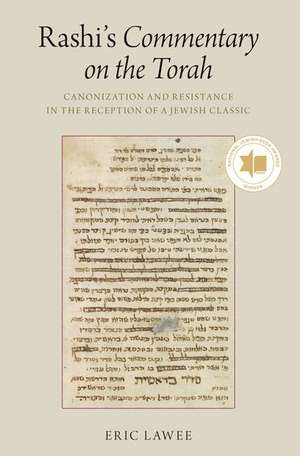
Rashi's Commentary on the Torah: Canonization and Resistance in the Reception of a Jewish Classic
Autor Eric Laweeen Limba Engleză Paperback – 7 sep 2021
Preț: 210.08 lei
Preț vechi: 282.37 lei
-26%
Puncte Express: 315
Carte tipărită la comandă
Livrare economică 11-17 iunie
Specificații
ISBN-13: 9780197584354
ISBN-10: 0197584357
Pagini: 496
Dimensiuni: 231 x 155 x 25 mm
Greutate: 0.61 kg
Editura: Oxford University Press
Colecția OUP USA
Locul publicării:New York, United States
ISBN-10: 0197584357
Pagini: 496
Dimensiuni: 231 x 155 x 25 mm
Greutate: 0.61 kg
Editura: Oxford University Press
Colecția OUP USA
Locul publicării:New York, United States
Recenzii
His work is [written] from a palpably interdisciplinary angle. From this point of view, it uncovers an entire cultural world that until now had only been known in bit and pieces. Hence, this book is of great importance for the understanding of an interpretive and theological dynamic and tracing the coming into existence of cultural modalities of knowledge transmission in late medieval times.
This lucid and comprehensive book should be found in every library of Judaica. It should be studied in courses in the history of Jewish exegesis of Scripture, and it should be on the desk of every teacher, scholar, and student who cherishes the third most important book in the Jewish sacred canon.
Lawee's masterful book is really two works in one. The second is the more academically novel, but the first is both stunningly impressive and of greater interest to RBL readers.
... in every way remarkable, expressed in rich language, at times subtle in thought and informed by theories of hermeneutics beyond the basic requirements of the history of Jewish commentaries, yet always clearly expressed.
The study is ambitious in its scope, thoroughly researched and authoritative, judicious in its evaluations and extremely well written... The story of the Commentary's modern reception remains to be told, Lawee has certainly done an excellent job in tracing its vicissitudes during the centuries of the late Middle Ages. This is a remarkable story and Lawee has told it well. It is a demanding read, but an enlightening and rewarding one.
It is very unusual for a scholar to identify a subject of manifestly great importance that has barely been addressed, but Eric Lawee has succeeded in doing so...We owe Lawee a debt of gratitude for his sweeping, learned, and original contribution to our understanding of how this classic text achieved its well-deserved renown.
An important work to be able to appreciate the impact of Rashi's biblical exegesis on posterity and to understand a good deal of medieval and modern Jewish exegesis.
This seminal work offers profound insights into the complexities of medieval Jewish rabbinical thought. For students seeking to delve into this rich intellectual tradition, Lawee's book emerges as one of the most valuable resources available. It not only illuminates the significance of Rashi's commentary but also explores the intricate processes of canonization, the varied responses it elicited over centuries, and the critical debates surrounding its reception. Moreover, the themes and analyses presented in Lawee's work make it an indispensable asset for courses in Judaic Studies and comparative religions.
This lucid and comprehensive book should be found in every library of Judaica. It should be studied in courses in the history of Jewish exegesis of Scripture, and it should be on the desk of every teacher, scholar, and student who cherishes the third most important book in the Jewish sacred canon.
Lawee's masterful book is really two works in one. The second is the more academically novel, but the first is both stunningly impressive and of greater interest to RBL readers.
... in every way remarkable, expressed in rich language, at times subtle in thought and informed by theories of hermeneutics beyond the basic requirements of the history of Jewish commentaries, yet always clearly expressed.
The study is ambitious in its scope, thoroughly researched and authoritative, judicious in its evaluations and extremely well written... The story of the Commentary's modern reception remains to be told, Lawee has certainly done an excellent job in tracing its vicissitudes during the centuries of the late Middle Ages. This is a remarkable story and Lawee has told it well. It is a demanding read, but an enlightening and rewarding one.
It is very unusual for a scholar to identify a subject of manifestly great importance that has barely been addressed, but Eric Lawee has succeeded in doing so...We owe Lawee a debt of gratitude for his sweeping, learned, and original contribution to our understanding of how this classic text achieved its well-deserved renown.
An important work to be able to appreciate the impact of Rashi's biblical exegesis on posterity and to understand a good deal of medieval and modern Jewish exegesis.
This seminal work offers profound insights into the complexities of medieval Jewish rabbinical thought. For students seeking to delve into this rich intellectual tradition, Lawee's book emerges as one of the most valuable resources available. It not only illuminates the significance of Rashi's commentary but also explores the intricate processes of canonization, the varied responses it elicited over centuries, and the critical debates surrounding its reception. Moreover, the themes and analyses presented in Lawee's work make it an indispensable asset for courses in Judaic Studies and comparative religions.
Notă biografică
Eric Lawee is Professor of Bible at Bar-Ilan University where he specializes in Jewish biblical interpretation in medieval and modern times. He holds the Weiser Chair for Research into Medieval Jewish Biblical Interpretation and directs Bar-Ilan's Institute for Jewish Bible Interpretation. He recently served as Shoshana Shier Distinguished Visiting Professor for Jewish Studies at the University of Toronto. His studies appear in leading journals of Jewish studies, religious studies, and medieval studies. His first book, Isaac Abarbanel's Stance Toward Tradition: Defense, Dissent, and Dialogue (2001), won a Canadian Jewish Book Award and was a finalist for a National Jewish Book Award.