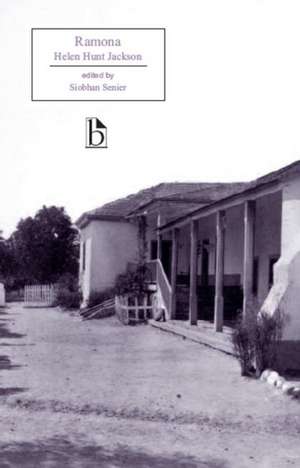
Ramona
Autor Helen Hunt Jackson Editat de Siobhan Senieren Limba Engleză Paperback – 28 mar 2008
This Broadview edition re-examines the novel’s legacy by placing it alongside public speeches, letters, and newspaper articles that promoted what was ultimately a damaging campaign by reformers to “assimilate” Native American peoples. Selections from Jackson’s non-fiction writings call into question the link between assimilationist policies and the story told in Ramona; also included are the writings and testimonies of some of Jackson’s Native American contemporaries, as well as a selection of travel essays and images that helped to create “the Ramona myth.”
Preț: 176.13 lei
Preț vechi: 209.36 lei
-16%
Puncte Express: 264
Carte disponibilă
Livrare economică 16-30 noiembrie
Livrare prin curier în România Termenul estimat este afișat lângă disponibilitate.
Transport gratuit de la 400.00 lei Plată online sau ramburs, în funcție de opțiunile comenzii.
Retur gratuit în 14 zile Comandă securizată și suport în română.
Specificații
ISBN-13: 9781551117201
ISBN-10: 1551117207
Pagini: 450
Dimensiuni: 140 x 216 x 22 mm
Greutate: 0.59 kg
Ediția:Critical
Editura: BROADVIEW PR
Colecția Broadview Press
Locul publicării:Peterborough, Canada
ISBN-10: 1551117207
Pagini: 450
Dimensiuni: 140 x 216 x 22 mm
Greutate: 0.59 kg
Ediția:Critical
Editura: BROADVIEW PR
Colecția Broadview Press
Locul publicării:Peterborough, Canada
V-ar putea interesa
-
 Daughter of FortuneIsabel AllendePreț: 94.06 lei
 -
 The RomaMadeline PotterPreț: 157.22 lei
 -
 To Kill a MockingbirdHarper Lee-18%Preț: 52.91 lei64.56 lei
 -
 Island of the Blue DolphinsScott O'Dell-19%Preț: 46.91 lei57.60 lei
 -
 The Grapes of WrathJohn Steinbeck-24%Preț: 55.78 lei73.18 lei
 -
 Dream On, Ramona RileyAshley Herring Blake-24%Preț: 60.43 lei79.95 lei
 -
 A Brutal ReckoningPeter CozzensPreț: 133.33 lei
 -
 The Squatter and the DonMaria Amparo Ruiz De BurtonPreț: 101.55 lei
 -
 God's Little AcreErskine CaldwellPreț: 133.43 lei
 -
 The Accidental MalayKarina Robles Bahrin-33%Preț: 48.62 lei72.22 lei
 -
 -25%Preț: 87.19 lei115.90 lei
 -
 A Century of DishonorHelen Hunt JacksonPreț: 89.00 lei
 -
 -25%Preț: 81.31 lei108.89 lei
 -
 -25%Preț: 54.27 lei72.29 lei
 -
 Black Sun Rising / La Corazonada: A Novel / Una NovelaBarry Gifford-13%Preț: 88.60 lei101.65 lei
 -
 Finding FloraElinor FlorencePreț: 80.13 leiRecomandat
 -
 Gone with the Wind: Annotated EditionMargaret MitchellPreț: 64.19 lei
 -
 Called by the HillsAnuradha RoyPreț: 94.56 lei
Recenzii
Ramona has often been compared to Uncle Tom’s Cabin for its influence on American social policy, and this is the only edition available that presents this important novel in its full historical context. A huge popular and critical success when it was first published in 1884, Ramona is set among the California Spanish missions and tells the story of the young mixed-blood heroine, Ramona, and her Native American lover Alessandro, as they flee from the brutal violence of white settlers.
This Broadview edition re-examines the novel’s legacy by placing it alongside public speeches, letters, and newspaper articles that promoted what was ultimately a damaging campaign by reformers to “assimilate” Native American peoples. Selections from Jackson’s non-fiction writings call into question the link between assimilationist policies and the story told in Ramona; also included are the writings and testimonies of some of Jackson’s Native American contemporaries, as well as a selection of travel essays and images that helped to create “the Ramona myth.”
“Siobhan Senier’s invaluable new edition effectively situates Ramona in its cultural, political, and historical contexts. The appendices assemble a riveting collection of documents, including texts on public opinion surrounding allotment and on women’s roles in Indian reform. Particularly valuable, the section on contemporary Native American voices restores historically silenced perspectives on the allotment and assimilation debates. The lucid, thoughtful introduction and the group of images related to the novel further enhance our ability to appreciate Jackson’s classic novel. Absorbing and challenging, Senier’s edition sets the standard.” — Karen L. Kilcup, University of North Carolina
“In this new edition, Siobhan Senier insightfully reads Ramona in its many modes: a vehicle to advocate for Indian rights; a reinscription, however strategic, of the most common stereotypes of Native peoples; a record of one activist who was wholly consumed with ‘the Indian question’; and a ‘sugar-coated’ narrative of the Mission era in Alta California. Senier deftly sets the stage for readers to grasp the myriad voices echoing in Ramona through her appendices of contemporary works by tribal and non-tribal authors of the time, reflecting current trends in Native American literary studies that seek to engage indigenous perspectives. With these materials in hand, readers are better poised than ever to comprehend the complexity and longevity of the legend of Ramona.” — Penelope Kelsey, Western Illinois University
“Siobhan Senier’s edition of Ramona finally gives this important American novel the critical attention that it deserves. Not only does Senier’s graceful introduction situate Ramona in relation to Jackson’s own activism on behalf of American Indian peoples and to the contentious historical climate of the late nineteenth-century, the included appendices provide ample context for multiple understandings of the novel and its historical moment. I could as easily teach this edition of Ramona in an American Indian rhetoric studies course as well as in a literature course. I am particularly impressed by how this serious scholarly contextualization works in relation to Senier’s equally serious consideration of the ‘Ramona myth’ and how that myth plays out in contemporary Californian culture.” — Malea Powell, Michigan State University
This Broadview edition re-examines the novel’s legacy by placing it alongside public speeches, letters, and newspaper articles that promoted what was ultimately a damaging campaign by reformers to “assimilate” Native American peoples. Selections from Jackson’s non-fiction writings call into question the link between assimilationist policies and the story told in Ramona; also included are the writings and testimonies of some of Jackson’s Native American contemporaries, as well as a selection of travel essays and images that helped to create “the Ramona myth.”
“Siobhan Senier’s invaluable new edition effectively situates Ramona in its cultural, political, and historical contexts. The appendices assemble a riveting collection of documents, including texts on public opinion surrounding allotment and on women’s roles in Indian reform. Particularly valuable, the section on contemporary Native American voices restores historically silenced perspectives on the allotment and assimilation debates. The lucid, thoughtful introduction and the group of images related to the novel further enhance our ability to appreciate Jackson’s classic novel. Absorbing and challenging, Senier’s edition sets the standard.” — Karen L. Kilcup, University of North Carolina
“In this new edition, Siobhan Senier insightfully reads Ramona in its many modes: a vehicle to advocate for Indian rights; a reinscription, however strategic, of the most common stereotypes of Native peoples; a record of one activist who was wholly consumed with ‘the Indian question’; and a ‘sugar-coated’ narrative of the Mission era in Alta California. Senier deftly sets the stage for readers to grasp the myriad voices echoing in Ramona through her appendices of contemporary works by tribal and non-tribal authors of the time, reflecting current trends in Native American literary studies that seek to engage indigenous perspectives. With these materials in hand, readers are better poised than ever to comprehend the complexity and longevity of the legend of Ramona.” — Penelope Kelsey, Western Illinois University
“Siobhan Senier’s edition of Ramona finally gives this important American novel the critical attention that it deserves. Not only does Senier’s graceful introduction situate Ramona in relation to Jackson’s own activism on behalf of American Indian peoples and to the contentious historical climate of the late nineteenth-century, the included appendices provide ample context for multiple understandings of the novel and its historical moment. I could as easily teach this edition of Ramona in an American Indian rhetoric studies course as well as in a literature course. I am particularly impressed by how this serious scholarly contextualization works in relation to Senier’s equally serious consideration of the ‘Ramona myth’ and how that myth plays out in contemporary Californian culture.” — Malea Powell, Michigan State University
Cuprins
Acknowledgements
Foreward (by Phil Brigandi)
Introduction
Helen Hunt Jackson: A Brief Chronology
A Note on the Text
Ramona
Appendix A: Public Opinion on Allotment and Assimilation
Foreward (by Phil Brigandi)
Introduction
Helen Hunt Jackson: A Brief Chronology
A Note on the Text
Ramona
Appendix A: Public Opinion on Allotment and Assimilation
- From Massachusetts Senator Henry L. Dawes, “Solving the Indian Problem” (1883)
- From Richard Henry Pratt, “The Advantages of Mingling Indians with Whites” (1892)
- From United States Congress, Committee on Indian Affairs, Minority Report on Land in Severalty Bill (1880)
- “In the Way,” New York Times (24 December 1879)
- “The Indian Severalty Law,” New York Times (27 May 1887)
- Letter to the Editor, New York Tribune (23 December 1879)
- Letter to the Editor, New York Tribune (26 December 1879)
- Letter to the Editor, New York Tribune (31 January 1879)
- From the Report on the Condition and Needs of the Mission Indians of California (1883)
- Alice Cunningham Fletcher, letter to Harriet Hawley (6 January 1884)
- From The Women’s National Indian Association, Sunshine Work (1894)
- From Anna R. Dawson (Arikara), Report from the Fort Berthold Reservation (1900)
- From Thomas Wildcat Alford, Civilization and the Story of the Absentee Shawnees (1936)
- Francis LaFlesche (Omaha), “An Indian Allotment” (1900)
- From Suzette LaFlesche (Omaha), Preface to William Justin Harsha, Ploughed Under (1881)
- From S. Alice Callahan (Muscogee), Wynema: A Child of the Forest (1891)
- Pleasant Porter (Muscogee), “What Is Best for the Indian” (1902)
- From Zitkala-Sa (Dakota), “Lost Treaties of the California Indians” (1922)
- From Alfred C. Gillis (Wintun), “The California Indians” (1924)
- Lone Wolf (Kiowa) et al.,Testimony before the Jerome Commission (1899)
- From The Los Angeles Times (13 January 1885)
- From The Nation (29 January 1885)
- From Elaine Goodale, The Southern Workman (February 1885)
- From Elizabeth B. Custer, The Boston Evening Transcript (14 May 1887)
- José Martí, “‘Ramona’ de Helen Hunt Jackson” (1887)
- From George Wharton James, Through Ramona’s Country (1909)
- Map of Ramona’s Homeland
- Rancho Camulos, South Veranda
- The Altar at Rancho Camulos
- Mission San Luis Rey (1910)
- Mission Capistrano (1915)
- Henry Sandham, illustration of Ramona
- Henry Sandham, illustration of Alessandro’s Murder
- Ramona Lubo at her Husband’s Grave
- Ramona Lubo at George Wharton James’s Graphophone
- 1908 Meeting of the Mission Indian Conference
- Ramona’s Marriage Place (1920s)
- The Ramona Pageant (c. 1930)
Notă biografică
HELEN HUNT JACKSON (1830-1885) (born Helen Maria Fiske) was an American poet and author who became an advocate for the improved treatment of Native Americans and other minorities by the United States government. Complementing A Century of Dishonor, Jackson also illustrated the plight of Native Americans trying to integrate into the white culture in a novel entitled Ramona.
Textul de pe ultima copertă
Ramona has often been compared to Uncle Tom's Cabin for its influence on American social policy, and this is the only edition available that presents this important novel in its full historical context. A huge popular and critical success when it was first published in 1884, Ramona is set among the California Spanish missions and tells the story of the young mixed-blood heroine, Ramona, and her Native American lover Alessandro, as they flee from the brutal violence of white settlers. This Broadview edition re-examines the novel's legacy by placing it alongside public speeches, letters, and newspaper articles that promoted what was ultimately a damaging campaign by reformers to "assimilate" Native American peoples. Selections from Jackson's non-fiction writings call into question the link between assimilationist policies and the story told in Ramona; also included are the writings and testimonies of some of Jackson's Native American contemporaries, as well as a selection of travel essays and images that helped to create "the Ramona myth."
Extras
I. It was sheep-shearing time in Southern California; but sheep-shearing was late at the Señora Moreno’s. The Fates had seemed to combine to put it off. In the first place, Felipe Moreno had been ill. He was the Señora’s eldest son, and since his father’s death had been at the head of his mother’s house. Without him, nothing could be done on the ranch, the Señora thought. It had been always, “Ask Señor Felipe,” “Go to Señor Felipe,” “Señor Felipe will attend to it,” ever since Felipe had had the dawning of a beard on his handsome face.
In truth, it was not Felipe, but the Señora, who really decided all questions from greatest to least, and managed everything on the place, from the sheep-pastures to the artichoke-patch; but nobody except the Señora herself knew this. An exceedingly clever woman for her day and generation was Señora Gonzaga Moreno,—as for that matter, exceedingly clever for any day and generation; but exceptionally clever for the day and generation to which she belonged. Her life, the mere surface of it, if it had been written, would have made a romance, to grow hot and cold over: sixty years of the best of old Spain and the wildest of New Spain, Bay of Biscay, Gulf of Mexico, Pacific Ocean,—the waves of them all had tossed destinies for the Señora.1
The Holy Catholic Church had had its arms round her from first to last; and that was what had brought her safe through, she would have said, if she had ever said anything about herself, which she never did,—one of her many wisdoms. So quiet, so reserved, so gentle an exterior never was known to veil such an imperious and passionate nature, brimful of storm, always passing through stress; never thwarted, except at peril of those who did it; adored and hated by turns, and each at the hottest. A tremendous force, wherever she appeared, was Señora Moreno; but no stranger would suspect it, to see her gliding about, in her scanty black gown, with her rosary hanging at her side, her soft dark eyes cast down, and an expression of mingled melancholy and devotion on her face. She looked simply like a sad, spiritual-minded old lady, amiable and indolent, like her race, but sweeter and more thoughtful than their wont. Her voice heightened this mistaken impression. She was never heard to speak either loud or fast. There was at times even a curious hesitancy in her speech, which came near being a stammer, or suggested the measured care with which people speak who have been cured of stammering. It made her often appear as if she did not know her own mind: at which people sometimes took heart; when, if they had only known the truth, they would have known that the speech hesitated solely because the Señora knew her mind so exactly that she was finding it hard to make the words convey it as she desired, or in a way to best attain her ends.
About this very sheep-shearing there had been, between her and the head shepherd, Juan Canito, called Juan Can for short, and to distinguish him from Juan José, the upper herdsman of the cattle, some discussions which would have been hot and angry ones in any other hands than the Señora’s.
Juan Canito wanted the shearing to begin, even though Señor Felipe were ill in bed, and though that lazy shepherd Luigo had not yet got back with the flock that had been driven up the coast for pasture. “There were plenty of sheep on the place to begin with,” he said one morning,—“at least a thousand;” and by the time they were done, Luigo would surely be back with the rest; and as for Señor Felipe’s being in bed, had not he, Juan Canito, stood at the packing-bag, and handled the wool, when Señor Felipe was a boy? Why could he not do it again? The Señora did not realize how time was going; there would be no shearers to be hired presently, since the Señora was determined to have none but Indians. Of course, if she would employ Mexicans, as all the other ranches in the valley did, it would be different; but she was resolved upon having Indians,—“God knows why,” he interpolated surlily, under his breath.
“I do not quite understand you, Juan,” interrupted Señora Moreno at the precise instant the last syllable of this disrespectful ejaculation had escaped Juan’s lips; “speak a little louder. I fear I am growing deaf in my old age.”
What gentle, suave, courteous tones! and the calm dark eyes rested on Juan Canito with a look to the fathoming of which he was as unequal as one of his own sheep would have been. He could not have told why he instantly and involuntarily said, “Beg your pardon, Señora.”
“Oh, you need not ask my pardon, Juan,” the Señora replied with exquisite gentleness; “it is not you who are to blame, if I am deaf. I have fancied for a year I did not hear quite as well as I once did. But about the Indians, Juan; did not Señor Felipe tell you that he had positively engaged the same band of shearers we had last autumn, Alessandro’s band from Temecula? They will wait until we are ready for them. Señor Felipe will send a messenger for them. He thinks them the best shearers in the country. He will be well enough in a week or two, he thinks, and the poor sheep must bear their loads a few days longer. Are they looking well, do you think, Juan? Will the crop be a good one? General Moreno used to say that you could reckon up the wool-crop to a pound, while it was on the sheep’s backs.”
“Yes, Señora,” answered the mollified Juan; “the poor beasts look wonderfully well considering the scant feed they have had all winter. We’ll not come many pounds short of our last year’s crop, if any. Though, to be sure, there is no telling in what case that—Luigo will bring his flock back.”
The Señora smiled, in spite of herself, at the pause and gulp with which Juan had filled in the hiatus where he had longed to set a contemptuous epithet before Luigo’s name.
This was another of the instances where the Señora’s will and Juan Canito’s had clashed and he did not dream of it, having set it all down as usual to the score of young Señor Felipe.
Encouraged by the Señora’s smile, Juan proceeded: “Señor Felipe can see no fault in Luigo, because they were boys together; but I can tell him, he will rue it, one of these mornings, when he finds a flock of sheep worse than dead on his hands, and no thanks to anybody but Luigo. While I can have him under my eye, here in the valley, it is all very well; but he is no more fit to take responsibility of a flock, than one of the very lambs themselves. He’ll drive them off their feet one day, and starve them the next; and I’ve known him to forget to give them water. When he’s in his dreams, the Virgin only knows what he won’t do.”
During this brief and almost unprecedented outburst of Juan’s the Señora’s countenance had been slowly growing stern. Juan had not seen it. His eyes had been turned away from her, looking down into the upturned eager face of his favorite colley, who was leaping and gambolling and barking at his feet.
“Down, Capitan, down!” he said in a fond tone, gently repulsing him; “thou makest such a noise the Señora can hear nothing but thy voice.”
“I heard only too distinctly, Juan Canito,” said the Señora in a sweet but icy tone. “It is not well for one servant to backbite another. It gives me great grief to hear such words; and I hope when Father Salvierderra comes, next month, you will not forget to confess this sin of which you have been guilty in thus seeking to injure a fellow-being. If Señor Felipe listens to you, the poor boy Luigo will be cast out homeless on the world some day; and what sort of a deed would that be, Juan Canito, for one Christian to do to another? I fear the Father will give you penance, when he hears what you have said.”
“Señora, it is not to harm the lad,” Juan began, every fibre of his faithful frame thrilling with a sense of the injustice of her reproach.
But the Señora had turned her back. Evidently she would hear no more from him then. He stood watching her as she walked away, at her usual slow pace, her head slightly bent forward, her rosary lifted in her left hand, and the fingers of the right hand mechanically slipping the beads.
“Prayers, always prayers!” thought Juan to himself, as his eyes followed her. “If they’ll take one to heaven, the Señora’ll go by the straight road, that’s sure! I’m sorry I vexed her. But what’s a man to do, if he’s the interest of the place at heart, I’d like to know. Is he to stand by, and see a lot of idle mooning louts run away with everything? Ah, but it was an ill day for the estate when the General died,—an ill day! an ill day! And they may scold me as much as they please, and set me to confessing my sins to the Father; it’s very well for them, they’ve got me to look after matters. Señor Felipe will do well enough when he’s a man, maybe; but a boy like him! Bah!” And the old man stamped his foot with a not wholly unreasonable irritation, at the false position in which he felt himself put.
“Confess to Father Salvierderra, indeed!” he muttered aloud. “Ay, that will I. He’s a man of sense, if he is a priest,”—at which slip of the tongue the pious Juan hastily crossed himself,—“and I’ll ask him to give me some good advice as to how I’m to manage between this young boy at the head of everything, and a doting mother who thinks he has the wisdom of a dozen grown men. The Father knew the place in the olden time. He knows it’s no child’s play to look after the estate even now, much smaller as it is! An ill day when the old General died, an ill day indeed, the saints rest his soul!” Saying this, Juan shrugged his shoulders, and whistling to Capitan, walked towards the sunny veranda of the south side of the kitchen wing of the house, where it had been for twenty odd years his habit to sit on the long bench and smoke his pipe of a morning. Before he had got half-way across the court-yard, however, a thought struck him. He halted so suddenly that Capitan, with the quick sensitiveness of his breed, thought so sudden a change of purpose could only come from something in connection with sheep; and, true to his instinct of duty, pricked up his ears, poised himself for a full run, and looked up in his master’s face waiting for explanation and signal. But Juan did not observe him.
“Ha!” he said, “Father Salvierderra comes next month, does he? Let’s see. To-day is the 25th. That’s it. The sheep-shearing is not to come off till the Father gets here. Then each morning it will be mass in the chapel, and each night vespers; and the crowd will be here at least two days longer to feed, for the time they will lose by that and by the confessions. That’s what Señor Felipe is up to. He’s a pious lad. I recollect now, it was the same way two years ago. Well, well, it is a good thing for those poor Indian devils to get a bit of religion now and then; and it’s like old times to see the chapel full of them kneeling, and more than can get in at the door; I doubt not it warms the Señora’s heart to see them all there, as if they belonged to the house, as they used to: and now I know when it’s to be, I have only to make my arrangements accordingly.2 It is always in the first week of the month the Father gets here. Yes; she said, ‘Señor Felipe will be well enough in a week or two, he thinks.’ Ha! ha! It will be nearer two; ten days or thereabouts. I’ll begin the booths next week. A plague on that Luigo for not being back here. He’s the best hand I have to cut the willow boughs for the roofs. He knows the difference between one year’s growth and another’s; I’ll say that much for him, spite of the silly dreaming head he’s got on his shoulders.”
Juan was so pleased with this clearing up in his mind as to Señor Felipe’s purpose about the time of the sheep-shearing, that it put him in good humor for the day,—good humor with everybody, and himself most of all. As he sat on the low bench, his head leaning back against the whitewashed wall, his long legs stretched out nearly across the whole width of the veranda, his pipe firm wedged in the extreme left corner of his mouth, his hands in his pockets, he was the picture of placid content. The troop of youngsters which still swarmed around the kitchen quarters of Señora Moreno’s house, almost as numerous and inexplicable as in the grand old days of the General’s time, ran back and forth across Juan’s legs, fell down between them, and picked themselves up by help of clutches at his leather trousers, all unreproved by Juan, though loudly scolded and warned by their respective mothers from the kitchen.
“What’s come to Juan Can to be so good-natured to-day?” saucily asked Margarita, the youngest and prettiest of the maids, popping her head out of a window, and twitching Juan’s hair. He was so gray and wrinkled that the maids all felt at ease with him. He seemed to them as old as Methuselah;3 but he was not really so old as they thought, nor they so safe in their tricks. The old man had hot blood in his veins yet, as the under-shepherds could testify.
“The sight of your pretty face, Señorita Margarita,” answered Juan quickly, cocking his eye at her, rising to his feet, and making a mock bow towards the window.
“He! he! Señorita, indeed!” chuckled Margarita’s mother, old Marda the cook. “Señor Juan Canito is pleased to be merry at the doors of his betters;” and she flung a copper saucepan full of not over-clean water so deftly past Juan’s head, that not a drop touched him, and yet he had the appearance of having been ducked. At which bit of sleight-of-hand the whole court-yard, young and old, babies, cocks, hens, and turkeys, all set up a shout and a cackle, and dispersed to the four corners of the yard as if scattered by a volley of bird-shot. Hearing the racket, the rest of the maids came running,—Anita and Maria, the twins, women forty years old, born on the place the year after General Moreno brought home his handsome young bride; their two daughters, Rosa and Anita the Little, as she was still called, though she outweighed her mother; old Juanita, the oldest woman in the household, of whom even the Señora was said not to know the exact age or history; and she, poor thing, could tell nothing, having been silly for ten years or more, good for nothing except to shell beans: that she did as fast and well as ever, and was never happy except she was at it. Luckily for her, beans are the one crop never omitted or stinted on a Mexican estate; and for sake of old Juanita they stored every year in the Moreno house, rooms full of beans in the pod (tons of them, one would think), enough to feed an army.
But then, it was like a little army even now, the Señora’s household; nobody ever knew exactly how many women were in the kitchen, or how many men in the fields. There were always women cousins, or brother’s wives or widows or daughters, who had come to stay, or men cousins, or sister’s husbands or sons, who were stopping on their way up or down the valley. When it came to the pay-roll, Señor Felipe knew to whom he paid wages; but who were fed and lodged under his roof, that was quite another thing. It could not enter into the head of a Mexican gentleman to make either count or account of that. It would be a disgraceful niggardly thought.
To the Señora it seemed as if there were no longer any people about the place. A beggarly handful, she would have said, hardly enough to do the work of the house, or of the estate, sadly as the latter had dwindled. In the General’s day, it had been a free-handed boast of his that never less than fifty persons, men, women and children, were fed within his gates each day; how many more, he did not care, nor know. But that time had indeed gone, gone forever; and though a stranger, seeing the sudden rush and muster at door and window, which followed on old Marda’s letting fly the water at Juan’s head, would have thought, “Good heavens, do all those women, children, and babies belong in that one house!” the Señora’s sole thought, as she at that moment went past the gate, was, “Poor things! how few there are left of them! I am afraid old Marda has to work too hard. I must spare Margarita more from the house to help her.” And she sighed deeply, and unconsciously held her rosary nearer to her heart, as she went into the house and entered her son’s bedroom. The picture she saw there was one to thrill any mother’s heart; and as it met her eye, she paused on the threshold for a second,—only a second, however; and nothing could have astonished Felipe Moreno so much as to have been told that at the very moment when his mother’s calm voice was saying to him, “Good morning, my son, I hope you have slept well, and are better,” there was welling up in her heart a passionate ejaculation, “O my glorious son! The saints have sent me in him the face of his father! He is fit for a kingdom!”
The truth is, Felipe Moreno was not fit for a kingdom at all. If he had been, he would not have been so ruled by his mother without ever finding it out. But so far as mere physical beauty goes, there never was a king born, whose face, stature, and bearing would set off a crown or a throne, or any of the things of which the outside of royalty is made up, better than would Felipe Moreno’s. And it was true, as the Señora said, whether the saints had anything to do with it or not, that he had the face of his father. So strong a likeness is seldom seen. When Felipe once, on the occasion of a grand celebration and procession, put on the gold-wrought velvet mantle, gayly embroidered short breeches fastened at the knee with red ribbons, and gold-and-silver-trimmed sombrero, which his father had worn twenty-five years before, the Señora fainted at her first look at him,—fainted and fell; and when she opened her eyes, and saw the same splendid, gayly arrayed, dark-bearded man, bending over her in distress, with words of endearment and alarm, she fainted again.
“Mother, mother mia,” cried Felipe, “I will not wear them if it makes you feel like this! Let me take them off. I will not go to their cursed parade;” and he sprang to his feet, and began with trembling fingers to unbuckle the sword-belt.
“No, no, Felipe,” faintly cried the Señora, from the ground. “It is my wish that you wear them;” and staggering to her feet, with a burst of tears, she rebuckled the old sword-belt, which her fingers had so many times—never unkissed—buckled, in the days when her husband had bade her farewell and gone forth to the uncertain fates of war. “Wear them!” she cried, with gathering fire in her tones, and her eyes dry of tears,—“wear them, and let the American hounds see what a Mexican officer and gentleman looked like before they had set their base, usurping feet on our necks!” And she followed him to the gate, and stood erect, bravely waving her handkerchief as he galloped off, till he was out of sight. Then with a changed face and a bent head she crept slowly to her room, locked herself in, fell on her knees before the Madonna at the head of her bed, and spent the greater part of the day praying that she might be forgiven, and that all heretics might be discomfited. From which part of these supplications she derived most comfort is easy to imagine.
Juan Canito had been right in his sudden surmise that it was for Father Salvierderra’s coming that the sheep-shearing was being delayed, and not in consequence of Señor Felipe’s illness, or by the non-appearance of Luigo and his flock of sheep. Juan would have chuckled to himself still more at his perspicacity, had he overheard the conversation going on between the Señora and her son, at the very time when he, half asleep on the veranda, was, as he would have called it, putting two and two together and convincing himself that old Juan was as smart as they were, and not to be kept in the dark by all their reticence and equivocation.
“Juan Can is growing very impatient about the sheep-shearing,” said the Señora. “I suppose you are still of the same mind about it, Felipe,—that it is better to wait till Father Salvierderra comes? As the only chance those Indians have of seeing him is here, it would seem a Christian duty to so arrange it, if it be possible; but Juan is very restive. He is getting old, and chafes a little, I fancy, under your control. He cannot forget that you were a boy on his knee. Now I, for my part, am like to forget that you were ever anything but a man for me to lean on.”
Felipe turned his handsome face toward his mother with a beaming smile of filial affection and gratified manly vanity. “Indeed, my mother, if I can be sufficient for you to lean on, I will ask nothing more of the saints;” and he took his mother’s thin and wasted little hands, both at once, in his own strong right hand, and carried them to his lips as a lover might have done. “You will spoil me, mother,” he said, “you make me so proud.”
“No, Felipe, it is I who am proud,” promptly replied the mother; “and I do not call it being proud, only grateful to God for having given me a son wise enough to take his father’s place, and guide and protect me through the few remaining years I have to live. I shall die content, seeing you at the head of the estate, and living as a Mexican gentleman should; that is, so far as now remains possible in this unfortunate country. But about the sheep-shearing, Felipe. Do you wish to have it begun before the Father is here? Of course, Alessandro is all ready with his band. It is but two days’ journey for a messenger to bring him. Father Salvierderra cannot be here before the 10th of the month. He leaves Santa Barbara on the 1st, and he will walk all the way,—a good six days’ journey, for he is old now and feeble; then he must stop in Ventura for a Sunday, and a day at the Ortega’s ranch, and at the Lopez’s—there, there is a christening. Yes, the 10th is the very earliest that he can be here,—near two weeks from now. So far as your getting up is concerned, it might perhaps be next week. You will be nearly well by that time.”
“Yes indeed,” laughed Felipe, stretching himself out in the bed and giving a kick to the bedclothes that made the high bedposts and the fringed canopy roof shake and creak; “I am well now, if it were not for this cursed weakness when I stand on my feet. I believe it would do me good to get out of doors.”
In truth, Felipe had been hankering for the sheep-shearing himself. It was a brisk, busy, holiday sort of time to him, hard as he worked in it; and two weeks looked long to wait.
“It is always thus after a fever,” said his mother. “The weakness lasts many weeks. I am not sure that you will be strong enough even in two weeks to do the packing; but, as Juan Can said this morning, he stood at the packing-bag when you were a boy, and there was no need of waiting for you for that!”
“He said that, did he!” exclaimed Felipe, wrathfully. “The old man is getting insolent. I’ll tell him that nobody will pack the sacks but myself, while I am master here; and I will have the sheep-shearing when I please, and not before.”
“I suppose it would not be wise to say that it is not to take place till the Father comes, would it?” asked the Señora, hesitatingly, as if the thing were evenly balanced in her mind. “The Father has not that hold on the younger men he used to have, and I have thought that even in Juan himself I have detected a remissness. The spirit of unbelief is spreading in the country since the Americans are running up and down everywhere seeking money, like dogs with their noses to the ground! It might vex Juan if he knew that you were waiting only for the Father. What do you think?”
“I think it is enough for him to know that the sheep-shearing waits for my pleasure,” answered Felipe, still wrathful, “and that is the end of it.” And so it was; and, moreover, precisely the end which Señora Moreno had had in her own mind from the beginning; but not even Juan Canito himself suspected its being solely her purpose, and not her son’s. As for Felipe, if any person had suggested to him that it was his mother, and not he, who had decided that the sheep-shearing would better be deferred until the arrival of Father Salvierderra from Santa Barbara, and that nothing should be said on the ranch about this being the real reason of the postponing, Felipe would have stared in astonishment, and have thought that person either crazy or a fool.
To attain one’s ends in this way is the consummate triumph of art. Never to appear as a factor in the situation; to be able to wield other men, as instruments, with the same direct and implicit response to will that one gets from a hand or a foot,—this is to triumph, indeed: to be as nearly controller and conqueror of Fates as fate permits. There have been men prominent in the world’s affairs at one time and another, who have sought and studied such a power and have acquired it to a great degree. By it they have manipulated legislators, ambassadors, sovereigns; and have grasped, held, and played with the destinies of empires. But it is to be questioned whether even in these notable instances there has ever been so marvellous completeness of success as is sometimes seen in the case of a woman in whom the power is an instinct and not an attainment; a passion rather than a purpose. Between the two results, between the two processes, there is just that difference which is always to be seen between the stroke of talent and the stroke of genius.
Señora Moreno’s was the stroke of genius.4
II.
The Señora Moreno’s house was one of the best specimens to be found in California of the representative house of the half barbaric, half elegant, wholly generous and free-handed life led there by Mexican men and women of degree in the early part of this century, under the rule of the Spanish and Mexican viceroys, when the laws of the Indies were still the law of the land, and its old name, “New Spain,” was an ever-present link and stimulus to the warmest memories and deepest patriotisms of its people.1
It was a picturesque life, with more of sentiment and gayety in it, more also that was truly dramatic, more romance, than will ever be seen again on those sunny shores. The aroma of it all lingers there still; industries and inventions have not yet slain it; it will last out its century,—in fact, it can never be quite lost, so long as there is left standing one such house as the Señora Moreno’s.
When the house was built, General Moreno owned all the land within a radius of forty miles,—forty miles westward, down the valley to the sea; forty miles eastward, into the San Fernando Mountains; and good forty miles more or less along the coast. The boundaries were not very strictly defined; there was no occasion, in those happy days, to reckon land by inches. It might be asked, perhaps, just how General Moreno owned all this land, and the question might not be easy to answer. It was not and could not be answered to the satisfaction of the United States Land Commission, which, after the surrender of California, undertook to sift and adjust Mexican land-titles; and that was the way it had come about that the Señora Moreno now called herself a poor woman. Tract after tract, her lands had been taken away from her; it looked for a time as if nothing would be left. Every one of the claims based on deeds of gift from Governor Pio Pico,2 her husband’s most intimate friend, was disallowed.
They all went by the board in one batch, and took away from the Señora in a day the greater part of her best pasture-lands. They were lands which had belonged to the Bonaventura Mission, and lay along the coast at the mouth of the valley down which the little stream which ran past her house went to the sea; and it had been a great pride and delight to the Señora, when she was young, to ride that forty miles by her husband’s side, all the way on their own lands, straight from their house to their own strip of shore. No wonder she believed the Americans thieves, and spoke of them always as hounds. The people of the United States have never in the least realized that the taking possession of California was not only a conquering of Mexico, but a conquering of California as well;3 that the real bitterness of the surrender was not so much to the empire which gave up the country, as to the country itself which was given up. Provinces passed back and forth in that way, helpless in the hands of great powers, have all the ignominy and humiliation of defeat, with none of the dignities or compensations of the transaction.
Mexico saved much by her treaty, spite of having to acknowledge herself beaten; but California lost all. Words cannot tell the sting of such a transfer. It is a marvel that a Mexican remained in the country; probably none did, except those who were absolutely forced to it.
Luckily for the Señora Moreno, her title to the lands midway in the valley was better than to those lying to the east and the west, which had once belonged to the missions of San Fernando and Bonaventura; and after all the claims, counter-claims, petitions, appeals, and adjudications were ended, she still was left in undisputed possession of what would have been thought by any new-comer into the country to be a handsome estate, but which seemed to the despoiled and indignant Señora a pitiful fragment of one. Moreover, she declared that she should never feel secure of a foot of even this. Any day, she said, the United States Government might send out a new Land Commission to examine the decrees of the first, and revoke such as they saw fit. Once a thief, always a thief. Nobody need feel himself safe under American rule. There was no knowing what might happen any day; and year by year the lines of sadness, resentment, anxiety, and antagonism deepened on the Señora’s fast aging face.
It gave her unspeakable satisfaction, when the Commissioners, laying out a road down the valley, ran it at the back of her house instead of past the front. “It is well,” she said. “Let their travel be where it belongs, behind our kitchens; and no one have sight of the front doors of our houses, except friends who have come to visit us.” Her enjoyment of this never flagged. Whenever she saw, passing the place, wagons or carriages belonging to the hated Americans, it gave her a distinct thrill of pleasure to think that the house turned its back on them. She would like always to be able to do the same herself; but whatever she, by policy or in business, might be forced to do, the old house, at any rate, would always keep the attitude of contempt,—its face turned away.
One other pleasure she provided herself with, soon after this road was opened,—a pleasure in which religious devotion and race antagonism were so closely blended that it would have puzzled the subtlest of priests to decide whether her act were a sin or a virtue. She caused to be set up, upon every one of the soft rounded hills which made the beautiful rolling sides of that part of the valley, a large wooden cross; not a hill in sight of her house left without the sacred emblem of her faith. “That the heretics may know, when they go by, that they are on the estate of a good Catholic,” she said, “and that the faithful may be reminded to pray. There have been miracles of conversion wrought on the most hardened by a sudden sight of the Blessed Cross.”
There they stood, summer and winter, rain and shine, the silent, solemn, outstretched arms, and became landmarks to many a guideless traveller who had been told that his way would be by the first turn to the left or the right, after passing the last one of the Señora Moreno’s crosses, which he couldn’t miss seeing. And who shall say that it did not often happen that the crosses bore a sudden message to some idle heart journeying by, and thus justified the pious half of the Señora’s impulse? Certain it is, that many a good Catholic halted and crossed himself when he first beheld them, in the lonely places, standing out in sudden relief against the blue sky; and if he said a swift short prayer at the sight, was he not so much the better?
In truth, it was not Felipe, but the Señora, who really decided all questions from greatest to least, and managed everything on the place, from the sheep-pastures to the artichoke-patch; but nobody except the Señora herself knew this. An exceedingly clever woman for her day and generation was Señora Gonzaga Moreno,—as for that matter, exceedingly clever for any day and generation; but exceptionally clever for the day and generation to which she belonged. Her life, the mere surface of it, if it had been written, would have made a romance, to grow hot and cold over: sixty years of the best of old Spain and the wildest of New Spain, Bay of Biscay, Gulf of Mexico, Pacific Ocean,—the waves of them all had tossed destinies for the Señora.1
The Holy Catholic Church had had its arms round her from first to last; and that was what had brought her safe through, she would have said, if she had ever said anything about herself, which she never did,—one of her many wisdoms. So quiet, so reserved, so gentle an exterior never was known to veil such an imperious and passionate nature, brimful of storm, always passing through stress; never thwarted, except at peril of those who did it; adored and hated by turns, and each at the hottest. A tremendous force, wherever she appeared, was Señora Moreno; but no stranger would suspect it, to see her gliding about, in her scanty black gown, with her rosary hanging at her side, her soft dark eyes cast down, and an expression of mingled melancholy and devotion on her face. She looked simply like a sad, spiritual-minded old lady, amiable and indolent, like her race, but sweeter and more thoughtful than their wont. Her voice heightened this mistaken impression. She was never heard to speak either loud or fast. There was at times even a curious hesitancy in her speech, which came near being a stammer, or suggested the measured care with which people speak who have been cured of stammering. It made her often appear as if she did not know her own mind: at which people sometimes took heart; when, if they had only known the truth, they would have known that the speech hesitated solely because the Señora knew her mind so exactly that she was finding it hard to make the words convey it as she desired, or in a way to best attain her ends.
About this very sheep-shearing there had been, between her and the head shepherd, Juan Canito, called Juan Can for short, and to distinguish him from Juan José, the upper herdsman of the cattle, some discussions which would have been hot and angry ones in any other hands than the Señora’s.
Juan Canito wanted the shearing to begin, even though Señor Felipe were ill in bed, and though that lazy shepherd Luigo had not yet got back with the flock that had been driven up the coast for pasture. “There were plenty of sheep on the place to begin with,” he said one morning,—“at least a thousand;” and by the time they were done, Luigo would surely be back with the rest; and as for Señor Felipe’s being in bed, had not he, Juan Canito, stood at the packing-bag, and handled the wool, when Señor Felipe was a boy? Why could he not do it again? The Señora did not realize how time was going; there would be no shearers to be hired presently, since the Señora was determined to have none but Indians. Of course, if she would employ Mexicans, as all the other ranches in the valley did, it would be different; but she was resolved upon having Indians,—“God knows why,” he interpolated surlily, under his breath.
“I do not quite understand you, Juan,” interrupted Señora Moreno at the precise instant the last syllable of this disrespectful ejaculation had escaped Juan’s lips; “speak a little louder. I fear I am growing deaf in my old age.”
What gentle, suave, courteous tones! and the calm dark eyes rested on Juan Canito with a look to the fathoming of which he was as unequal as one of his own sheep would have been. He could not have told why he instantly and involuntarily said, “Beg your pardon, Señora.”
“Oh, you need not ask my pardon, Juan,” the Señora replied with exquisite gentleness; “it is not you who are to blame, if I am deaf. I have fancied for a year I did not hear quite as well as I once did. But about the Indians, Juan; did not Señor Felipe tell you that he had positively engaged the same band of shearers we had last autumn, Alessandro’s band from Temecula? They will wait until we are ready for them. Señor Felipe will send a messenger for them. He thinks them the best shearers in the country. He will be well enough in a week or two, he thinks, and the poor sheep must bear their loads a few days longer. Are they looking well, do you think, Juan? Will the crop be a good one? General Moreno used to say that you could reckon up the wool-crop to a pound, while it was on the sheep’s backs.”
“Yes, Señora,” answered the mollified Juan; “the poor beasts look wonderfully well considering the scant feed they have had all winter. We’ll not come many pounds short of our last year’s crop, if any. Though, to be sure, there is no telling in what case that—Luigo will bring his flock back.”
The Señora smiled, in spite of herself, at the pause and gulp with which Juan had filled in the hiatus where he had longed to set a contemptuous epithet before Luigo’s name.
This was another of the instances where the Señora’s will and Juan Canito’s had clashed and he did not dream of it, having set it all down as usual to the score of young Señor Felipe.
Encouraged by the Señora’s smile, Juan proceeded: “Señor Felipe can see no fault in Luigo, because they were boys together; but I can tell him, he will rue it, one of these mornings, when he finds a flock of sheep worse than dead on his hands, and no thanks to anybody but Luigo. While I can have him under my eye, here in the valley, it is all very well; but he is no more fit to take responsibility of a flock, than one of the very lambs themselves. He’ll drive them off their feet one day, and starve them the next; and I’ve known him to forget to give them water. When he’s in his dreams, the Virgin only knows what he won’t do.”
During this brief and almost unprecedented outburst of Juan’s the Señora’s countenance had been slowly growing stern. Juan had not seen it. His eyes had been turned away from her, looking down into the upturned eager face of his favorite colley, who was leaping and gambolling and barking at his feet.
“Down, Capitan, down!” he said in a fond tone, gently repulsing him; “thou makest such a noise the Señora can hear nothing but thy voice.”
“I heard only too distinctly, Juan Canito,” said the Señora in a sweet but icy tone. “It is not well for one servant to backbite another. It gives me great grief to hear such words; and I hope when Father Salvierderra comes, next month, you will not forget to confess this sin of which you have been guilty in thus seeking to injure a fellow-being. If Señor Felipe listens to you, the poor boy Luigo will be cast out homeless on the world some day; and what sort of a deed would that be, Juan Canito, for one Christian to do to another? I fear the Father will give you penance, when he hears what you have said.”
“Señora, it is not to harm the lad,” Juan began, every fibre of his faithful frame thrilling with a sense of the injustice of her reproach.
But the Señora had turned her back. Evidently she would hear no more from him then. He stood watching her as she walked away, at her usual slow pace, her head slightly bent forward, her rosary lifted in her left hand, and the fingers of the right hand mechanically slipping the beads.
“Prayers, always prayers!” thought Juan to himself, as his eyes followed her. “If they’ll take one to heaven, the Señora’ll go by the straight road, that’s sure! I’m sorry I vexed her. But what’s a man to do, if he’s the interest of the place at heart, I’d like to know. Is he to stand by, and see a lot of idle mooning louts run away with everything? Ah, but it was an ill day for the estate when the General died,—an ill day! an ill day! And they may scold me as much as they please, and set me to confessing my sins to the Father; it’s very well for them, they’ve got me to look after matters. Señor Felipe will do well enough when he’s a man, maybe; but a boy like him! Bah!” And the old man stamped his foot with a not wholly unreasonable irritation, at the false position in which he felt himself put.
“Confess to Father Salvierderra, indeed!” he muttered aloud. “Ay, that will I. He’s a man of sense, if he is a priest,”—at which slip of the tongue the pious Juan hastily crossed himself,—“and I’ll ask him to give me some good advice as to how I’m to manage between this young boy at the head of everything, and a doting mother who thinks he has the wisdom of a dozen grown men. The Father knew the place in the olden time. He knows it’s no child’s play to look after the estate even now, much smaller as it is! An ill day when the old General died, an ill day indeed, the saints rest his soul!” Saying this, Juan shrugged his shoulders, and whistling to Capitan, walked towards the sunny veranda of the south side of the kitchen wing of the house, where it had been for twenty odd years his habit to sit on the long bench and smoke his pipe of a morning. Before he had got half-way across the court-yard, however, a thought struck him. He halted so suddenly that Capitan, with the quick sensitiveness of his breed, thought so sudden a change of purpose could only come from something in connection with sheep; and, true to his instinct of duty, pricked up his ears, poised himself for a full run, and looked up in his master’s face waiting for explanation and signal. But Juan did not observe him.
“Ha!” he said, “Father Salvierderra comes next month, does he? Let’s see. To-day is the 25th. That’s it. The sheep-shearing is not to come off till the Father gets here. Then each morning it will be mass in the chapel, and each night vespers; and the crowd will be here at least two days longer to feed, for the time they will lose by that and by the confessions. That’s what Señor Felipe is up to. He’s a pious lad. I recollect now, it was the same way two years ago. Well, well, it is a good thing for those poor Indian devils to get a bit of religion now and then; and it’s like old times to see the chapel full of them kneeling, and more than can get in at the door; I doubt not it warms the Señora’s heart to see them all there, as if they belonged to the house, as they used to: and now I know when it’s to be, I have only to make my arrangements accordingly.2 It is always in the first week of the month the Father gets here. Yes; she said, ‘Señor Felipe will be well enough in a week or two, he thinks.’ Ha! ha! It will be nearer two; ten days or thereabouts. I’ll begin the booths next week. A plague on that Luigo for not being back here. He’s the best hand I have to cut the willow boughs for the roofs. He knows the difference between one year’s growth and another’s; I’ll say that much for him, spite of the silly dreaming head he’s got on his shoulders.”
Juan was so pleased with this clearing up in his mind as to Señor Felipe’s purpose about the time of the sheep-shearing, that it put him in good humor for the day,—good humor with everybody, and himself most of all. As he sat on the low bench, his head leaning back against the whitewashed wall, his long legs stretched out nearly across the whole width of the veranda, his pipe firm wedged in the extreme left corner of his mouth, his hands in his pockets, he was the picture of placid content. The troop of youngsters which still swarmed around the kitchen quarters of Señora Moreno’s house, almost as numerous and inexplicable as in the grand old days of the General’s time, ran back and forth across Juan’s legs, fell down between them, and picked themselves up by help of clutches at his leather trousers, all unreproved by Juan, though loudly scolded and warned by their respective mothers from the kitchen.
“What’s come to Juan Can to be so good-natured to-day?” saucily asked Margarita, the youngest and prettiest of the maids, popping her head out of a window, and twitching Juan’s hair. He was so gray and wrinkled that the maids all felt at ease with him. He seemed to them as old as Methuselah;3 but he was not really so old as they thought, nor they so safe in their tricks. The old man had hot blood in his veins yet, as the under-shepherds could testify.
“The sight of your pretty face, Señorita Margarita,” answered Juan quickly, cocking his eye at her, rising to his feet, and making a mock bow towards the window.
“He! he! Señorita, indeed!” chuckled Margarita’s mother, old Marda the cook. “Señor Juan Canito is pleased to be merry at the doors of his betters;” and she flung a copper saucepan full of not over-clean water so deftly past Juan’s head, that not a drop touched him, and yet he had the appearance of having been ducked. At which bit of sleight-of-hand the whole court-yard, young and old, babies, cocks, hens, and turkeys, all set up a shout and a cackle, and dispersed to the four corners of the yard as if scattered by a volley of bird-shot. Hearing the racket, the rest of the maids came running,—Anita and Maria, the twins, women forty years old, born on the place the year after General Moreno brought home his handsome young bride; their two daughters, Rosa and Anita the Little, as she was still called, though she outweighed her mother; old Juanita, the oldest woman in the household, of whom even the Señora was said not to know the exact age or history; and she, poor thing, could tell nothing, having been silly for ten years or more, good for nothing except to shell beans: that she did as fast and well as ever, and was never happy except she was at it. Luckily for her, beans are the one crop never omitted or stinted on a Mexican estate; and for sake of old Juanita they stored every year in the Moreno house, rooms full of beans in the pod (tons of them, one would think), enough to feed an army.
But then, it was like a little army even now, the Señora’s household; nobody ever knew exactly how many women were in the kitchen, or how many men in the fields. There were always women cousins, or brother’s wives or widows or daughters, who had come to stay, or men cousins, or sister’s husbands or sons, who were stopping on their way up or down the valley. When it came to the pay-roll, Señor Felipe knew to whom he paid wages; but who were fed and lodged under his roof, that was quite another thing. It could not enter into the head of a Mexican gentleman to make either count or account of that. It would be a disgraceful niggardly thought.
To the Señora it seemed as if there were no longer any people about the place. A beggarly handful, she would have said, hardly enough to do the work of the house, or of the estate, sadly as the latter had dwindled. In the General’s day, it had been a free-handed boast of his that never less than fifty persons, men, women and children, were fed within his gates each day; how many more, he did not care, nor know. But that time had indeed gone, gone forever; and though a stranger, seeing the sudden rush and muster at door and window, which followed on old Marda’s letting fly the water at Juan’s head, would have thought, “Good heavens, do all those women, children, and babies belong in that one house!” the Señora’s sole thought, as she at that moment went past the gate, was, “Poor things! how few there are left of them! I am afraid old Marda has to work too hard. I must spare Margarita more from the house to help her.” And she sighed deeply, and unconsciously held her rosary nearer to her heart, as she went into the house and entered her son’s bedroom. The picture she saw there was one to thrill any mother’s heart; and as it met her eye, she paused on the threshold for a second,—only a second, however; and nothing could have astonished Felipe Moreno so much as to have been told that at the very moment when his mother’s calm voice was saying to him, “Good morning, my son, I hope you have slept well, and are better,” there was welling up in her heart a passionate ejaculation, “O my glorious son! The saints have sent me in him the face of his father! He is fit for a kingdom!”
The truth is, Felipe Moreno was not fit for a kingdom at all. If he had been, he would not have been so ruled by his mother without ever finding it out. But so far as mere physical beauty goes, there never was a king born, whose face, stature, and bearing would set off a crown or a throne, or any of the things of which the outside of royalty is made up, better than would Felipe Moreno’s. And it was true, as the Señora said, whether the saints had anything to do with it or not, that he had the face of his father. So strong a likeness is seldom seen. When Felipe once, on the occasion of a grand celebration and procession, put on the gold-wrought velvet mantle, gayly embroidered short breeches fastened at the knee with red ribbons, and gold-and-silver-trimmed sombrero, which his father had worn twenty-five years before, the Señora fainted at her first look at him,—fainted and fell; and when she opened her eyes, and saw the same splendid, gayly arrayed, dark-bearded man, bending over her in distress, with words of endearment and alarm, she fainted again.
“Mother, mother mia,” cried Felipe, “I will not wear them if it makes you feel like this! Let me take them off. I will not go to their cursed parade;” and he sprang to his feet, and began with trembling fingers to unbuckle the sword-belt.
“No, no, Felipe,” faintly cried the Señora, from the ground. “It is my wish that you wear them;” and staggering to her feet, with a burst of tears, she rebuckled the old sword-belt, which her fingers had so many times—never unkissed—buckled, in the days when her husband had bade her farewell and gone forth to the uncertain fates of war. “Wear them!” she cried, with gathering fire in her tones, and her eyes dry of tears,—“wear them, and let the American hounds see what a Mexican officer and gentleman looked like before they had set their base, usurping feet on our necks!” And she followed him to the gate, and stood erect, bravely waving her handkerchief as he galloped off, till he was out of sight. Then with a changed face and a bent head she crept slowly to her room, locked herself in, fell on her knees before the Madonna at the head of her bed, and spent the greater part of the day praying that she might be forgiven, and that all heretics might be discomfited. From which part of these supplications she derived most comfort is easy to imagine.
Juan Canito had been right in his sudden surmise that it was for Father Salvierderra’s coming that the sheep-shearing was being delayed, and not in consequence of Señor Felipe’s illness, or by the non-appearance of Luigo and his flock of sheep. Juan would have chuckled to himself still more at his perspicacity, had he overheard the conversation going on between the Señora and her son, at the very time when he, half asleep on the veranda, was, as he would have called it, putting two and two together and convincing himself that old Juan was as smart as they were, and not to be kept in the dark by all their reticence and equivocation.
“Juan Can is growing very impatient about the sheep-shearing,” said the Señora. “I suppose you are still of the same mind about it, Felipe,—that it is better to wait till Father Salvierderra comes? As the only chance those Indians have of seeing him is here, it would seem a Christian duty to so arrange it, if it be possible; but Juan is very restive. He is getting old, and chafes a little, I fancy, under your control. He cannot forget that you were a boy on his knee. Now I, for my part, am like to forget that you were ever anything but a man for me to lean on.”
Felipe turned his handsome face toward his mother with a beaming smile of filial affection and gratified manly vanity. “Indeed, my mother, if I can be sufficient for you to lean on, I will ask nothing more of the saints;” and he took his mother’s thin and wasted little hands, both at once, in his own strong right hand, and carried them to his lips as a lover might have done. “You will spoil me, mother,” he said, “you make me so proud.”
“No, Felipe, it is I who am proud,” promptly replied the mother; “and I do not call it being proud, only grateful to God for having given me a son wise enough to take his father’s place, and guide and protect me through the few remaining years I have to live. I shall die content, seeing you at the head of the estate, and living as a Mexican gentleman should; that is, so far as now remains possible in this unfortunate country. But about the sheep-shearing, Felipe. Do you wish to have it begun before the Father is here? Of course, Alessandro is all ready with his band. It is but two days’ journey for a messenger to bring him. Father Salvierderra cannot be here before the 10th of the month. He leaves Santa Barbara on the 1st, and he will walk all the way,—a good six days’ journey, for he is old now and feeble; then he must stop in Ventura for a Sunday, and a day at the Ortega’s ranch, and at the Lopez’s—there, there is a christening. Yes, the 10th is the very earliest that he can be here,—near two weeks from now. So far as your getting up is concerned, it might perhaps be next week. You will be nearly well by that time.”
“Yes indeed,” laughed Felipe, stretching himself out in the bed and giving a kick to the bedclothes that made the high bedposts and the fringed canopy roof shake and creak; “I am well now, if it were not for this cursed weakness when I stand on my feet. I believe it would do me good to get out of doors.”
In truth, Felipe had been hankering for the sheep-shearing himself. It was a brisk, busy, holiday sort of time to him, hard as he worked in it; and two weeks looked long to wait.
“It is always thus after a fever,” said his mother. “The weakness lasts many weeks. I am not sure that you will be strong enough even in two weeks to do the packing; but, as Juan Can said this morning, he stood at the packing-bag when you were a boy, and there was no need of waiting for you for that!”
“He said that, did he!” exclaimed Felipe, wrathfully. “The old man is getting insolent. I’ll tell him that nobody will pack the sacks but myself, while I am master here; and I will have the sheep-shearing when I please, and not before.”
“I suppose it would not be wise to say that it is not to take place till the Father comes, would it?” asked the Señora, hesitatingly, as if the thing were evenly balanced in her mind. “The Father has not that hold on the younger men he used to have, and I have thought that even in Juan himself I have detected a remissness. The spirit of unbelief is spreading in the country since the Americans are running up and down everywhere seeking money, like dogs with their noses to the ground! It might vex Juan if he knew that you were waiting only for the Father. What do you think?”
“I think it is enough for him to know that the sheep-shearing waits for my pleasure,” answered Felipe, still wrathful, “and that is the end of it.” And so it was; and, moreover, precisely the end which Señora Moreno had had in her own mind from the beginning; but not even Juan Canito himself suspected its being solely her purpose, and not her son’s. As for Felipe, if any person had suggested to him that it was his mother, and not he, who had decided that the sheep-shearing would better be deferred until the arrival of Father Salvierderra from Santa Barbara, and that nothing should be said on the ranch about this being the real reason of the postponing, Felipe would have stared in astonishment, and have thought that person either crazy or a fool.
To attain one’s ends in this way is the consummate triumph of art. Never to appear as a factor in the situation; to be able to wield other men, as instruments, with the same direct and implicit response to will that one gets from a hand or a foot,—this is to triumph, indeed: to be as nearly controller and conqueror of Fates as fate permits. There have been men prominent in the world’s affairs at one time and another, who have sought and studied such a power and have acquired it to a great degree. By it they have manipulated legislators, ambassadors, sovereigns; and have grasped, held, and played with the destinies of empires. But it is to be questioned whether even in these notable instances there has ever been so marvellous completeness of success as is sometimes seen in the case of a woman in whom the power is an instinct and not an attainment; a passion rather than a purpose. Between the two results, between the two processes, there is just that difference which is always to be seen between the stroke of talent and the stroke of genius.
Señora Moreno’s was the stroke of genius.4
II.
The Señora Moreno’s house was one of the best specimens to be found in California of the representative house of the half barbaric, half elegant, wholly generous and free-handed life led there by Mexican men and women of degree in the early part of this century, under the rule of the Spanish and Mexican viceroys, when the laws of the Indies were still the law of the land, and its old name, “New Spain,” was an ever-present link and stimulus to the warmest memories and deepest patriotisms of its people.1
It was a picturesque life, with more of sentiment and gayety in it, more also that was truly dramatic, more romance, than will ever be seen again on those sunny shores. The aroma of it all lingers there still; industries and inventions have not yet slain it; it will last out its century,—in fact, it can never be quite lost, so long as there is left standing one such house as the Señora Moreno’s.
When the house was built, General Moreno owned all the land within a radius of forty miles,—forty miles westward, down the valley to the sea; forty miles eastward, into the San Fernando Mountains; and good forty miles more or less along the coast. The boundaries were not very strictly defined; there was no occasion, in those happy days, to reckon land by inches. It might be asked, perhaps, just how General Moreno owned all this land, and the question might not be easy to answer. It was not and could not be answered to the satisfaction of the United States Land Commission, which, after the surrender of California, undertook to sift and adjust Mexican land-titles; and that was the way it had come about that the Señora Moreno now called herself a poor woman. Tract after tract, her lands had been taken away from her; it looked for a time as if nothing would be left. Every one of the claims based on deeds of gift from Governor Pio Pico,2 her husband’s most intimate friend, was disallowed.
They all went by the board in one batch, and took away from the Señora in a day the greater part of her best pasture-lands. They were lands which had belonged to the Bonaventura Mission, and lay along the coast at the mouth of the valley down which the little stream which ran past her house went to the sea; and it had been a great pride and delight to the Señora, when she was young, to ride that forty miles by her husband’s side, all the way on their own lands, straight from their house to their own strip of shore. No wonder she believed the Americans thieves, and spoke of them always as hounds. The people of the United States have never in the least realized that the taking possession of California was not only a conquering of Mexico, but a conquering of California as well;3 that the real bitterness of the surrender was not so much to the empire which gave up the country, as to the country itself which was given up. Provinces passed back and forth in that way, helpless in the hands of great powers, have all the ignominy and humiliation of defeat, with none of the dignities or compensations of the transaction.
Mexico saved much by her treaty, spite of having to acknowledge herself beaten; but California lost all. Words cannot tell the sting of such a transfer. It is a marvel that a Mexican remained in the country; probably none did, except those who were absolutely forced to it.
Luckily for the Señora Moreno, her title to the lands midway in the valley was better than to those lying to the east and the west, which had once belonged to the missions of San Fernando and Bonaventura; and after all the claims, counter-claims, petitions, appeals, and adjudications were ended, she still was left in undisputed possession of what would have been thought by any new-comer into the country to be a handsome estate, but which seemed to the despoiled and indignant Señora a pitiful fragment of one. Moreover, she declared that she should never feel secure of a foot of even this. Any day, she said, the United States Government might send out a new Land Commission to examine the decrees of the first, and revoke such as they saw fit. Once a thief, always a thief. Nobody need feel himself safe under American rule. There was no knowing what might happen any day; and year by year the lines of sadness, resentment, anxiety, and antagonism deepened on the Señora’s fast aging face.
It gave her unspeakable satisfaction, when the Commissioners, laying out a road down the valley, ran it at the back of her house instead of past the front. “It is well,” she said. “Let their travel be where it belongs, behind our kitchens; and no one have sight of the front doors of our houses, except friends who have come to visit us.” Her enjoyment of this never flagged. Whenever she saw, passing the place, wagons or carriages belonging to the hated Americans, it gave her a distinct thrill of pleasure to think that the house turned its back on them. She would like always to be able to do the same herself; but whatever she, by policy or in business, might be forced to do, the old house, at any rate, would always keep the attitude of contempt,—its face turned away.
One other pleasure she provided herself with, soon after this road was opened,—a pleasure in which religious devotion and race antagonism were so closely blended that it would have puzzled the subtlest of priests to decide whether her act were a sin or a virtue. She caused to be set up, upon every one of the soft rounded hills which made the beautiful rolling sides of that part of the valley, a large wooden cross; not a hill in sight of her house left without the sacred emblem of her faith. “That the heretics may know, when they go by, that they are on the estate of a good Catholic,” she said, “and that the faithful may be reminded to pray. There have been miracles of conversion wrought on the most hardened by a sudden sight of the Blessed Cross.”
There they stood, summer and winter, rain and shine, the silent, solemn, outstretched arms, and became landmarks to many a guideless traveller who had been told that his way would be by the first turn to the left or the right, after passing the last one of the Señora Moreno’s crosses, which he couldn’t miss seeing. And who shall say that it did not often happen that the crosses bore a sudden message to some idle heart journeying by, and thus justified the pious half of the Señora’s impulse? Certain it is, that many a good Catholic halted and crossed himself when he first beheld them, in the lonely places, standing out in sudden relief against the blue sky; and if he said a swift short prayer at the sight, was he not so much the better?