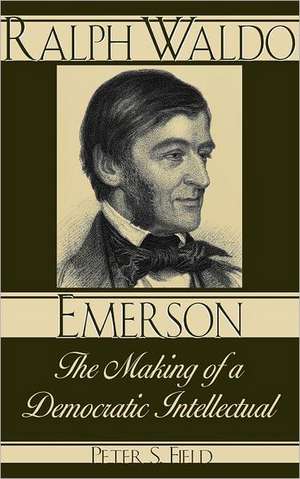
Ralph Waldo Emerson: The Making of a Democratic Intellectual: American Intellectual Culture
Autor Peter S. Fielden Limba Engleză Paperback – 9 oct 2003


Preț: 314.00 lei
Preț vechi: 388.70 lei
-19%
Puncte Express: 471
Carte tipărită la comandă
Livrare economică 30 noiembrie-14 decembrie
Livrare prin curier în România Termenul estimat este afișat lângă disponibilitate.
Transport gratuit de la 400.00 lei Plată online sau ramburs, în funcție de opțiunile comenzii.
Retur gratuit în 14 zile Comandă securizată și suport în română.
Specificații
ISBN-13: 9780847688432
ISBN-10: 0847688437
Pagini: 272
Dimensiuni: 144 x 222 x 15 mm
Greutate: 0.33 kg
Ediția:0272
Editura: Bloomsbury Publishing
Colecția Rowman & Littlefield
Seria American Intellectual Culture
Locul publicării:New York, United States
ISBN-10: 0847688437
Pagini: 272
Dimensiuni: 144 x 222 x 15 mm
Greutate: 0.33 kg
Ediția:0272
Editura: Bloomsbury Publishing
Colecția Rowman & Littlefield
Seria American Intellectual Culture
Locul publicării:New York, United States
V-ar putea interesa
-
 -31%Preț: 597.14 lei864.36 lei
 -
 Democracy Declassified: The Secrecy Dilemma in National SecurityMichael P. Colaresi-20%Preț: 278.61 lei346.32 lei
 -
 -31%Preț: 919.07 lei1333.88 lei
 -
 -31%Preț: 773.24 lei1123.21 lei
 -
 -32%Preț: 531.23 lei781.72 lei
 -
 Democracy and Public Space: The Physical Sites of Democratic PerformanceJohn R. Parkinson-14%Preț: 292.78 lei339.77 lei
 -
 -31%Preț: 742.28 lei1077.22 lei
 -
 On Thinking InstitutionallyHugh Heclo-17%Preț: 208.61 lei251.12 lei
 -
 Encyclopedia of Democratic ThoughtPaul Barry Clarke-15%Preț: 488.07 lei574.19 lei
 -
 The Last VotePhilip CogganPreț: 114.36 lei
 -
 -30%Preț: 967.53 lei1374.30 lei
 -
 The Art of FreedomJuliane RebentischPreț: 170.04 lei
 -
 Preț: 116.69 lei
Cuprins
Chapter 1 Introduction
Chapter 2 From Emerson to Emerson
Chapter 3 "Born to be Educated"
Chapter 4 The Problem of Vocation
Chapter 5 Unitarianism and Its Discontents
Chapter 6 "The Transformation of Genius into Practical Power"
Chapter 7 Abolitionism and the Strange Career of Emerson and Race
Chapter 8 Assessing Emerson as Democratic Intellectual
Chapter 9 Bibliography
Chapter 2 From Emerson to Emerson
Chapter 3 "Born to be Educated"
Chapter 4 The Problem of Vocation
Chapter 5 Unitarianism and Its Discontents
Chapter 6 "The Transformation of Genius into Practical Power"
Chapter 7 Abolitionism and the Strange Career of Emerson and Race
Chapter 8 Assessing Emerson as Democratic Intellectual
Chapter 9 Bibliography
Recenzii
Field's book is a welcome addition to the literature that examines Emerson as a product of his times and explores how, throughout his life, he attempted to situate himself as a spokesman for a particular issue or issues. . . . Field has produced an excellent, suggestive evaluation of the public Emerson-the one who continually refashioned himself as his ideas and venues changed-and a book that deserves to be placed among the best studies of Emerson's intellectual and professional development.
Field stands atop the current reassessment of Ralph Waldo Emerson's public voice with his fresh sense of all the relevant texts and contexts, from origins in the Boston ministry through national politics of the Civil War era. This book makes an admirable case for nineteenth-century America's most influential thinker.
Field does a convincing job of showing the growth of this public thinker, and his volume certainly adds to our understanding of the man and his times.
None of Ralph Waldo Emerson's accomplishments was more important than his reinvention of himself. Peter S. Field persuasively traces Emerson's transformation from Unitarian minister to public intellectual in this able biography of one of the 19th century's most enduring figures.
As a brief for Emerson as a public intellectual, Field's book is valuable and has the virtue of offering readers a focused examination of the ways in which, from the years of his first ministry on, this seminal thinker understood that the age demanded a new kind of cultural critic.
Peter Field's new study of Emerson portrays him in very human and compelling terms, searching for his self, finding his voice and vocation, and becoming America's prototypical 'public intellectual.' Emerson springs to life in its pages, engaged with the challenges facing his age. A wonderful introduction to the Sage of Concord.
A sharply-etched portrait of America's first public intellectual and his search for a vocation.
It is often said-and the claim is supported persuasively in Peter Field's fine study-that Emerson was America's first 'public intellectual.' But Field goes further than that, seeing in Emerson an especially prophetic exponent of the possibilities of democracy itself, a lone voice attributing American intellectuals' famous 'alienation from the crowd' not to the insufficiencies of the American people and the doleful effects of 'democratic leveling' but to the failures of the thinking class itself.
Field stands atop the current reassessment of Ralph Waldo Emerson's public voice with his fresh sense of all the relevant texts and contexts, from origins in the Boston ministry through national politics of the Civil War era. This book makes an admirable case for nineteenth-century America's most influential thinker.
Field does a convincing job of showing the growth of this public thinker, and his volume certainly adds to our understanding of the man and his times.
None of Ralph Waldo Emerson's accomplishments was more important than his reinvention of himself. Peter S. Field persuasively traces Emerson's transformation from Unitarian minister to public intellectual in this able biography of one of the 19th century's most enduring figures.
As a brief for Emerson as a public intellectual, Field's book is valuable and has the virtue of offering readers a focused examination of the ways in which, from the years of his first ministry on, this seminal thinker understood that the age demanded a new kind of cultural critic.
Peter Field's new study of Emerson portrays him in very human and compelling terms, searching for his self, finding his voice and vocation, and becoming America's prototypical 'public intellectual.' Emerson springs to life in its pages, engaged with the challenges facing his age. A wonderful introduction to the Sage of Concord.
A sharply-etched portrait of America's first public intellectual and his search for a vocation.
It is often said-and the claim is supported persuasively in Peter Field's fine study-that Emerson was America's first 'public intellectual.' But Field goes further than that, seeing in Emerson an especially prophetic exponent of the possibilities of democracy itself, a lone voice attributing American intellectuals' famous 'alienation from the crowd' not to the insufficiencies of the American people and the doleful effects of 'democratic leveling' but to the failures of the thinking class itself.