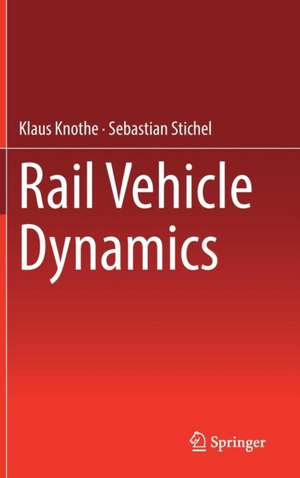
Rail Vehicle Dynamics
Autor Klaus Knothe, Sebastian Stichelen Limba Engleză Hardback – dec 2016
Preț: 1156.63 lei
Preț vechi: 1410.52 lei
-18%
Puncte Express: 1735
Carte tipărită la comandă
Livrare economică 25 decembrie 26 - 08 ianuarie 27
Livrare prin curier în România Termenul estimat este afișat lângă disponibilitate.
Transport gratuit pentru acest produs Plată online sau ramburs, în funcție de opțiunile comenzii.
Retur gratuit în 14 zile Comandă securizată și suport în română.
Specificații
ISBN-13: 9783319453743
ISBN-10: 3319453742
Pagini: 340
Ilustrații: XVI, 321 p. 152 illus.
Dimensiuni: 160 x 241 x 24 mm
Greutate: 0.62 kg
Ediția:1st edition 2017
Editura: Springer
Locul publicării:Cham, Switzerland
ISBN-10: 3319453742
Pagini: 340
Ilustrații: XVI, 321 p. 152 illus.
Dimensiuni: 160 x 241 x 24 mm
Greutate: 0.62 kg
Ediția:1st edition 2017
Editura: Springer
Locul publicării:Cham, Switzerland
V-ar putea interesa
-
 Surface Waves in Anisotropic and Laminated Bodies and Defects DetectionRobert V Goldstein-18%Preț: 1278.50 lei1559.14 lei
-
 -18%Preț: 1279.05 lei1559.82 lei
-
 -18%Preț: 1281.69 lei1563.05 lei
-
 Noise Control ManualDavid A. Harris-15%Preț: 643.76 lei757.36 lei
-
 Mechanical Vibration: Where Do We Stand?Isaac Elishakoff-18%Preț: 999.92 lei1219.41 lei
-
 -15%Preț: 642.91 lei756.37 lei
-
 Dynamics, Bifurcations and ControlFritz Colonius-18%Preț: 919.34 lei1121.14 lei
-
 SchienenfahrzeugdynamikKlaus Knothe-18%Preț: 1432.53 lei1747.00 lei
-
 StrukturdynamikRobert GaschPreț: 497.32 lei
-
 Linearization Methods for Stochastic Dynamic SystemsLeslaw SochaPreț: 385.64 lei
-
 Finite ElementeKlaus Knothe-11%Preț: 609.15 lei684.44 lei
-
 Impact Engineering of Composite StructuresSerge Abrate-18%Preț: 954.50 lei1164.02 lei
-
 Dynamical Inverse Problems: Theory and ApplicationGraham M. L. Gladwell-15%Preț: 616.24 lei724.99 lei
-
 Mechanics and Model-Based Control of Advanced Engineering SystemsAlexander K. Belyaev-15%Preț: 671.79 lei790.34 lei
-
 -15%Preț: 643.25 lei756.75 lei
-
 Active and Passive Vibration Control of StructuresPeter Hagedorn-15%Preț: 673.09 lei791.87 lei
-
 Motion Control in Offshore and DredgingP. Albers-24%Preț: 1087.08 lei1430.37 lei
-
 Analytical Methods in Rotor DynamicsAndrew D. Dimarogonas-15%Preț: 669.16 lei787.26 lei
-
 Preț: 374.91 lei
-
 Preț: 372.67 lei
-
 Preț: 382.85 lei
-
 Preț: 399.10 lei
-
 Vibration and Structural Acoustics AnalysisC. M. A. Vasques-18%Preț: 921.50 lei1123.79 lei
Cuprins
Introduction.- Modeling of vehicle, track and excitation.- Modeling of wheel/rail contact.- Vertical dynamics, equations of motion and free vibrations.- Forced vertical vibrations and frequency domain solution.- Random vibrations.- Human perception of vibrations: ride comfort.- Introduction to lateral dynamics.- Equations of motion for lateral dynamics.- Lateral eigenbehavior of a wheelset.- Lateral eigenbehavior and stability of bogies.- Stability of bogie vehicles.- Non-linear stability investigations.- Quasi-static curving behavior. - Load collectives for vehicle components.- Appendix.
Notă biografică
Professor Klaus Knothe, 1937 in Breslau geboren, studierte von 1956 bis 1963 an den Technischen Hochschulen in München und Darmstadt Bauingenieurwesen und Mathematik. Er war anschließend Assistent und Oberassistent für Mechanik und Konstruktionsberechnung bei Prof. Giencke an der TU Berlin. In der Promotion im Jahr 1967 befasste er sich mit dem Thema "Plattenberechnung nach dem Kraftgrößenverfahren". 1971 Habilitation zum Thema "Vergleichende Darstellung verschiedener Verfahren zur Berechnung der Eigenschwingungen von Rahmentragwerken". Klaus Knothe war anschließend, bis zu seinem Ruhestand, als Professor zunächst in der Fakultät Maschinenbau, später im Fachbereich Verkehrswesen und Angewandte Mechanik an der TU Berlin tätig.
Dipl.-Ing. Heribert Wessels, geb. 1953, studierte von 1975 bis 1983 Bauingenieurswesen an der TU Berlin. Von 1983 bis 1988 war er am Institut für Luft- und Raumfahrt der TU Berlin als wissenschaftlicher Mitarbeiter beschäftigt. Der Arbeitsschwerpunkt lag auf Finite-Elemente-Methoden und Flächentragwerkslehre. Seit 1996 ist er in einer der Automobilindustrie nahestehenden Innovationsgesellschaft im Bereich Computer-Prozess-Simulation mit Schwerpunkt auf die Entwicklung von Tiefziehsimulationen dünner Bleche tätig.
Textul de pe ultima copertă
This book on the dynamics of rail vehicles is developed from the manuscripts for a class with the same name at TU Berlin. It is directed mainly to master students with pre-knowledge in mathematics and mechanics and engineers that want to learn more. The important phenomena of the running behaviour of rail vehicles are derived and explained. Also recent research results and experience from the operation of rail vehicles are included. One focus is the description of the complex wheel-rail contact phenomena that are essential to understand the concept of running stability and curving. A reader should in the end be able to understand the background of simulation tools that are used by the railway industry and universities today.
Caracteristici
Introduction to the topic Backgrounds of the theory behind as general vibration theory are repeated Of interest to students and practitioners Includes supplementary material: sn.pub/extras