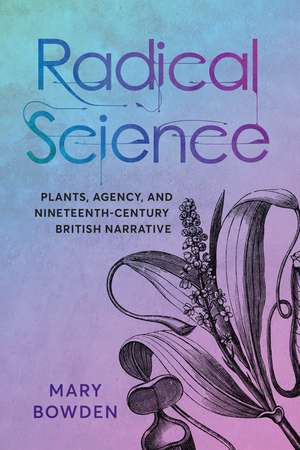
Radical Science: Plants, Agency, and Nineteenth-Century British Narrative
Autor Mary Bowdenen Hardback – 16 mar 2026
Can plants move? Can they think? Can they act? In Radical Science, Mary Bowden shows that debates about plants’ capabilities are not new but can be traced to the nineteenth century, where they moved from scientific inquiries to popular articles and literary fiction. Examining the work of nineteenth-century physiological botanists, Bowden expands beyond Charles Darwin’s work in the field to uncover the full story of these debates and the impacts they had on literature, culture, and people. While many have interpreted the frequent comparisons between plants and people in nineteenth-century literature to be exemplative of aesthetic values or sexual symbolism, Bowden maintains that comparisons between plants and women, members of the working class, and people of color reiterate botanical debates about how to recognize agency in beings that are assumed to be passive. Studying the scientific texts of Darwin and Maria Elizabetha Jacson alongside social problem novels by Elizabeth Gaskell and Charles Kingsley and early science fiction by H. G. Wells, Radical Science foregrounds the connection between science and literature and ultimately suggests that we look to the propositions of nineteenth-century physiological botany to find more sustaining models of social and environmental relationship.
Preț: 445.09 lei
Preț vechi: 549.49 lei
-19% Precomandă
Puncte Express: 668
Preț estimativ în valută:
78.76€ • 92.36$ • 69.17£
78.76€ • 92.36$ • 69.17£
Carte nepublicată încă
Doresc să fiu notificat când acest titlu va fi disponibil:
Se trimite...
Preluare comenzi: 021 569.72.76
Specificații
ISBN-13: 9780814216095
ISBN-10: 0814216099
Pagini: 214
Dimensiuni: 152 x 229 mm
Greutate: 0.45 kg
Editura: Ohio State University Press
Colecția Ohio State University Press
ISBN-10: 0814216099
Pagini: 214
Dimensiuni: 152 x 229 mm
Greutate: 0.45 kg
Editura: Ohio State University Press
Colecția Ohio State University Press
Recenzii
“With confidence and precision, Bowden brings nineteenth-century scientific texts into vibrant focus. Radical Science will appeal to a growing community of scholars whose work explores the ecologies and environments of nineteenth-century British literature, science, and culture, thus speaking to our current climate crisis.” —Lynn Voskuil, author of Nineteenth-Century Energies: Literature, Technology, Culture
“Refreshing in its sophisticated approach to the relationship between literature and science, Radical Science is convincing and original, a deeply engaging and learned study that both specialists in the field as well as more general students of Victorian literature and culture will want to read.” —Amy King, author of The Divine in the Commonplace: Reverent Natural History and the Novel in Britain
Notă biografică
Mary Bowden is Assistant Professor at the University of Delaware. Her articles have appeared in Victorian Literature and Culture,ISLE: Interdisciplinary Studies in Literature and Environment, and Victorian Review.
Extras
In these first decades of the twenty-first century, public interest in plants is surging. Some of this interest is environmentalist, heeding plant species’ keystone significance in an era of ecological crisis. Campaigns to combat climate change, for instance, urge us to halt deforestation and plant more trees, the increased threat of severe storms has inspired wetlands restoration schemes that prominently feature mangroves and marsh grasses, and crashing insect populations have prompted new interest in pollinator-friendly native plants. But while these efforts to affirm plants’ environmental significance are important in this time of environmental precarity, I suggest that much of the current interest in plants actually transcends these ecological imperatives. Rather, many of us seem to be seeking closer connections between the plants that dominate our world—current estimates suggest that plants form at least 80 percent of the Earth’s biomass—and ourselves. In recent years, bestseller and book award lists have been filled with books that, to cite just a few examples, describe the kinship relations of “mother trees,” reveal trees’ “hidden li[ves]” of socialist community, and explicate the mutual interdependence of Native Americans and the plants indigenous to the lands now known as the United States. While fictive explorations of humans’ relationships with plants have also garnered public attention (especially Richard Powers’ Pulitzer-Prize-winning 2018 novel The Overstory), much of this new interest in the commonalities between people and plants, including key sections of Powers’ novel, is grounded in recent scientific work that explores plants’ capacities.
The plant scientist Monica Gagliano’s 2018 memoir Thus Spoke the Plant might be taken as an exemplar text in this twenty-first-century turn to plants. Gagliano argues that “we humans walk through nature not seeing plants as highly evolved creatures, but rather as inanimate, passive, and inferior species. We have constructed a simple vision of plants as lacking in intelligence, agency, or sentience.” Gagliano questions these negative definitions of plants’ abilities and seeks to highlight similarities between plants and animals. She devises experiments that test young chili plants’ ability to communicate with their neighbors and measure Mimosa pudica plants’ capacities for memory and learning. Gagliano argues that her work should prompt a reevaluation of our understanding and ethical orientation toward plants; by revealing plants’ unexpectedly animal- or human-like capabilities, her experiments should convince us to treat plants as “the persons and companions they are.” In a 2013 New Yorker piece, Michael Pollan situates Gagliano’s work, alongside that of scientists Richard Karban, Stefano Mancuso, and Anthony Trewavas, within a new field called plant neurobiology. Its proponents argue that plant neurobiology offers “a radical new paradigm in our understanding of life. . . . wWe must stop regarding plants as passive objects—the mute, immobile furniture of our world—and begin to treat them as protagonists in their own dramas.” Simultaneously pulling from and prompting new public interest in plants, recent scientific works such as Gagliano’s reevaluate both plants’ capabilities and our assumptions that their abilities differ markedly from our own. And while these experiments are grounded in the scientific method, these researchers also often move into the more metaphysical realms of ethics and philosophy when interpreting their results, as exemplified by Gagliano’s insistence on treating plants as “companions.”
The plant scientist Monica Gagliano’s 2018 memoir Thus Spoke the Plant might be taken as an exemplar text in this twenty-first-century turn to plants. Gagliano argues that “we humans walk through nature not seeing plants as highly evolved creatures, but rather as inanimate, passive, and inferior species. We have constructed a simple vision of plants as lacking in intelligence, agency, or sentience.” Gagliano questions these negative definitions of plants’ abilities and seeks to highlight similarities between plants and animals. She devises experiments that test young chili plants’ ability to communicate with their neighbors and measure Mimosa pudica plants’ capacities for memory and learning. Gagliano argues that her work should prompt a reevaluation of our understanding and ethical orientation toward plants; by revealing plants’ unexpectedly animal- or human-like capabilities, her experiments should convince us to treat plants as “the persons and companions they are.” In a 2013 New Yorker piece, Michael Pollan situates Gagliano’s work, alongside that of scientists Richard Karban, Stefano Mancuso, and Anthony Trewavas, within a new field called plant neurobiology. Its proponents argue that plant neurobiology offers “a radical new paradigm in our understanding of life. . . . wWe must stop regarding plants as passive objects—the mute, immobile furniture of our world—and begin to treat them as protagonists in their own dramas.” Simultaneously pulling from and prompting new public interest in plants, recent scientific works such as Gagliano’s reevaluate both plants’ capabilities and our assumptions that their abilities differ markedly from our own. And while these experiments are grounded in the scientific method, these researchers also often move into the more metaphysical realms of ethics and philosophy when interpreting their results, as exemplified by Gagliano’s insistence on treating plants as “companions.”
Cuprins
Contents
Introduction
Chapter 1 Physiological Botany’s Radical Roots
Chapter 2 Plant-People in the Social Problem Novel
Chapter 3 Charles Darwin’s Radicle Science
Chapter 4 H. G. Wells’s Plantocenes
Conclusion Seeing Plants
Acknowledgments
Works Cited
Index
Introduction
Chapter 1 Physiological Botany’s Radical Roots
Chapter 2 Plant-People in the Social Problem Novel
Chapter 3 Charles Darwin’s Radicle Science
Chapter 4 H. G. Wells’s Plantocenes
Conclusion Seeing Plants
Acknowledgments
Works Cited
Index
Descriere
Expands beyond Darwin’s work in physiological botany to examine how nineteenth-century debates about plants’ agency were also applied to people throughout literary and popular discussions of race, gender, and class.