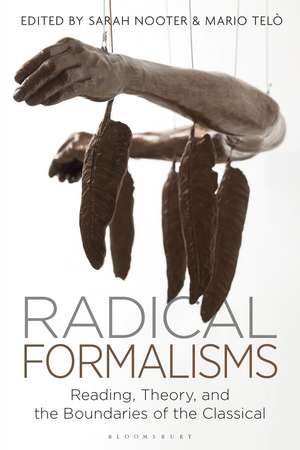
Radical Formalisms: Reading, Theory, and the Boundaries of the Classical
Editat de Sarah Nooter, Professor Mario Telòen Limba Engleză Hardback – 11 ian 2024
This edited volume seeks to draw the reader toward unconventional networks and the connections found in ancient Greek and Roman literature, as well as the poetic traditions developed in the Black Americas.
Subdivided into three parts, the chapters combine studies of poetics in ancient and modern contexts, exploring subversions of the canonical and formal resistances to the hegemony of textual order.
‘Radical formalism’ is the term given to strategies for defamiliarising – revitalizing while disrupting and unsettling – modes of formalistic reading practiced in deconstructionism, microformalism and psychoanalysis.
This collection will not only provide new, provocative insights into a corpus of texts that has exerted a lasting impact on modern literature and philosophy, but will also challenge current interpretive methods, reconceptualizing the very practice of reading and experiencing form, poetics, language, sound, temporalities and textuality.
Preț: 585.15 lei
Preț vechi: 912.53 lei
-36%
Carte tipărită la comandă
Livrare economică 26 noiembrie-10 decembrie
Specificații
ISBN-10: 1350377430
Pagini: 312
Ilustrații: 10 bw illus
Dimensiuni: 164 x 236 x 22 mm
Greutate: 0.62 kg
Editura: Bloomsbury Publishing
Colecția Bloomsbury Academic
Locul publicării:London, United Kingdom
Cuprins
Foreword: A Word Besides, Sarah Nooter (University of Chicago, USA)
Introduction, Mario Telo (University of California, Berkeley, USA)
Part I: Shaping Forms
1. Myth Formalism and Black Expression: The Case of Icarus, Patrice Rankine (University of Chicago, USA)
2. What Was Classics? Shane Butler (John Hopkins University, USA)
3. Mixed Media: Two Black Artists and the Icons of Classical Antiquity, Allannah Karas (University of Miami, USA)
Part II: Proximate Forms
4. Two Ways of Being Alone: Dual Form in Sappho Fragment 168b, Alex Purves (UCLA, USA)
5. Aristophanes and the Flying Sound, Sarah Nooter (University of Chicago, USA)
6. What Thou Art We Know Not: Pindar and Romanticism, Tom Phillips (University of Manchester, UK)
7. "I'm sorry about the poem"; 'Narcissi' and Incommensurability in Jamaica Kincaid's 'Lucy', Ren Ellis Neyra (Wesleyan University, USA)
Part III: Forms (Un)becoming
8. Heraclitus Stuttered, Victoria Wohl (University of Toronto, Canada)
9. Electra, Again, Sarah Olsen (Williams College, USA)
10. A Poetics of Imperceptibility in Statius's 'Thebaid', Efrossini Spentzou (Royal Holloway University, UK)
11. Form as Precarious Shelter: Gwendolyn Brooks' 'In the Mecca', Lucy Alford (Wake Forest University, USA)
Part IV: Forms Unfurling
12. Formalizations at the Threshold: Introductions to Horace, Victoria Rimell (University of Warwick, UK)
13. Quite a Bind: Couplet, Constraint, Claustrophobia, i.e., Ovid's 'Ibis', Tom Geue (Australian National University, Australia
14. Open Form in Nathaniel Mackey, Sean Alexander Gurd (University of Texas, Austin, USA)
15. 'Chal Chal Chal': Apollonius's Talos Tales (and Medea's), Mario Telo (University of California, Berkeley, USA)
Notes
Bibliography
Contributors
Index
Recenzii
A joyous collection by a constellation of star scholars. Mind-expanding, political and systematically committed to the affordances of literary form from the roots: a veritable wake-up call to classical philology.