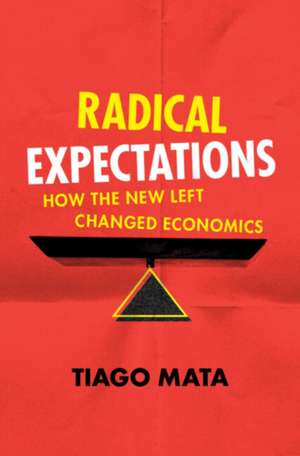
Radical Expectations
Autor Tiago Mataen Limba Engleză Paperback – 27 aug 2026
Preț: 441.55 lei
Nou
Puncte Express: 662
Carte tipărită la comandă
Livrare economică 06-20 noiembrie
Livrare prin curier în România Termenul estimat este afișat lângă disponibilitate.
Transport gratuit pentru acest produs Plată online sau ramburs, în funcție de opțiunile comenzii.
Retur gratuit în 14 zile Comandă securizată și suport în română.
Specificații
ISBN-13: 9781009783064
ISBN-10: 1009783068
Pagini: 346
Dimensiuni: 152 x 229 x 18 mm
Greutate: 0.46 kg
Editura: Cambridge University Press
ISBN-10: 1009783068
Pagini: 346
Dimensiuni: 152 x 229 x 18 mm
Greutate: 0.46 kg
Editura: Cambridge University Press
Notă biografică
Tiago Mata is Professor of Science and Technology Studies at University College London. His research focuses on the history of economics and economic journalism. He has edited The Economist as Public Intellectual (2013) and Economics as News (2023). His work has received awards from the History of Economics Society and Association for Evolutionary Economics.
Cuprins
1. Introduction; 2. In 1968; 3. Radical vocation; 4. Campuses in struggle; 5. A discipline divided; 6. Praising convention; 7. Studies on power; 8. Surviving in academia; 9. Outreach; 10. Activist journalism; 11. Economic democracy; 12. Conclusion.