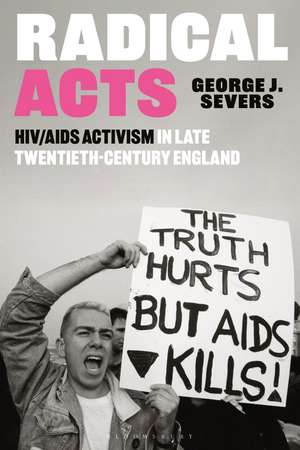
Radical Acts: HIV/AIDS Activism in Late Twentieth-Century England
Autor George Seversen Limba Engleză Hardback – 30 mai 2024
Radical Acts explores expressions of activism that were far more common than demonstrations and marches. Manifestations of a political commitment to ameliorating the injustices facing people living with HIV permeated most aspects of everyday life. These forms of 'everyday activism' played out in workplaces, universities and church halls across England, as well as through networks that stretched across Europe and North America. This book breaks new ground by studying the radical alongside the everyday, presenting a diverse constellation of activist responses to the epidemic.
Preț: 421.67 lei
Preț vechi: 608.31 lei
-31%
Puncte Express: 633
Carte tipărită la comandă
Livrare economică 10-24 noiembrie
Livrare prin curier în România Termenul estimat este afișat lângă disponibilitate.
Transport gratuit pentru acest produs Plată online sau ramburs, în funcție de opțiunile comenzii.
Retur gratuit în 14 zile Comandă securizată și suport în română.
Specificații
ISBN-13: 9781350374539
ISBN-10: 1350374539
Pagini: 224
Dimensiuni: 162 x 236 x 20 mm
Greutate: 0.52 kg
Editura: Bloomsbury Publishing
Colecția Bloomsbury Academic
Locul publicării:London, United Kingdom
ISBN-10: 1350374539
Pagini: 224
Dimensiuni: 162 x 236 x 20 mm
Greutate: 0.52 kg
Editura: Bloomsbury Publishing
Colecția Bloomsbury Academic
Locul publicării:London, United Kingdom
Cuprins
Introduction
1. The Streets
2. Crossing Borders
3. At Work
4. Universities
5. Church
Conclusion
Bibliography
Index
1. The Streets
2. Crossing Borders
3. At Work
4. Universities
5. Church
Conclusion
Bibliography
Index
Recenzii
This highly readable study is convincing due to its successful contextualization and is easily understandable even without in-depth knowledge of English queer and AIDS history. Through a comprehensive presentation of different groups, forms, and modes of action, as well as their specific contexts, Severs succeeds in nuanced the existing image of AIDS activism.
Severs makes a major contribution, expanding our grasp of the varied responses to the AIDS crisis and our understanding of the nature of activism itself.
Providing the first substantial account of HIV/AIDS activism at the height of England's epidemic, George Severs' Radical Acts is a necessary and compelling intervention into twentieth-century historiography.
Radical Acts is a breath-taking analysis of activism against the HIV/AIDS epidemic that blends local, street-level confrontations with everyday acts of engagement and friendship. George Severs explores the diversity of activist movements: conflicts, creativity, silences, and solidarity. This perfectly crafted and surprisingly optimistic book also hints at the future of activism.
With an engaging writing style, Severs combines insightful theorizing with rich detail. Through the wealth of experiences it narrates, and its careful analysis, Radical Acts does not only look back at a complex historical moment but also makes sense of it for our future.
AIDS activism has taken many forms with variable identities and stages. George Severs' book ranges widely and with insight over activist groups from UK ACTUP to Positively Women, from religious groups such as the Sisters of Perpetual Indulgence to the Jewish AIDS Trust. Using oral histories, it draws our attention to quieter activism , to the growth of the 'AIDS sector' and to the continuing international significance of activist links and connections. A valuable addition to the history of HIV/AIDS activism.
George Severs' book is deeply scholarly and wonderfully readable at the same time. It charts the progress of HIV activism here in the UK, its battle with stigma and exclusion, its triumphs and its challenges, its links with queer radicalism, and the continuing need we all have for both. This is an illuminating and essential story.
George Severs sensitively and boldly combines an unusual range of evidence to extend our historiographical understanding of what radical, community and activist has meant in the context of HIV/AIDS in England. He includes more familiar (but contested) accounts of direct action on the streets alongside everyday activism in the workplace, universities and the Church, to more broadly examine the reaches of activism and key actors involved.
Overall, Radical Acts offers an engaging history of several different facets of an 'HIV/AIDS activist constellation'. The book will be particularly useful to historians of sexuality, gender and medicine, but also has much to offer to social and political historians who are interested in rethinking what we mean when we talk about activism.
This monograph is a very welcome development in the study of HIV and AIDS in England. Besides those significant strengths in the conceptual and methodological approach to the subject matter, Severs deploys careful language, which shows the dire conditions that people living with HIV experienced due to the illness and the discrimination they faced, but also conveys stories of resilience.
While every reader will experience and perceive this work differently, I believe no one who comes across this book will remain indifferent to it -and what it conveys, how it embraces the activism in its fullest forms by exploring its complex spectrum and how it shows that 'people with everything to lose create networks to not simply survive but find joy and pleasure'.
Severs makes a major contribution, expanding our grasp of the varied responses to the AIDS crisis and our understanding of the nature of activism itself.
Providing the first substantial account of HIV/AIDS activism at the height of England's epidemic, George Severs' Radical Acts is a necessary and compelling intervention into twentieth-century historiography.
Radical Acts is a breath-taking analysis of activism against the HIV/AIDS epidemic that blends local, street-level confrontations with everyday acts of engagement and friendship. George Severs explores the diversity of activist movements: conflicts, creativity, silences, and solidarity. This perfectly crafted and surprisingly optimistic book also hints at the future of activism.
With an engaging writing style, Severs combines insightful theorizing with rich detail. Through the wealth of experiences it narrates, and its careful analysis, Radical Acts does not only look back at a complex historical moment but also makes sense of it for our future.
AIDS activism has taken many forms with variable identities and stages. George Severs' book ranges widely and with insight over activist groups from UK ACTUP to Positively Women, from religious groups such as the Sisters of Perpetual Indulgence to the Jewish AIDS Trust. Using oral histories, it draws our attention to quieter activism , to the growth of the 'AIDS sector' and to the continuing international significance of activist links and connections. A valuable addition to the history of HIV/AIDS activism.
George Severs' book is deeply scholarly and wonderfully readable at the same time. It charts the progress of HIV activism here in the UK, its battle with stigma and exclusion, its triumphs and its challenges, its links with queer radicalism, and the continuing need we all have for both. This is an illuminating and essential story.
George Severs sensitively and boldly combines an unusual range of evidence to extend our historiographical understanding of what radical, community and activist has meant in the context of HIV/AIDS in England. He includes more familiar (but contested) accounts of direct action on the streets alongside everyday activism in the workplace, universities and the Church, to more broadly examine the reaches of activism and key actors involved.
Overall, Radical Acts offers an engaging history of several different facets of an 'HIV/AIDS activist constellation'. The book will be particularly useful to historians of sexuality, gender and medicine, but also has much to offer to social and political historians who are interested in rethinking what we mean when we talk about activism.
This monograph is a very welcome development in the study of HIV and AIDS in England. Besides those significant strengths in the conceptual and methodological approach to the subject matter, Severs deploys careful language, which shows the dire conditions that people living with HIV experienced due to the illness and the discrimination they faced, but also conveys stories of resilience.
While every reader will experience and perceive this work differently, I believe no one who comes across this book will remain indifferent to it -and what it conveys, how it embraces the activism in its fullest forms by exploring its complex spectrum and how it shows that 'people with everything to lose create networks to not simply survive but find joy and pleasure'.