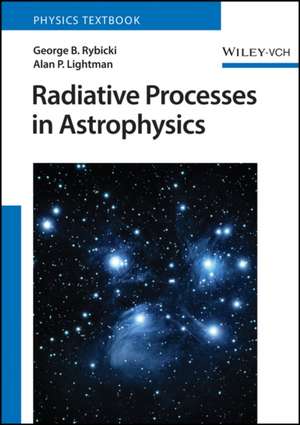
Radiative Processes in Astrophysics
Autor George B. Rybicki, Alan Lightmanen Limba Engleză Paperback – 24 iul 2024
Acest manual de referință, publicat de Wiley-VCH GmbH, reprezintă o resursă fundamentală pentru înțelegerea proceselor fizice care guvernează emisia și transportul energiei în univers. Radiative Processes in Astrophysics este conceput special pentru studenții de la facultățile de fizică și astronomie, oferind o punte riguroasă între fizica teoretică și observațiile astrofizice. Suntem de părere că abordarea autorilor George B. Rybicki și Alan P. Lightman este una exemplară: aceștia nu se mulțumesc să prezinte formule finite, ci derivă fiecare rezultat din principii fundamentale, motivând fizic fiecare pas al argumentației. Structura volumului este echilibrată, acoperind teme esențiale precum teoria transferului radiativ, covarianța relativistă, radiația sincrotron și tranzițiile atomice. Un aspect distinctiv față de alte cursuri universitare este includerea celor 75 de probleme rezolvate, care nu sunt simple exerciții, ci extensii ale textului ce dezvoltă intuiția fizică necesară în cercetarea spațială. Deși textul presupune o bază solidă în electromagnetism și mecanică cuantică, autorii oferă secțiuni de recapitulare care transformă cartea într-un instrument de lucru autonom. Comparabil cu Astrophysics Processes de Hale Bradt în ceea ce privește rigoarea matematică, acest volum se concentrează mai specific pe fenomenologia radiației, fiind mai detaliat în analiza proceselor atomice și a efectelor plasmei. În timp ce alte lucrări pot fi enciclopedice, Radiative Processes in Astrophysics rămâne un text pedagogic clar, esențial pentru pregătirea examenelor de grad și pentru fundamentarea proiectelor de cercetare în astrofizică și cosmologie.
Preț: 815.10 lei
Preț vechi: 895.71 lei
-9%
Carte tipărită la comandă
Livrare economică 03-17 decembrie
Livrare express 29 octombrie-04 noiembrie pentru 58.64 lei
Specificații
ISBN-10: 3527414495
Pagini: 382
Ilustrații: 92 schwarz-weiße Abbildungen
Dimensiuni: 173 x 240 x 21 mm
Greutate: 0.75 kg
Editura: Wiley-VCH GmbH
De ce să citești această carte
Găsim în această carte resursa definitivă pentru stăpânirea proceselor radiative. Este recomandată studenților și cercetătorilor care doresc să înțeleagă mecanismele fizice din spatele datelor observaționale. Prin rezolvarea problemelor incluse, cititorul câștigă abilitatea practică de a calcula spectre și fluxuri radiative, competențe critice în astrofizica modernă.
Descriere
Notă biografică
Cuprins
Chapter 1 Fundamentals of Radiative Transfer
1.1 The Electromagnetic Spectrum; Elementary Properties of Radiation
1.2 Radiative Flux
1.3 The Specific Intensity and Its Moments
1.4 Radiative Transfer
1.5 Thermal Radiation
1.6 The Einstein Coefficients
1.7 Scattering Effects; Random Walks
1.8 Radiative Diffusion
Chapter 2 Basic Theory of Radiation Fields
2.1 Review of Maxwell's Equations
2.2 Plane Electromagnetic Waves
2.3 The Radiation Spectrum
2.4 Polarization and Stokes Parameters 62
2.5 Electromagnetic Potentials
2.6 Applicability of Transfer Theory and the Geometrical Optics Limit
Chapter 3 Radiation from Moving Charges
3.1 Retarded Potentials of Single Moving Charges: The Liénard-Wiechart Potentials
3.2 The Velocity and Radiation Fields
3.3 Radiation from Nonrelativistic Systems of Particles
3.4 Thomson Scattering (Electron Scattering)
3.5 Radiation Reaction
3.6 Radiation from Harmonically Bound Particles
Chapter 4 Relativistic Covariance and Kinematics
4.1 Review of Lorentz Transformations
4.2 Four-Vectors
4.3 Tensor Analysis
4.4 Covariance of Electromagnetic Phenomena
4.5 A Physical Understanding of Field Transformations 129
4.6 Fields of a Uniformly Moving Charge
4.7 Relativistic Mechanics and the Lorentz Four-Force
4.8 Emission from Relativistic Particles
4.9 Invariant Phase Volumes and Specific Intensity
Chapter 5 Bremsstrahlung
5.1 Emission from Single-Speed Electrons
5.2 Thermal Bremsstrahlung Emission
5.3 Thermal Bremsstrahlung (Free-Free) Absorption
5.4 Relativistic Bremsstrahlung
Chapter 6 Synchrotron Radiation
6.1 Total Emitted Power
6.2 Spectrum of Synchrotron Radiation: A Qualitative Discussion
6.3 Spectral Index for Power-Law Electron Distribution
6.4 Spectrum and Polarization of Synchrotron Radiation: A Detailed Discussion
6.5 Polarization of Synchrotron Radiation
6.6 Transition from Cyclotron to Synchrotron Emission
6.7 Distinction between Received and Emitted Power
6.8 Synchrotron Self-Absorption
6.9 The Impossibility of a Synchrotron Maser in Vacuum
Chapter 7 Compton Scattering
7.1 Cross Section and Energy Transfer for the Fundamental Process
7.2 Inverse Compton Power for Single Scattering
7.3 Inverse Compton Spectra for Single Scattering
7.4 Energy Transfer for Repeated Scatterings in a Finite, Thermal Medium: The Compton Y Parameter
7.5 Inverse Compton Spectra and Power for Repeated Scatterings by Relativistic Electrons of Small Optical Depth
7.6 Repeated Scatterings by Nonrelativistic Electrons: The Kompaneets Equation
7.7 Spectral Regimes for Repeated Scattering by Nonrelativistic Electrons
Chapter 8 Plasma Effects
8.1 Dispersion in Cold, Isotropic Plasma
8.2 Propagation Along a Magnetic Field; Faraday Rotation
8.3 Plasma Effects in High-Energy Emission Processes
Chapter 9 Atomic Structure
9.1 A Review of the Schrödinger Equation
9.2 One Electron in a Central Field
9.3 Many-Electron Systems
9.4 Perturbations, Level Splittings, and Term Diagrams
9.5 Thermal Distribution of Energy Levels and Ionization
Chapter 10 Radiative Transitions
10.1 Semi-Classical Theory of Radiative Transitions
10.2 The Dipole Approximation
10.3 Einstein Coefficients and Oscillator Strengths
10.4 Selection Rules
10.5 Transition Rates
10.6 Line Broadening Mechanisms
Chapter 11 Molecular Structure
11.1 The Born-Oppenheimer Approximation: An Order of Magnitude Estimate of Energy Levels
11.2 Electronic Binding of Nuclei
11.3 Pure Rotation Spectra
11.4 Rotation-Vibration Spectra
11.5 Electronic-Rotational-Vibrational Spectra
Solutions
Index