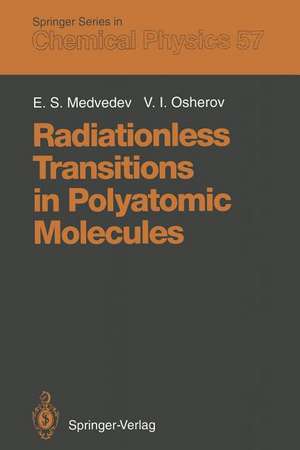
Radiationless Transitions in Polyatomic Molecules: Springer Series in Chemical Physics, cartea 57
Autor Emile S. Medvedev, Vladimir I. Osheroven Limba Engleză Paperback – 11 ian 2012
Din seria Springer Series in Chemical Physics
- 18%
 Preț: 916.03 lei
 - 15%
 Preț: 628.78 lei
 - 15%
 Preț: 641.76 lei
 - 15%
 Preț: 677.28 lei
 - 18%
 Preț: 958.57 lei
 - 15%
 Preț: 639.42 lei
 - 15%
 Preț: 666.56 lei
 - 18%
 Preț: 863.49 lei
 - 15%
 Preț: 662.81 lei
 - 15%
 Preț: 670.25 lei
 - 18%
 Preț: 1296.05 lei
 - 15%
 Preț: 667.41 lei
 - 15%
 Preț: 650.00 lei
 - 18%
 Preț: 988.65 lei
 - 27%
 Preț: 1267.85 lei
 - 18%
 Preț: 641.82 lei
 - 18%
 Preț: 997.15 lei
 - 18%
 Preț: 1151.15 lei
 - 24%
 Preț: 734.17 lei
 - 18%
 Preț: 981.92 lei
 - 18%
 Preț: 854.02 lei
 - 15%
 Preț: 670.48 lei
 - 18%
 Preț: 941.50 lei
 - 15%
 Preț: 619.84 lei
 - 15%
 Preț: 566.02 lei
 - 15%
 Preț: 662.13 lei
 - 18%
 Preț: 860.17 lei
 - 18%
 Preț: 909.13 lei
 - 18%
 Preț: 960.61 lei
 -
 Preț: 376.47 lei
 - 15%
 Preț: 624.06 lei
 -
 Preț: 369.93 lei
Preț: 649.05 lei
Preț vechi: 763.59 lei
-15%
Puncte Express: 974
Carte tipărită la comandă
Livrare economică 27 noiembrie-11 decembrie
Livrare prin curier în România Termenul estimat este afișat lângă disponibilitate.
Transport gratuit pentru acest produs Plată online sau ramburs, în funcție de opțiunile comenzii.
Retur gratuit în 14 zile Comandă securizată și suport în română.
Specificații
ISBN-13: 9783642851117
ISBN-10: 3642851118
Pagini: 388
Ilustrații: X, 374 p.
Dimensiuni: 155 x 235 x 21 mm
Greutate: 0.59 kg
Ediția:Softcover reprint of the original 1st edition 1995
Editura: Springer
Colecția Springer Series in Chemical Physics
Seria Springer Series in Chemical Physics
Locul publicării:Berlin, Heidelberg, Germany
ISBN-10: 3642851118
Pagini: 388
Ilustrații: X, 374 p.
Dimensiuni: 155 x 235 x 21 mm
Greutate: 0.59 kg
Ediția:Softcover reprint of the original 1st edition 1995
Editura: Springer
Colecția Springer Series in Chemical Physics
Seria Springer Series in Chemical Physics
Locul publicării:Berlin, Heidelberg, Germany
V-ar putea interesa
-
 Dreams Of A Final TheorySteven WeinbergPreț: 115.08 lei
 -
 Elementary Atomic StructureG. K. Woodgate-29%Preț: 410.61 lei574.51 lei
 -
 Molecular BeamsNorman Ramsey-31%Preț: 574.64 lei829.00 lei
 -
 -21%Preț: 391.64 lei498.28 lei
 -
 -21%Preț: 364.97 lei461.42 lei
 -
 -22%Preț: 474.68 lei611.28 lei
 -
 -28%Preț: 516.21 lei717.85 lei
 -
 Nuclear Physics - Principles & ApplicationsJohn LilleyPreț: 400.16 lei
 -
 Introduction to High Energy PhysicsDonald H. Perkins-23%Preț: 739.48 lei960.36 lei
 -
 The Road to RealityRoger PenrosePreț: 199.59 lei
 -
 A Walk through the Southern SkyMilton HeifetzPreț: 286.48 lei
 -
 -15%Preț: 680.10 lei800.11 lei
 -
 Introducing Particle PhysicsTom WhyntiePreț: 63.96 lei
 -
 Quantum PhysicsAlistair I M RaePreț: 65.69 lei
 -
 INTR TO BLACK HOLES, INFORMATION & THE..Susskind LeonardPreț: 132.15 lei
Public țintă
ResearchCuprins
1. Introduction.- 2. Qualitative Theory of Radiationless Transitions.- 2.1 Balance Equation.- 2.2 Experimental Observations and Empirical Rules.- 2.3 Molecular Energy Level Model.- 2.4 Physical Nature of Radiationless Transitions.- 2.5 General Description of Luminescence Kinetics: Intermediate Case and Statistical Limit.- 2.6 Strong-Coupling Limit.- 2.7 Weak-Coupling Limit.- 2.8 Time-Dependent Perturbation Theory.- 2.9 Comparison of Various Expressions for the Transition Rate.- 2.10 Characterization of the Final States of an Isolated Molecule.- 2.11 Small, Large and Intermediate Molecules.- 3. Luminescence Intensity as a Function of Time and the Radiationless Transition Rate.- 3.1 Formulation of the Problem.- 3.2 Laplace Transformation, Green’s Functions and Resonant States.- 3.3 Computation of the Green’s Functions.- 3.4 Evolution of the Initial State and the Luminescence Intensity.- 3.5 Resonant States.- 3.6 Method of Projection Operators.- 4. Matrix Elements of Intramolecular Interactions.- 4.1 Adiabatic Approximation.- 4.2 Accuracy of the Adiabatic Approximation.- 4.3 Crude Adiabatic Approximation.- 4.4 Coupling Operators.- 4.5 Condon Approximation.- 4.6 Model of Noninteracting Oscillators.- 4.7 Mechanisms and Selection Rules for Radiationless Transitions.- 4.8 Overlap Integrals for Harmonic and Morse Oscillators.- 5. Quasiclassical Methods.- 5.1 Introductory Remarks.- 5.2 Overlap Integral for a Harmonic Oscillator.- 5.3 Overlap Integral for an Anharmonic Oscillator.- 5.4 Franck-Condon Principle for Radiationless Transitions.- 5.5 Transitions Between Parallel Terms.- 5.6 Overtone Vibrational Transitions.- 5.7 Collision Model.- 5.8 Two-State Vibronic Levels.- 6. The Statistical Limit.- 6.1 Accepting Modes, Effective States and the Transition Rate.- 6.2Generating-Function Method.- 6.3 Saddle-Point Method.- 6.4 Single Vibronic Level (SVL) Transition-Rate Dependence upon Initial Vibrational Energy.- 6.5 Transition Rate from Statistically Equilibrated Initial States.- 6.6 Summation of the Franck-Condon Factors.- 6.7 Inductive-Resonant-Transfer Mechanism.- 7. The Intermediate Case.- 7.1 Physical Effects.- 7.2 Correlation-Function Method.- 7.3 Kinetic Model.- 8. Conclusion.- Appendix. Commutation Rules for Angular Momentum in the Laboratory and Molecular Frame.- References.