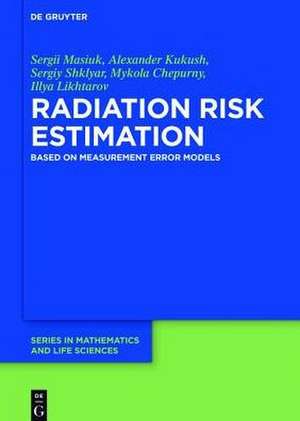
Radiation Risk Estimation: Based on Measurement Error Models: De Gruyter Series in Mathematics and Life Sciences, cartea 5
Autor Sergii Masiuk, Alexander Kukush, Sergiy Shklyar, Mykola Chepurny, Illya Likhtaroven Limba Engleză Hardback – 14 iul 2016
Contents:
Part I - Estimation in regression models with errors in covariates Measurement error models Linear models with classical error Polynomial regression with known variance of classical error Nonlinear and generalized linear models
Part II Radiation risk estimation under uncertainty in exposure doses Overview of risk models realized in program package EPICURE Estimation of radiation risk under classical or Berkson multiplicative error in exposure doses Radiation risk estimation for persons exposed by radioiodine as a result of the Chornobyl accident Elements of estimating equations theory Consistency of efficient methods Efficient SIMEX method as a combination of the SIMEX method and the corrected score method Application of regression calibration in the model with additive error in exposure doses

Preț: 981.70 lei
Preț vechi: 1274.92 lei
-23%
Carte tipărită la comandă
Livrare economică 23 noiembrie-07 decembrie
Specificații
ISBN-10: 3110441802
Pagini: 288
Ilustrații: 13 schw.-w. u. 1 farb. Abb., 7 schw.-w. Tab.
Dimensiuni: 170 x 240 mm
Greutate: 0.59 kg
Editura: De Gruyter
Colecția De Gruyter
Seria De Gruyter Series in Mathematics and Life Sciences
Locul publicării:Berlin/Boston
V-ar putea interesa
-
 Stochastic Processes and ModelsDavid Stirzaker-28%Preț: 428.96 lei598.33 lei
 -
 Preț: 211.16 lei
 -
 -11%Preț: 645.38 lei725.14 lei
 -
 -15%Preț: 522.29 lei614.46 lei
 -
 Introduction to Statistical Mediation AnalysisDavid MacKinnon-15%Preț: 476.50 lei560.59 lei
 -
 -18%Preț: 796.24 lei971.02 lei
 -
 -20%Preț: 751.63 lei939.53 lei
 -
 Applied Nonparametric Statistical MethodsPeter Sprent-18%Preț: 800.23 lei975.89 lei
 -
 Handbook of Statistical Analyses Using StataBrian S. Everitt-15%Preț: 656.48 lei772.33 lei
Notă biografică
Descriere
The De Gruyter Series in Mathematics and Life Sciences is devoted to the publication of monographs in the field. They cover topics and methods in fields of current interest that use mathematical approaches to understand and explain, model and influence phenomena in all areas of life sciences. This includes, among others, theory and application of biological mathematical modeling, complex systems biology, bioinformatics, computational biomodeling stochastic modeling, biostatistics, computational evolutionary biology, comparative genomics, or structural bioinformatics. Also, new types of mathematical problems shall be covered that arise from biological knowledge.
The main objectives is to make such expositions available to and accessible by an interdisciplinary, growing readership hailing from all disciplines involved. The volumes shall convey the context of the given topic and enable these readers to understand, apply and develop further mathematical methods to given problems in biology. For this reason, works with up to four authors are preferred over edited volumes.
Therefore, contributions which are on the borderline of mathematics and life sciences and which stimulate further research at the crossroads of these areas are particularly welcome. In addition, use of electronic media to demonstrate, visualize and model the methods presented are very welcome, especially when interwoven with the written text.