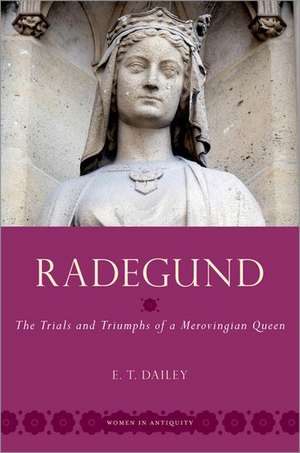
Radegund: The Trials and Triumphs of a Merovingian Queen: WOMEN IN ANTIQUITY
Autor E. T. Daileyen Limba Engleză Paperback – 23 noi 2023
Bazându-ne pe o vastă bibliografie de specialitate în limbile engleză, franceză și germană, descoperim în volumul Radegund o reinterpretare riguroasă a vieții uneia dintre cele mai influente figuri feminine din perioada medievală timpurie. E. T. Dailey analizează parcursul excepțional al unei prințese turingiene devenite captivă de război, forțată să se căsătorească cu regele franc care îi masacrase familia, pentru ca ulterior să renunțe la coroană în favoarea vieții monahale. Autorul documentează minuțios modul în care Radegund a reușit să navigheze într-o lume marcată de violență și schimbări politice radicale, obținând o poziție de autoritate morală fără a recurge la intrigile sângeroase tipice elitei vremii.
Textul este structurat pentru a servi atât specialiștilor, cât și cititorilor pasionați de istorie, fiind îmbogățit cu 12 figuri și 2 hărți care ajută la cartografierea contextului geografic al Galiei din secolul al VI-lea. Analiza se concentrează pe rolul ei de lider religios la mănăstirea Sfânta Cruce din Poitiers și pe eforturile de a securiza relicve sacre, elemente care au definit modelul de sfințenie regală pentru generațiile următoare. Comparabil cu Sainted Women of the Dark Ages de Jo Ann McNamara în ceea ce privește rigoarea hagiografică, volumul lui E. T. Dailey se distinge prin focalizarea exclusivă pe mecanismele de putere și supraviețuire specifice lui Radegund, oferind o perspectivă mai actualizată asupra autonomiei feminine în dinastia Merovingiană. Apreciem în mod deosebit modul în care autorul echilibrează dimensiunea politică a reginei cu cea ascetică a sfântei, oferind un portret coerent al unei femei care a definit standardele monahismului feminin european.
Preț: 144.92 lei
Preț vechi: 172.36 lei
-16%
Carte disponibilă
Livrare economică 29 octombrie-04 noiembrie
Livrare express 13-17 octombrie pentru 52.24 lei
Specificații
ISBN-10: 0197699200
Pagini: 228
Ilustrații: 12 b/w figures, 2 maps
Dimensiuni: 236 x 156 x 14 mm
Greutate: 0.35 kg
Editura: Oxford University Press
Colecția OUP USA
Seria WOMEN IN ANTIQUITY
Locul publicării:New York, United States
De ce să citești această carte
Această monografie este esențială pentru cei interesați de istoria medievală timpurie și de studiile de gen. Cititorul câștigă o înțelegere profundă a modului în care o femeie putea exercita puterea într-o societate patriarhală violentă. Este un studiu de caz fascinant despre reziliență și diplomație, oferind un portret autoritar al sfintei care a influențat curțile regale europene timp de secole.
Despre autor
E. T. Dailey este un istoric specializat în perioada antichității târzii și a evului mediu timpuriu, cu un interes academic marcat pentru dinastia Merovingiană și rolul femeilor în structurile de putere ale Galiei. Publicat de Oxford University Press, Dailey a mai semnat lucrări de referință precum Queens, Consorts, Concubines, unde a explorat reprezentările autorității feminine la Grigore de Tours. Experiența sa în analizarea surselor primare latine și a istoriografiei europene moderne îi permite să ofere perspective noi asupra modului în care identitatea și sfințenia au fost construite în secolele VI-VII, transformând figuri mitologizate în subiecte de analiză istorică validă.
Descriere
Recenzii
E.T. Dailey has produced a sparkling new biography of Radegund. He does so by a meticulous reading of the sources, and by reminding the reader of her cultural context, steeped as it was in the Bible. As a result, the royal saint appears freshly minted, as does her community of the Holy Cross, and those around her, even the leading members of the Merovingian family.
This is a highly readable biography of Radegund's life and achievements as queen, consecrated woman and leader in Merovingian society. It not only will find a wide audience among early medievalists and those interested in the development both of queenship and of female monasticism, including students, but also serves as a text that will appeal to a broader readership, interested in a well-told tale of a woman who made her mark without, as Dailey reminds us, resorting to the violence that was so often a political tool of her contemporaries... His prose is lively, and even - a rarity in academic books - at times beautiful in its descriptions.
His book is mostly well researched and based upon a thorough awareness not only of the sixth- and seventh-century accounts, but also of modern scholarship in several languages. It is clearly and engagingly written.
It is a balanced mix of a scholarly approach to the topic and an easy-to-read presentation. A great advantage of the book is that the author wrote his biography very close to the sources. Quotations from early medieval texts are repeatedly presented, and then carefully contextualized and explained. The book also contains new thoughts and theses that will have a stimulating effect on future research. At the same time, it is written in such a way that it can be easily understood by non-specialist readers. The maps, illustrations of objects, and building floor plans further contribute to making the text accessible to a wider audience. Experts, students, and laypeople can therefore read the book with benefit. Anyone wishing to learn more about Radegund in the future will have to read Erin Thomas Dailey's biography.
Overall, the book is a fine synthesis that makes the most of both textual and archaeological data [...]. It should quickly become a must-read for anyone seeking to understand the work of women in the early Middle Ages.
Dailey's reflections on the reasons for the convent's difficulties shortly after the queen's death are essentially comprehensive: Sainte-Croix was the founding of a very special Merovingianqueen who was in the end irreplaceable.
Notă biografică
Cuprins
- Map 1: Gaul in the Sixth Century
- Map 2: Poitiers in the Time of Radegund
- List of Figures
- Acknowledgements
- Introduction
- Chapter 1. And the Lots Were Cast
- Chapter 2. A Temple Consumed by Fire
- Chapter 3. What Can Man Do Unto Me?
- Chapter 4. They Will Be as Bears and Wolves
- Chapter 5. The Lord Knows His Own
- Chapter 6. Veil of Veils, Holy of Holies
- Chapter 7. Like Eve Driven from Paradise
- Chapter 8. Amen
- Appendix 1: Radegund's Letter Dominis sanctis
- Appendix 2: Family Tree of Select Merovingians
- Bibliography
- Index