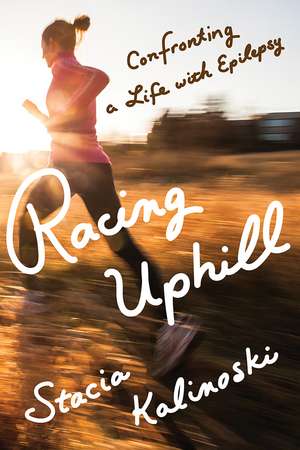
Racing Uphill: Confronting a Life with Epilepsy
Autor Stacia Kalinoskien Limba Engleză Paperback – iul 2025
When twenty-nine-year-old reporter Stacia Kalinoski regained consciousness on a couch at the TV station where she worked, she assumed that she’d had another seizure. But the electrical storm that had just torn through her brain was more destructive than she could have imagined, and the broadcast journalism career she loved swiftly came to an end. Forced to confront the reality of her medical condition, Kalinoski made the risky decision to undergo brain surgery, targeting the epilepsy that was ravaging her life.
In Racing Uphill, Kalinoski describes the seizures that occurred while she was running, which led to her pursuit of an uncertain cure. Rallying the grit she developed as an athlete and engaging the research and reporting skills she acquired as a journalist, she gives us a rare inside look at the ways epilepsy can change a life. Moving beyond her own personal experience, Kalinoski interviews prominent epileptologists to understand how seizures can spread, steal memories, and create strange behaviors and mood disorders. She seamlessly joins what she learned from her research with her own story, offering valuable insight into the experience of grappling with a relentless neurological disease.
The vivid auras that preceded seizures and the damage that followed; the toll of her epilepsy on her family and loved ones; the extraordinary determination her reckoning required—these are all part of Kalinoski’s story of adversity, denial, acceptance, and resilience. In sharing the remarkable opportunity that epilepsy presented for her courage and growth, Stacia Kalinoski speaks to anyone facing an uphill battle and offers inspiration for taking control of one’s own health.
Preț: 108.11 lei
Puncte Express: 162
Carte disponibilă
Livrare economică 20 octombrie-03 noiembrie
Livrare express 06-10 octombrie pentru 54.09 lei
Livrare prin curier în România Termenul estimat este afișat lângă disponibilitate.
Transport gratuit de la 400.00 lei Plată online sau ramburs, în funcție de opțiunile comenzii.
Retur gratuit în 14 zile Comandă securizată și suport în română.
Specificații
ISBN-13: 9781517917463
ISBN-10: 1517917468
Pagini: 232
Ilustrații: 8 black and white illustrations
Dimensiuni: 140 x 210 x 23 mm
Greutate: 0.29 kg
Editura: University of Minnesota Press
Colecția Univ Of Minnesota Press
ISBN-10: 1517917468
Pagini: 232
Ilustrații: 8 black and white illustrations
Dimensiuni: 140 x 210 x 23 mm
Greutate: 0.29 kg
Editura: University of Minnesota Press
Colecția Univ Of Minnesota Press
V-ar putea interesa
-
 That's a Great Question, I'd Love to Tell YouElyse MyersPreț: 143.37 lei
 -
 Brain On Fire: My Month of MadnessSusannah Cahalan-31%Preț: 62.72 lei91.31 lei
 -
 EpilepticDavid B-24%Preț: 144.70 lei189.71 lei
 -
 My Stroke of InsightJill Bolte Taylor-28%Preț: 55.39 lei76.78 lei
 -
 -26%Preț: 90.08 lei121.78 lei
 -
 SanctuaryEmily Rapp BlackPreț: 151.27 lei
 -
 MigraineSamuel Fisher-28%Preț: 86.55 lei119.45 lei
 -
 Identity Theft, Second Edition: Rediscovering Ourselves After StrokeDebra E. Meyerson-16%Preț: 97.65 lei116.81 leiRecomandat
 -
 -10%Preț: 124.45 lei138.55 lei
 -
 Stories From a Stranger: Every person has a story.Hunter Prosper-22%Preț: 152.82 lei195.62 leiRecomandat
 -
 Told You SoMayci Neeley-19%Preț: 115.53 lei142.69 leiRecomandat
 -
 My Life with EpilepsyMari Schuh-12%Preț: 52.24 lei59.44 lei
 -
 -19%Preț: 98.69 lei121.86 lei
 -
 To Exist As I Am: Longlisted for the Women's Prize for Non-Fiction 2026Grace Spence Green-23%Preț: 92.32 lei120.65 lei
 -
 -23%Preț: 109.15 lei141.54 leiRecomandat
 -
 Brushes with a StrokeNeil HarmanPreț: 105.68 lei
 -
 BrainjackingBrian Clegg-5%Preț: 135.56 lei142.70 lei
 -
 -18%Preț: 76.82 lei93.41 lei
 -
 -22%Preț: 91.11 lei116.43 lei
 -
 Epilepsy - Understanding and Managing the Condition Across the LifespanCharbel El Kosseifi-5%Preț: 371.08 lei390.62 lei
Notă biografică
Stacia Kalinoski is an Emmy Award–winning TV news journalist whose documentary Brainstorm premiered on Twin Cities PBS and was nominated for a regional Emmy Award. Before a seizure ended her broadcast journalism career, she reported for television stations in Nebraska, Oregon, and Michigan. She now shares her story as a motivational speaker.
Extras
Prologue
The earthy scent of soil and fresh rain filled my lungs as I powered on my watch, jogged up a short hill in my quiet Eugene neighborhood, and ran the mile-long stretch to jump onto the Amazon Trail. The name was fitting—rain kept the bark chips densely packed and the trees a bright, almost neon green this time of year, making spring perfect for marathon training in Oregon.
The 2011 Eugene Marathon was in May—just one month away—and I was in the best shape of my life, chasing a 2:50 marathon. A year earlier I had reached my goal of breaking 3:00 in Seattle, so now the plan was to chip away and eventually hit 2:43, the qualifying marker for the Olympic trials. I was nowhere near the caliber of Olympic athletes, but I’d have the chance to race with the best women in America if I progressed slowly and didn’t get injured. For me, it was all about the chase, to find out how fast I could really run.
A soft mist started to fall as I finished my warm-up and geared up for my first 800-meter interval. Wiping the fog from my watch, I took a deep breath, hit the start button, and took off, my shoes kicking up mulch. The first interval felt good. I wish I could say the same about the next, but as my feet pounded the trail, the vivid green leaves of the trees started to blur slowly. I squeezed my eyes shut a few times in confusion, then in fear, as I glanced left and right. The familiar scenery ahead began to fade, like I was running into a cloud turning from white to gray. My pace slowed to a jog. The loop I ran almost daily suddenly looked foreign, as if I had turned a corner into a totally different city. The lefts and rights my feet normally took without even thinking were now dirt paths to nowhere. Trees that had once provided a scenic, comforting buffer from the streets were now barriers as I slowed down and tried to look beyond the mulch for any sense of direction toward home.
A few minutes later, I found myself standing on wet mulch, gazing at my surroundings. I was lost, confused, soaked, and nervous.
“Where am I?” I whispered aloud.
The trees stood silent.
The frightening experience slowly passed, but my confusion lingered. Anger started to build. Anger at my brain for failing me again. For failing me while I was doing something I loved. With no clue where to turn, I sat down on the trail and hoped my inner compass would somehow renavigate me. But my heart rate had yet to slow down, and as the emotions bubbled up, salty tears mixed with rain fell down my cheeks.
“Hey there, are you alright?”
A young couple in rain boots and umbrellas looked down at me, their eyes wide with concern. Wiping away my tears, I was equal parts embarrassed and grateful to see them.
“Hi, um, yes, I’m kind of lost,” I replied, my voice shaky. “I was running and now I have no clue what part of the trail this is.”
They asked for my address, and if they were surprised by my answer, they didn’t show it. I was just two blocks from home.
They were nice enough to walk me to my door.
Before this run, I could always come up with an excuse to keep training and downplay the seriousness of my epilepsy. Over the last year, seizures had gradually started taking control of my life, but they hadn’t directly interfered with the one thing that eased the stress of epilepsy—running—until now. Burning my shoulder on a hot iron, falling into a brick wall, breaking a tooth, and acquiring multiple black eyes were the ugly aftermath of a storm of neurons misfiring in my brain. But by the time those injuries had occurred, I had already lost consciousness.
That day on the trail was different. I had to physically, mentally, and emotionally endure a seizure that interrupted not only a challenging workout but also my sense of place and time, and it scared me.
The first part of the seizure that I consciously experienced is called an aura—a sensation of something to come; it’s usually a warning that a larger seizure is on the way. Auras come in many forms, and this particular one is called “jamais vu,” which means an unfamiliar feeling with something that’s usually very familiar—like my running trail. On that day, the larger seizure struck when I lost awareness.
The aura from that day is ingrained in my memory. Most aren’t though, and that’s partly due to where in the brain my seizures were firing from. I struggle to recall other devastating seizures, only learning about them later from family, friends, and coworkers—or from lingering scars and bruises. If the seizures themselves weren’t bad enough, having my memory escape me slowly and unwittingly began to take its toll. Leafing through the multiple scrapbooks I’ve created will evoke a range of emotions—from tears, to laughter, to surprise—but above all, I feel complete shock that the smile lighting up my eyes in photos with loved ones is a memory that has since escaped me forever.
As I gathered around a campfire recently with my siblings and parents, we opened up a game with some contemplative thought starters.
“Would you rather remember everything, bad or good? Or remember nothing?”
If only it was simple enough to be given a choice.
Gazing into the flames reminded me of all the firestorms that had ripped across my brain over the course of six years. Seizures had left behind bits and pieces, but the memories were often so fragmented that things fell out of context, and sometimes turned to ash.
Epilepsy can affect all types of memory. I struggle mostly with recalling events. For this book, I have relied heavily on close friends, family, medical records, and emails to fill in the blanks. Seizures have stolen many memories, both good and bad, from all points of my life. They have stormed through my highlight reels and my lowest moments, erasing some of the lessons that came with them. I’m often amazed when I think about how a brain so powerful—a conductor that directs every second of every movement, thought, and emotion—can also be so vulnerable when a storm passes through. The aftermath of those storms? Me, holding a scrapbook in my hands and struggling to recognize the girl in the photos.
While many experiences that shaped me have faded with each seizure, there’s still so much I do recall. And when one particularly devastating seizure tore through my brain and upended my career, I was forced to dig deeper into my remaining memories—and the grit I developed as an athlete—to pick myself up and find the strength to take the biggest opportunity of my life.
The earthy scent of soil and fresh rain filled my lungs as I powered on my watch, jogged up a short hill in my quiet Eugene neighborhood, and ran the mile-long stretch to jump onto the Amazon Trail. The name was fitting—rain kept the bark chips densely packed and the trees a bright, almost neon green this time of year, making spring perfect for marathon training in Oregon.
The 2011 Eugene Marathon was in May—just one month away—and I was in the best shape of my life, chasing a 2:50 marathon. A year earlier I had reached my goal of breaking 3:00 in Seattle, so now the plan was to chip away and eventually hit 2:43, the qualifying marker for the Olympic trials. I was nowhere near the caliber of Olympic athletes, but I’d have the chance to race with the best women in America if I progressed slowly and didn’t get injured. For me, it was all about the chase, to find out how fast I could really run.
A soft mist started to fall as I finished my warm-up and geared up for my first 800-meter interval. Wiping the fog from my watch, I took a deep breath, hit the start button, and took off, my shoes kicking up mulch. The first interval felt good. I wish I could say the same about the next, but as my feet pounded the trail, the vivid green leaves of the trees started to blur slowly. I squeezed my eyes shut a few times in confusion, then in fear, as I glanced left and right. The familiar scenery ahead began to fade, like I was running into a cloud turning from white to gray. My pace slowed to a jog. The loop I ran almost daily suddenly looked foreign, as if I had turned a corner into a totally different city. The lefts and rights my feet normally took without even thinking were now dirt paths to nowhere. Trees that had once provided a scenic, comforting buffer from the streets were now barriers as I slowed down and tried to look beyond the mulch for any sense of direction toward home.
A few minutes later, I found myself standing on wet mulch, gazing at my surroundings. I was lost, confused, soaked, and nervous.
“Where am I?” I whispered aloud.
The trees stood silent.
The frightening experience slowly passed, but my confusion lingered. Anger started to build. Anger at my brain for failing me again. For failing me while I was doing something I loved. With no clue where to turn, I sat down on the trail and hoped my inner compass would somehow renavigate me. But my heart rate had yet to slow down, and as the emotions bubbled up, salty tears mixed with rain fell down my cheeks.
“Hey there, are you alright?”
A young couple in rain boots and umbrellas looked down at me, their eyes wide with concern. Wiping away my tears, I was equal parts embarrassed and grateful to see them.
“Hi, um, yes, I’m kind of lost,” I replied, my voice shaky. “I was running and now I have no clue what part of the trail this is.”
They asked for my address, and if they were surprised by my answer, they didn’t show it. I was just two blocks from home.
They were nice enough to walk me to my door.
Before this run, I could always come up with an excuse to keep training and downplay the seriousness of my epilepsy. Over the last year, seizures had gradually started taking control of my life, but they hadn’t directly interfered with the one thing that eased the stress of epilepsy—running—until now. Burning my shoulder on a hot iron, falling into a brick wall, breaking a tooth, and acquiring multiple black eyes were the ugly aftermath of a storm of neurons misfiring in my brain. But by the time those injuries had occurred, I had already lost consciousness.
That day on the trail was different. I had to physically, mentally, and emotionally endure a seizure that interrupted not only a challenging workout but also my sense of place and time, and it scared me.
The first part of the seizure that I consciously experienced is called an aura—a sensation of something to come; it’s usually a warning that a larger seizure is on the way. Auras come in many forms, and this particular one is called “jamais vu,” which means an unfamiliar feeling with something that’s usually very familiar—like my running trail. On that day, the larger seizure struck when I lost awareness.
The aura from that day is ingrained in my memory. Most aren’t though, and that’s partly due to where in the brain my seizures were firing from. I struggle to recall other devastating seizures, only learning about them later from family, friends, and coworkers—or from lingering scars and bruises. If the seizures themselves weren’t bad enough, having my memory escape me slowly and unwittingly began to take its toll. Leafing through the multiple scrapbooks I’ve created will evoke a range of emotions—from tears, to laughter, to surprise—but above all, I feel complete shock that the smile lighting up my eyes in photos with loved ones is a memory that has since escaped me forever.
As I gathered around a campfire recently with my siblings and parents, we opened up a game with some contemplative thought starters.
“Would you rather remember everything, bad or good? Or remember nothing?”
If only it was simple enough to be given a choice.
Gazing into the flames reminded me of all the firestorms that had ripped across my brain over the course of six years. Seizures had left behind bits and pieces, but the memories were often so fragmented that things fell out of context, and sometimes turned to ash.
Epilepsy can affect all types of memory. I struggle mostly with recalling events. For this book, I have relied heavily on close friends, family, medical records, and emails to fill in the blanks. Seizures have stolen many memories, both good and bad, from all points of my life. They have stormed through my highlight reels and my lowest moments, erasing some of the lessons that came with them. I’m often amazed when I think about how a brain so powerful—a conductor that directs every second of every movement, thought, and emotion—can also be so vulnerable when a storm passes through. The aftermath of those storms? Me, holding a scrapbook in my hands and struggling to recognize the girl in the photos.
While many experiences that shaped me have faded with each seizure, there’s still so much I do recall. And when one particularly devastating seizure tore through my brain and upended my career, I was forced to dig deeper into my remaining memories—and the grit I developed as an athlete—to pick myself up and find the strength to take the biggest opportunity of my life.
Cuprins
Contents
Prologue
1. You Can Run Faster
2. Tonic-Clonic (or, How to Worry a Parent)
3. Tough As Nails
4. Cornhusker
5. Sleepless in Seattle
6. Calming the Storm
7. Déjà Vu
8. A Difficult Patient
9. Missing Reminiscing
10. Level 4: Denial
11. Looking for Answers
12. Bizarre and Unique
13. Nowhere Else to Hide
14. Jamais Vu
15. Epilepsy Wins
16. Termination
17. The Best Place to Start Over
18. Coming Home and Reaching New Heights
19. Stigma, Up Close and Personal
20. Black and White
21. A Battery of Tests
22. “You Are a Candidate”
23. Back behind the Camera
24. Brain Mapping
25. Caregivers’ Worry Never Ends
26. Brainstorm
Resources and Further Reading
Acknowledgments
Prologue
1. You Can Run Faster
2. Tonic-Clonic (or, How to Worry a Parent)
3. Tough As Nails
4. Cornhusker
5. Sleepless in Seattle
6. Calming the Storm
7. Déjà Vu
8. A Difficult Patient
9. Missing Reminiscing
10. Level 4: Denial
11. Looking for Answers
12. Bizarre and Unique
13. Nowhere Else to Hide
14. Jamais Vu
15. Epilepsy Wins
16. Termination
17. The Best Place to Start Over
18. Coming Home and Reaching New Heights
19. Stigma, Up Close and Personal
20. Black and White
21. A Battery of Tests
22. “You Are a Candidate”
23. Back behind the Camera
24. Brain Mapping
25. Caregivers’ Worry Never Ends
26. Brainstorm
Resources and Further Reading
Acknowledgments
Recenzii
"Stacia Kalinoski has been an inspiration in my life and my son’s life, giving hope to those with epilepsy through her resolve and willingness to stand up for herself and others with seizure disorders. Her memoir further highlights her amazing fighting spirit. Within these pages, she offers encouragement to millions of Americans who are struggling—emphasizing that they, too, can overcome."—Wayne Drash, Emmy Award–winning journalist and author
"Stacia Kalinoski’s courage in sharing her personal journey with epilepsy is truly inspiring. Epilepsy is one of the most common neurological disorders, yet as a society, we still have much to learn about understanding and supporting those who live with it. Through her powerful storytelling, Kalinoski not only raises vital public awareness but also offers hope and encouragement to others navigating life with seizures."—Jenna Carter, executive director, Epilepsy Foundation of Minnesota
"I respect Stacia Kalinoski so much for what she has done for epilepsy. She continues to work hard and help people."—Jerry Kill, Jerry Kill, Division I football coach
"This is a compelling memoir — an inside view of what it’s like to live with a widely misunderstood neurological condition."—MinnPost
"An eye-opening look into a neurological condition that affects 55,000 Minnesotans."—Pioneer Press
"Stacia Kalinoski’s courage in sharing her personal journey with epilepsy is truly inspiring. Epilepsy is one of the most common neurological disorders, yet as a society, we still have much to learn about understanding and supporting those who live with it. Through her powerful storytelling, Kalinoski not only raises vital public awareness but also offers hope and encouragement to others navigating life with seizures."—Jenna Carter, executive director, Epilepsy Foundation of Minnesota
"I respect Stacia Kalinoski so much for what she has done for epilepsy. She continues to work hard and help people."—Jerry Kill, Jerry Kill, Division I football coach
"This is a compelling memoir — an inside view of what it’s like to live with a widely misunderstood neurological condition."—MinnPost
"An eye-opening look into a neurological condition that affects 55,000 Minnesotans."—Pioneer Press