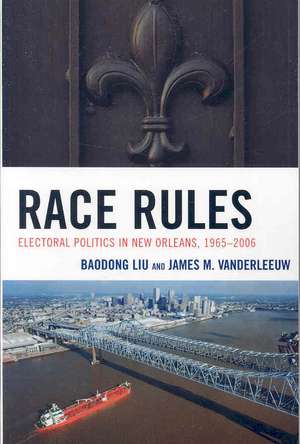
Race Rules: Electoral Politics in New Orleans, 1965-2006: Lexington Books
Autor Baodong Liu, James M. Vanderleeuwen Limba Engleză Paperback – 9 oct 2007
Din seria Lexington Books
- 32%
 Preț: 729.63 lei
 - 59%
 Preț: 427.24 lei
 - 35%
 Preț: 574.44 lei
 - 22%
 Preț: 341.76 lei
 - 31%
 Preț: 437.25 lei
 - 28%
 Preț: 352.50 lei
 - 23%
 Preț: 321.53 lei
 - 23%
 Preț: 333.36 lei
 - 23%
 Preț: 327.54 lei
 - 35%
 Preț: 593.04 lei
 - 33%
 Preț: 358.06 lei
 - 26%
 Preț: 363.28 lei
 - 24%
 Preț: 374.46 lei
 - 22%
 Preț: 330.56 lei
 - 28%
 Preț: 346.74 lei
 - 24%
 Preț: 308.07 lei
 - 23%
 Preț: 321.63 lei
 - 27%
 Preț: 263.04 lei
 - 24%
 Preț: 369.89 lei
 - 25%
 Preț: 884.44 lei
 - 36%
 Preț: 730.77 lei
 - 29%
 Preț: 345.71 lei
 - 33%
 Preț: 556.03 lei
 - 33%
 Preț: 428.79 lei
 - 34%
 Preț: 616.07 lei
 - 29%
 Preț: 342.12 lei
 - 26%
 Preț: 362.85 lei
 - 22%
 Preț: 338.89 lei
 - 28%
 Preț: 356.18 lei
 - 23%
 Preț: 321.63 lei
 - 28%
 Preț: 346.74 lei
 - 22%
 Preț: 340.40 lei
 - 29%
 Preț: 345.71 lei
 - 22%
 Preț: 329.89 lei
 - 37%
 Preț: 660.07 lei
 - 27%
 Preț: 355.41 lei
 - 32%
 Preț: 727.58 lei
 - 24%
 Preț: 313.51 lei
 - 28%
 Preț: 614.62 lei
 - 24%
 Preț: 309.62 lei
 - 34%
 Preț: 630.22 lei
 - 34%
 Preț: 575.26 lei
 - 34%
 Preț: 607.70 lei
 - 33%
 Preț: 639.19 lei
 - 33%
 Preț: 642.37 lei
 - 33%
 Preț: 640.95 lei
 - 25%
 Preț: 369.74 lei
Preț: 335.56 lei
Preț vechi: 432.94 lei
-22%
Puncte Express: 503
Carte tipărită la comandă
Livrare economică 07-21 decembrie
Livrare prin curier în România Termenul estimat este afișat lângă disponibilitate.
Transport gratuit de la 400.00 lei Plată online sau ramburs, în funcție de opțiunile comenzii.
Retur gratuit în 14 zile Comandă securizată și suport în română.
Specificații
ISBN-13: 9780739119686
ISBN-10: 0739119680
Pagini: 180
Dimensiuni: 154 x 232 x 14 mm
Greutate: 0.28 kg
Ediția:New.
Editura: Bloomsbury Publishing
Colecția Lexington Books
Seria Lexington Books
Locul publicării:New York, United States
ISBN-10: 0739119680
Pagini: 180
Dimensiuni: 154 x 232 x 14 mm
Greutate: 0.28 kg
Ediția:New.
Editura: Bloomsbury Publishing
Colecția Lexington Books
Seria Lexington Books
Locul publicării:New York, United States
V-ar putea interesa
-
 -27%Preț: 67.47 lei92.20 lei
 -
 International Relations Theory TodayKen BoothPreț: 372.33 lei
 -
 -24%Preț: 120.26 lei158.36 lei
 -
 -20%Preț: 118.55 lei149.01 lei
 -
 -11%Preț: 129.61 lei145.43 lei
 -
 Preț: 87.93 lei
 -
 Mossad: The Greatest Missions of the Israeli Secret ServiceMichael Bar-ZoharPreț: 86.66 lei
Cuprins
Chapter 1. Hurricane Katrina, Racial Change, and Electoral Politics in New Orleans: An Introduction
Chapter 2. Theories of Racial Politics in Urban America
Chapter 3. Racial Conflict and Accommodation in Electoral Politics
Chapter 4. Black Mayors in New Orleans
Chapter 5. Racial Conflict in the Electoral Arena
Chapter 6. Race and Strategic Voting
Chapter 7. Race, Katrina, and New Orleans' Electoral Politics: Conclusion
Chapter 2. Theories of Racial Politics in Urban America
Chapter 3. Racial Conflict and Accommodation in Electoral Politics
Chapter 4. Black Mayors in New Orleans
Chapter 5. Racial Conflict in the Electoral Arena
Chapter 6. Race and Strategic Voting
Chapter 7. Race, Katrina, and New Orleans' Electoral Politics: Conclusion
Recenzii
The authors of this unique longitudinal study of racial voting patterns challenge both Key's racial threat hypothesis and the racial tolerance hypothesis. As the authors show in the thorough analysis of decades of New Orleans' elections, racial voting patterns are the product of the racial makeup of the electorate and the candidate pool. This volume should be on the shelf of all those interested in racial politics and urban politics.
Liu and Vanderleeuw reaffirm that in urban politics race still matters and they provide a fresh insight into how it matters. As the post-civil rights era matures, they show that to understand electoral urban politics where race is involved is not so much V.O. Key's notion of 'black threat' to which we should attend, but rather his statement 'voters are not fools.'
Liu and Vanderleeuw reaffirm that in urban politics race still matters and they provide a fresh insight into how it matters. As the post-civil rights era matures, they show that to understand electoral urban politics where race is involved is not so much V.O. Key's notion of 'black threat' to which we should attend, but rather his statement 'voters are not fools.'