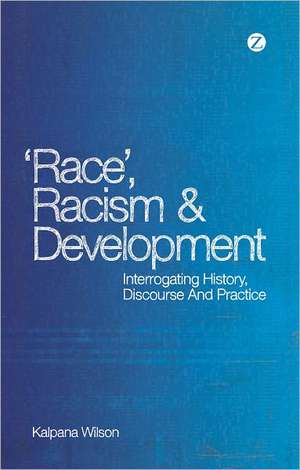
Race, Racism and Development: Interrogating History, Discourse and Practice
Autor Kalpana Wilsonen Limba Engleză Paperback – 11 oct 2012
Preț: 172.45 lei
Preț vechi: 193.70 lei
-11%
Puncte Express: 259
Carte tipărită la comandă
Livrare economică 30 noiembrie-14 decembrie
Livrare prin curier în România Termenul estimat este afișat lângă disponibilitate.
Transport gratuit de la 400.00 lei Plată online sau ramburs, în funcție de opțiunile comenzii.
Retur gratuit în 14 zile Comandă securizată și suport în română.
Specificații
ISBN-13: 9781848135123
ISBN-10: 1848135122
Pagini: 294
Dimensiuni: 138 x 216 x 16 mm
Greutate: 0.35 kg
Editura: Bloomsbury Publishing
Colecția Zed Books
Locul publicării:London, United Kingdom
ISBN-10: 1848135122
Pagini: 294
Dimensiuni: 138 x 216 x 16 mm
Greutate: 0.35 kg
Editura: Bloomsbury Publishing
Colecția Zed Books
Locul publicării:London, United Kingdom
Cuprins
Introduction
1. Race, capital and resistance through the lens of 1857
2. The gift of agency: gender and race in development representations
3. Population control, the Cold War and racialising reproduction
4. Pathologising racialised sexualities in the HIV/AIDS pandemic
5. New uses of 'race' in the 1990s: humanitarian intervention, good governance and democracy
6. Imperialism, accumulation and racialised embodiment
7. Worlds beyond the political? Postdevelopment and race
8. Reconfiguring 'Britishness': diasporas, DfID and neoliberalism
In lieu of a conclusion...
Notes
References
Index
1. Race, capital and resistance through the lens of 1857
2. The gift of agency: gender and race in development representations
3. Population control, the Cold War and racialising reproduction
4. Pathologising racialised sexualities in the HIV/AIDS pandemic
5. New uses of 'race' in the 1990s: humanitarian intervention, good governance and democracy
6. Imperialism, accumulation and racialised embodiment
7. Worlds beyond the political? Postdevelopment and race
8. Reconfiguring 'Britishness': diasporas, DfID and neoliberalism
In lieu of a conclusion...
Notes
References
Index
Recenzii
Kalpana Wilson's new book is a clear indictment of the imbrication of race in development, a fact well-known to race critical scholars, but one which has rarely been analysed in such historical and contemporary sociological depth. This accessibly written and cogently argued book is a must-read for students of race and development alike.
This important book breaks the silence on race and racism in development. Kalpana Wilson's nuanced historical and political analysis goes beyond a narrow critique of the development industry to address broader questions of injustice, making this a book that ought to be essential reading for all students and practitioners of development.
Race, Racism and Development makes several key interventions that bridge postcolonial, political economic, critical race, and feminist literatures. Wilson's critiques of Foucauldian approaches to power and development are a breath of fresh air ... [her] careful attention to the histories and dynamics of domination and resistance around the globe and their significance for contemporary politics is compelling ...The author rightly asks us to think more deeply about what a productive politics of transnational solidarity would look like. This book marks a major moment in the project to break the silence around race and racism in development studies.
This important book breaks the silence on race and racism in development. Kalpana Wilson's nuanced historical and political analysis goes beyond a narrow critique of the development industry to address broader questions of injustice, making this a book that ought to be essential reading for all students and practitioners of development.
Race, Racism and Development makes several key interventions that bridge postcolonial, political economic, critical race, and feminist literatures. Wilson's critiques of Foucauldian approaches to power and development are a breath of fresh air ... [her] careful attention to the histories and dynamics of domination and resistance around the globe and their significance for contemporary politics is compelling ...The author rightly asks us to think more deeply about what a productive politics of transnational solidarity would look like. This book marks a major moment in the project to break the silence around race and racism in development studies.