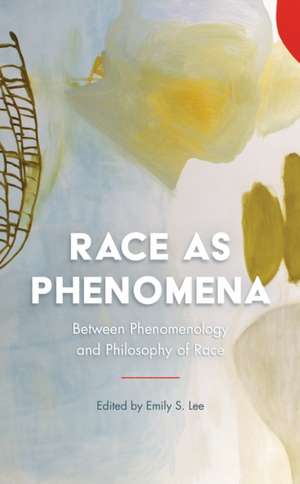
Race as Phenomena: Between Phenomenology and Philosophy of Race: Rowman & Littlefield Publishers
Editat de Emily S. Leeen Limba Engleză Paperback – 9 iul 2019
Philosophy of race conceives race as a social construction. Because of the sedimentation of racial meaning into the very structure and practices of society, the socially constructed meanings about features of the body are mistaken as natural. Hence although racial meaning is theoretically recognized as socially constructed, during an every-day interaction, racial meaning is mistaken as inevitable and natural.
Ideal for advanced students in phenomenology and philosophy of race, this volume pushes the phenomenological method forward by exploring its relation to questions within philosophy of race.
Din seria Rowman & Littlefield Publishers
-
 Preț: 113.89 lei
 - 13%
 Preț: 155.38 lei
 -
 Preț: 109.93 lei
 - 20%
 Preț: 370.93 lei
 - 19%
 Preț: 323.76 lei
 - 25%
 Preț: 228.52 lei
 - 19%
 Preț: 328.78 lei
 - 28%
 Preț: 148.13 lei
 - 20%
 Preț: 191.09 lei
 - 24%
 Preț: 255.02 lei
 - 16%
 Preț: 109.26 lei
 - 31%
 Preț: 351.69 lei
 - 15%
 Preț: 127.13 lei
 - 22%
 Preț: 328.37 lei
 - 19%
 Preț: 324.21 lei
 - 30%
 Preț: 355.24 lei
 - 23%
 Preț: 258.39 lei
 -
 Preț: 402.96 lei
 - 23%
 Preț: 282.77 lei
 - 24%
 Preț: 275.28 lei
 - 31%
 Preț: 351.50 lei
 - 22%
 Preț: 331.09 lei
 - 32%
 Preț: 373.39 lei
 - 34%
 Preț: 842.33 lei
 - 19%
 Preț: 314.30 lei
 - 23%
 Preț: 363.28 lei
 - 21%
 Preț: 128.84 lei
 - 30%
 Preț: 774.75 lei
 - 23%
 Preț: 278.65 lei
 - 22%
 Preț: 266.38 lei
 - 19%
 Preț: 344.02 lei
 - 32%
 Preț: 594.45 lei
 - 31%
 Preț: 566.85 lei
 - 22%
 Preț: 367.22 lei
 - 19%
 Preț: 322.03 lei
 - 16%
 Preț: 148.06 lei
 - 21%
 Preț: 369.53 lei
 - 19%
 Preț: 323.37 lei
 - 20%
 Preț: 314.77 lei
 - 30%
 Preț: 424.70 lei
 - 25%
 Preț: 344.18 lei
 - 30%
 Preț: 703.64 lei
 - 14%
 Preț: 152.49 lei
 - 30%
 Preț: 847.72 lei
 - 19%
 Preț: 316.66 lei
 - 23%
 Preț: 283.57 lei
 - 29%
 Preț: 727.24 lei
 - 23%
 Preț: 262.16 lei
 - 19%
 Preț: 343.92 lei
Preț: 285.56 lei
Preț vechi: 371.25 lei
-23%
Puncte Express: 428
Carte tipărită la comandă
Livrare economică 03-17 decembrie
Livrare prin curier în România Termenul estimat este afișat lângă disponibilitate.
Transport gratuit de la 400.00 lei Plată online sau ramburs, în funcție de opțiunile comenzii.
Retur gratuit în 14 zile Comandă securizată și suport în română.
Specificații
ISBN-13: 9781786605375
ISBN-10: 1786605376
Pagini: 288
Dimensiuni: 146 x 228 x 18 mm
Greutate: 0.37 kg
Editura: Bloomsbury Publishing
Colecția Rowman & Littlefield
Seria Rowman & Littlefield Publishers
Locul publicării:New York, United States
ISBN-10: 1786605376
Pagini: 288
Dimensiuni: 146 x 228 x 18 mm
Greutate: 0.37 kg
Editura: Bloomsbury Publishing
Colecția Rowman & Littlefield
Seria Rowman & Littlefield Publishers
Locul publicării:New York, United States
Cuprins
Introduction
1. A People Yet to Come: 'People of Color' Reconsidered, Boram Jeong
2. Multiplicitous Selves as Being-between-Worlds and Being-in-Worlds, Mariana Ortega
3. The Intersections of Race, Gender, and Criminality: A Black Women's Phenomenological Account, Shaeeda A. Mensah
4. The Veil, Race, and Appearance: A Political Phenomenology, Hourya Bentouhami
5. Challenging Conceptions of the 'Normal' Subject in Phenomenology, Christine Wieseler
6. Social Psychology, Phenomenology, and the Indeterminate Content of Unreflective Racial Bias, Alex Madva
7. A Phenomenology of Seeing and Affect in a Polarized Climate, Emily S. Lee
8. Race Consciousness, Phenomenologically Understood, Lewis Gordon
9. The Black Body: A Phenomenology of Being Stopped, George Yancy
10. The Phenomenology of White Identity, Linda Martin Alcoff
11. Seeing Like a Cop: A Critical Phenomenology of Whiteness as Property, Lisa Guenther
12. Becoming White: White Children and the Erasure of Black Suffering, Shannon Sullivan
Index
1. A People Yet to Come: 'People of Color' Reconsidered, Boram Jeong
2. Multiplicitous Selves as Being-between-Worlds and Being-in-Worlds, Mariana Ortega
3. The Intersections of Race, Gender, and Criminality: A Black Women's Phenomenological Account, Shaeeda A. Mensah
4. The Veil, Race, and Appearance: A Political Phenomenology, Hourya Bentouhami
5. Challenging Conceptions of the 'Normal' Subject in Phenomenology, Christine Wieseler
6. Social Psychology, Phenomenology, and the Indeterminate Content of Unreflective Racial Bias, Alex Madva
7. A Phenomenology of Seeing and Affect in a Polarized Climate, Emily S. Lee
8. Race Consciousness, Phenomenologically Understood, Lewis Gordon
9. The Black Body: A Phenomenology of Being Stopped, George Yancy
10. The Phenomenology of White Identity, Linda Martin Alcoff
11. Seeing Like a Cop: A Critical Phenomenology of Whiteness as Property, Lisa Guenther
12. Becoming White: White Children and the Erasure of Black Suffering, Shannon Sullivan
Index
Recenzii
As a collection, Race as Phenomena should prove to be a valuable resource for both scholars and students interested in philosophy of race.
Race as Phenomena is an accessible collection of reflections on concrete and theoretical aspects of race in the current post post-racial moment. The shared phenomenological approach encompasses experiences and identities of white, Asian, Latinx, and Black Americans, as well as Muslim feminism. The combined perspective is engaging and insightful.
Race as Phenomena is a vital contribution to a growing field. Du Bois once complained that social theorists too often prize abstractions over what he called "the hot reality of real life." The contributors to this valuable collection avoid that mistake while also suggesting the remarkable promise of phenomenological approaches to philosophical race theory. Professor Lee is to be commended!
Lee's anthology gathers a range of fascinating thinkers on topics that integrate phenomenological approaches with a broad range of topics. From essays on the veil, people of color, state violence against Black women, and on Blackness and whiteness, this volume is sure to interest scholars, students, and lay readers in philosophy, race studies, and feminist theory.
The pieces collected in Race as Phenomena vary significantly in tone, character and in terms of their balance between description and analysis. But this unevenness is no weakness. It reflects the method and intentions of the authors and the editor, and is the basis of its value. In every chapter, there are stimulating and original insights which resource our understanding of how 'race' operates and is experienced.
Race as Phenomena is an accessible collection of reflections on concrete and theoretical aspects of race in the current post post-racial moment. The shared phenomenological approach encompasses experiences and identities of white, Asian, Latinx, and Black Americans, as well as Muslim feminism. The combined perspective is engaging and insightful.
Race as Phenomena is a vital contribution to a growing field. Du Bois once complained that social theorists too often prize abstractions over what he called "the hot reality of real life." The contributors to this valuable collection avoid that mistake while also suggesting the remarkable promise of phenomenological approaches to philosophical race theory. Professor Lee is to be commended!
Lee's anthology gathers a range of fascinating thinkers on topics that integrate phenomenological approaches with a broad range of topics. From essays on the veil, people of color, state violence against Black women, and on Blackness and whiteness, this volume is sure to interest scholars, students, and lay readers in philosophy, race studies, and feminist theory.
The pieces collected in Race as Phenomena vary significantly in tone, character and in terms of their balance between description and analysis. But this unevenness is no weakness. It reflects the method and intentions of the authors and the editor, and is the basis of its value. In every chapter, there are stimulating and original insights which resource our understanding of how 'race' operates and is experienced.