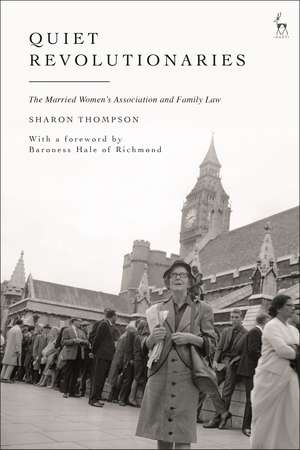
Quiet Revolutionaries: The Married Women's Association and Family Law
Autor Sharon Thompsonen Limba Engleză Hardback – 8 sep 2022
Formed in 1938, the Married Women's Association took reform of family property law as its chief focus. The name is deceptively innocuous, suggesting tea parties and charity fundraisers, but in fact the MWA was often involved in dramatic confrontations with politicians, civil servants, and Law Commissioners. The Association boasted powerful public figures, including MP Edith Summerskill, authors Vera Brittain and Dora Russell, and barrister Helena Normanton. They campaigned on matters that are still being debated in family law today.
Quiet Revolutionaries sheds new light upon legal reform then and now by challenging longstanding assumptions, showing that piecemeal legislation can be an effective stepping stone to comprehensive reform and highlighting how unsuccessful bills, though often now forgotten, can still be important triggers for change. Drawing upon interviews with members' friends and family, and thousands of archival documents, the book is compulsory reading for lawyers, legal historians, and anyone who wishes to explore histories of law reform from the ground up.
Winner of the SLSA Socio-Legal Theory and History Book Prize 2023.
To listen to podcast episodes about the Married Women's Association, featuring interviews and archival research, visit quietrevolutionaries.podbean.com.
Preț: 604.05 lei
Preț vechi: 928.17 lei
-35%
Puncte Express: 906
Carte tipărită la comandă
Livrare economică 07-21 decembrie
Livrare prin curier în România Termenul estimat este afișat lângă disponibilitate.
Transport gratuit pentru acest produs Plată online sau ramburs, în funcție de opțiunile comenzii.
Retur gratuit în 14 zile Comandă securizată și suport în română.
Specificații
ISBN-13: 9781509929412
ISBN-10: 150992941X
Pagini: 280
Dimensiuni: 242 x 166 x 34 mm
Greutate: 0.58 kg
Editura: Bloomsbury Publishing
Colecția Hart Publishing
Locul publicării:London, United Kingdom
ISBN-10: 150992941X
Pagini: 280
Dimensiuni: 242 x 166 x 34 mm
Greutate: 0.58 kg
Editura: Bloomsbury Publishing
Colecția Hart Publishing
Locul publicării:London, United Kingdom
Cuprins
Foreword by Brenda Hale, Baroness Hale of Richmond
Acknowledgments
Timeline
Archive References
List of Abbreviations
Prologue: After the Vote
1. Quiet Revolutionaries
2. Housewives: 'That Vast Army of the Great Unpaid'
Interlude: Juanita Frances
3. A Composite Portrait
4. A New Marriage Law
5. Mrs Blackwell
Interlude: A Note About Lord Denning
6. The Split
Interlude: Reform Movements Are Like Builders
7. One Step at a Time
8. Resistance as a Reform Strategy
Interlude: Poor Reggie
9. Two Steps Forward, One Step Back
10. A Subterranean Influence
Afterword
Bibliography
Index
Acknowledgments
Timeline
Archive References
List of Abbreviations
Prologue: After the Vote
1. Quiet Revolutionaries
2. Housewives: 'That Vast Army of the Great Unpaid'
Interlude: Juanita Frances
3. A Composite Portrait
4. A New Marriage Law
5. Mrs Blackwell
Interlude: A Note About Lord Denning
6. The Split
Interlude: Reform Movements Are Like Builders
7. One Step at a Time
8. Resistance as a Reform Strategy
Interlude: Poor Reggie
9. Two Steps Forward, One Step Back
10. A Subterranean Influence
Afterword
Bibliography
Index
Recenzii
I believe this book to be of central importance to scholars studying the history of women and feminist movements, and family law in the twentieth century. It is so rare for a legal history book to truly convey how and why the law developed in the way it did, and the significance of these developments to the people subject to the legislation. In Quiet Revolutionaries, Sharon Thompson has raised the bar for those of us working in the field.
Sharon Thompson is to be thanked and congratulated for giving us this detailed and perceptive account of the activities of a previously little-known group of quiet but determined activists . A treasure trove, offering newly accessible detail and contributing across so many areas to the understanding of the process of law reform and to the history of feminist thought and strategies for reformers.
Quiet Revolutionaries is a fantastic book that should be read by legal historians, practitioners and anyone interested in how legal change is achieved . Drawing upon rich insights from archival and empirical research, this book reveals that 'the MWA's story is a microcosm of feminist legal activism' . Quiet Revolutionaries provides a new way of thinking about that activism and how 'success' might be measured for reform projects in family law today.
The book is beautifully written, providing the reader with a real sense of what it was like for women (and men) in previous decades, for Thompson has done her research in archives and from interviews and knows the period thoroughly. What it also offers is a properly accurate and nuanced examination of the law and the proposed reforms that one could only get from an experienced teacher of both family law and property law. Quiet Revolutionaries takes feminist legal history - and legal history generally - to a new level.
I wholeheartedly recommend this thought provoking, pathbreaking book. Written in a highly accessible way, it should be set for undergraduate and graduate students working across multiple disciplines, including history, politics, and the social sciences, as well as being of interest to wider public audiences who want to know more about the women's movement and family law in the twentieth century.
A rich, multifaceted and thought-provoking resource, and an important contribution to the literature challenging narratives stressing the weakness and quiescence of the women's movement in the 1940s and 1950s
The influence and importance of the Married Women's Association and its visionary leading lights ... ought to be much better known, not only among family lawyers but also among everyone who is interested in the movement for women's equality. Sharon Thompson has enriched our knowledge and understanding by shining a light upon these quiet revolutionaries.
Quiet Revolutionaries brilliantly illustrates the value of taking a feminist approach to legal history. Meticulously researched and engaging, it shines a light on an overlooked but vitally important campaign for substantive equality within marriage and on the challenges of reforming the law.
Economic dependence in marriage was an abiding concern for twentieth-century feminists, but until now we have known too little about how activists used the law as a tool for change. Deeply researched and highly readable, Sharon Thompson's book recovers the dogged campaigning of the Married Women's Association, revealing its steely efforts to reshape norms about gender, power and the value of women's labour in the family.
Sharon Thompson is to be thanked and congratulated for giving us this detailed and perceptive account of the activities of a previously little-known group of quiet but determined activists . A treasure trove, offering newly accessible detail and contributing across so many areas to the understanding of the process of law reform and to the history of feminist thought and strategies for reformers.
Quiet Revolutionaries is a fantastic book that should be read by legal historians, practitioners and anyone interested in how legal change is achieved . Drawing upon rich insights from archival and empirical research, this book reveals that 'the MWA's story is a microcosm of feminist legal activism' . Quiet Revolutionaries provides a new way of thinking about that activism and how 'success' might be measured for reform projects in family law today.
The book is beautifully written, providing the reader with a real sense of what it was like for women (and men) in previous decades, for Thompson has done her research in archives and from interviews and knows the period thoroughly. What it also offers is a properly accurate and nuanced examination of the law and the proposed reforms that one could only get from an experienced teacher of both family law and property law. Quiet Revolutionaries takes feminist legal history - and legal history generally - to a new level.
I wholeheartedly recommend this thought provoking, pathbreaking book. Written in a highly accessible way, it should be set for undergraduate and graduate students working across multiple disciplines, including history, politics, and the social sciences, as well as being of interest to wider public audiences who want to know more about the women's movement and family law in the twentieth century.
A rich, multifaceted and thought-provoking resource, and an important contribution to the literature challenging narratives stressing the weakness and quiescence of the women's movement in the 1940s and 1950s
The influence and importance of the Married Women's Association and its visionary leading lights ... ought to be much better known, not only among family lawyers but also among everyone who is interested in the movement for women's equality. Sharon Thompson has enriched our knowledge and understanding by shining a light upon these quiet revolutionaries.
Quiet Revolutionaries brilliantly illustrates the value of taking a feminist approach to legal history. Meticulously researched and engaging, it shines a light on an overlooked but vitally important campaign for substantive equality within marriage and on the challenges of reforming the law.
Economic dependence in marriage was an abiding concern for twentieth-century feminists, but until now we have known too little about how activists used the law as a tool for change. Deeply researched and highly readable, Sharon Thompson's book recovers the dogged campaigning of the Married Women's Association, revealing its steely efforts to reshape norms about gender, power and the value of women's labour in the family.