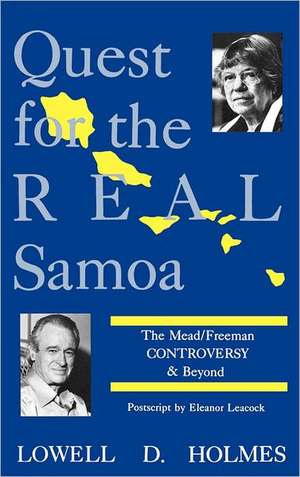
Quest for the Real Samoa
Autor Lowell D. Holmesen Limba Engleză Hardback – 30 noi 1986
Holmes has a special claim to be heard, for in 1954 he did a restudy of Tau, the same village Mead had worked in 29 years before. While Mr. Holmes disagrees with her on various points, he does not find the truth' to be midway between Mead and Mr. Freeman. His work showed the quality of Mead's Samoan research to be remarkably high, ' while Mr. Freeman's refuation was, in Mr. Holmes's opinion, both methodologically shoddy and uncorroborated by the evidence. "New York Times Book Review"
Preț: 488.97 lei
Preț vechi: 803.48 lei
-39%
Puncte Express: 733
Carte tipărită la comandă
Livrare economică 04-18 ianuarie 27
Livrare prin curier în România Termenul estimat este afișat lângă disponibilitate.
Transport gratuit pentru acest produs Plată online sau ramburs, în funcție de opțiunile comenzii.
Retur gratuit în 14 zile Comandă securizată și suport în română.
Specificații
ISBN-13: 9780897891103
ISBN-10: 0897891104
Pagini: 226
Dimensiuni: 161 x 240 x 17 mm
Greutate: 0.46 kg
Editura: Praeger
ISBN-10: 0897891104
Pagini: 226
Dimensiuni: 161 x 240 x 17 mm
Greutate: 0.46 kg
Editura: Praeger
V-ar putea interesa
-
 CookedMichael Pollan-16%Preț: 67.77 lei80.55 lei
-
 Comedy: A Very Short IntroductionMatthew Bevis-19%Preț: 57.71 lei71.00 lei
-
 CSR in the Middle EastYusuf SidaniPreț: 405.55 lei
-
 The Ministry of Guidance Invites You toHooman Majd-10%Preț: 84.99 lei94.44 lei
-
 Breakfast at Sotheby'sPhilip Hook-17%Preț: 66.34 lei79.80 lei
-
 Global Food Futures: Feeding the World in 2050Brian Gardner-21%Preț: 255.24 lei324.71 lei
-
 PuddingJeri QuinzioPreț: 93.00 lei
-
 WineMarc Millon-15%Preț: 92.65 lei108.86 lei
Descriere
Since the controversy began, Homes's restudy has been criticized by Freeman. Now Holmes has published his dissertation findings along with more recent observations on the controversy. Because he conducted the only explicit restudy of the Manu'a group, and because of his own extensive research in the islands over three decades, Holmes's Quest for the Real Samoa is worth reading. While the book will not resolve the controversy, it does provide an interesting perspective, some new data, and useful insights into the controversy. . . . Holmes concludes that Mead's work will endure, not because it was flawless or because it is a model for contemporary research, but precisely because it was pioneering and controversial. He sees the tragedy of the controversy in Freeman's almost exclusive focus on Mead, which could obscure Freeman's potential contribution to Samoan ethnography. This is where Freeman and Holmes differe fundamentally. For Freeman, the ultimate issue is the refutation of Mead's ideas on Samoan adolescence. For Holmes, it is a deeper appreciation of the possibilities of Samoan ethnography. To get beyond the Mead/Freeman controversy, it is this latter path that should be explored. American Anthropologist
Holmes has a special claim to be heard, for in 1954 he did a restudy of Tau, the same village Mead had worked in 29 years before. While Mr. Holmes disagrees with her on various points, he does not find the `truth' to be midway between Mead and Mr. Freeman. His work showed the quality of Mead's Samoan research to be `remarkably high,' while Mr. Freeman's refuation was, in Mr. Holmes's opinion, both methodologically shoddy and uncorroborated by the evidence. New York Times Book Review
Holmes has a special claim to be heard, for in 1954 he did a restudy of Tau, the same village Mead had worked in 29 years before. While Mr. Holmes disagrees with her on various points, he does not find the `truth' to be midway between Mead and Mr. Freeman. His work showed the quality of Mead's Samoan research to be `remarkably high,' while Mr. Freeman's refuation was, in Mr. Holmes's opinion, both methodologically shoddy and uncorroborated by the evidence. New York Times Book Review