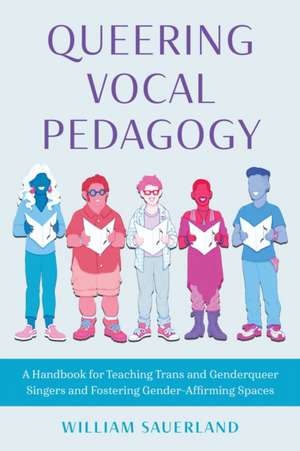
Queering Vocal Pedagogy: A Handbook for Teaching Trans and Genderqueer Singers and Fostering Gender-Affirming Spaces
Autor William Sauerlanden Limba Engleză Hardback – 15 mai 2022
This groundbreaking text weaves together singers' narratives with the practices and pedagogies of their teachers to provide a model for training gender expansive vocalists. William Sauerland promotes a two-fold action: first, cultivating gender-affirming practices for teaching trans and genderqueer singers, and second, disentangling vocal pedagogy from practices and traditions that have historically promoted cisgender narratives.
Through case studies representing various identities within the gender expansive population, this book provides an insider's view to lesson pacing, vocal exercises, repertoire, and processes toward vocal development. Sauerland provides a wealth of practical and theoretical knowledge for teachers, choral directors, and music educators, including:
Impacts of gender and identity in teaching singersInclusive language especially for voice classificationsStrategies for teachingRepertoire considerationsProfessional responsibility and socio-emotional support in the studio
| Toate formatele și edițiile | Preț | Express |
|---|---|---|
| Paperback (1) | 211.71 lei 6-8 săpt. | |
| Bloomsbury Publishing – 15 mai 2022 | 211.71 lei 6-8 săpt. | |
| Hardback (1) | 496.49 lei 6-8 săpt. | |
| Bloomsbury Publishing – 15 mai 2022 | 496.49 lei 6-8 săpt. |
Preț: 496.49 lei
Preț vechi: 686.58 lei
-28%
Puncte Express: 745
Preț estimativ în valută:
87.84€ • 102.12$ • 76.14£
87.84€ • 102.12$ • 76.14£
Carte tipărită la comandă
Livrare economică 04-18 martie
Preluare comenzi: 021 569.72.76
Specificații
ISBN-13: 9781538166666
ISBN-10: 1538166666
Pagini: 308
Ilustrații: 30 b/w illustrations;8 b/w photos; 3 tables
Dimensiuni: 161 x 226 x 24 mm
Greutate: 0.66 kg
Editura: Bloomsbury Publishing
Colecția Rowman & Littlefield Publishers
Locul publicării:New York, United States
ISBN-10: 1538166666
Pagini: 308
Ilustrații: 30 b/w illustrations;8 b/w photos; 3 tables
Dimensiuni: 161 x 226 x 24 mm
Greutate: 0.66 kg
Editura: Bloomsbury Publishing
Colecția Rowman & Littlefield Publishers
Locul publicării:New York, United States
Cuprins
List of Figures and Tables
Preface. Locating Myself
Chapter 1. Understanding Gender in Teaching and Learning
Chapter 2. Shifting Perspective: Theoretical Framework & Methodology
Chapter 3. Trans Feminine Singers
Chapter 4. Trans Masculine Singers
Chapter 5. Trans-Nonbinary Singers
Chapter 6. Pedagogical Considerations for Gender-Affirming Vocal Music Education
Chapter 7. Queering as a Teacher's Habit of Mind
Appendix 1. Glossary of LGBTQ+ Terms
Appendix 2. Short List of Songs Written for TGQ Singers or by TGQ Composers
Appendix 3. Musicals & Opera Featuring Gender Expansive Characters
Appendix 4. Gender-Neutral Performance Attire Guidelines
Appendix 5. Sample Affirmation Policy Statement for Studio Teachers and Choral Directors
Appendix 6. Additional Resources
Selected Bibliography
About the Author
Preface. Locating Myself
Chapter 1. Understanding Gender in Teaching and Learning
Chapter 2. Shifting Perspective: Theoretical Framework & Methodology
Chapter 3. Trans Feminine Singers
Chapter 4. Trans Masculine Singers
Chapter 5. Trans-Nonbinary Singers
Chapter 6. Pedagogical Considerations for Gender-Affirming Vocal Music Education
Chapter 7. Queering as a Teacher's Habit of Mind
Appendix 1. Glossary of LGBTQ+ Terms
Appendix 2. Short List of Songs Written for TGQ Singers or by TGQ Composers
Appendix 3. Musicals & Opera Featuring Gender Expansive Characters
Appendix 4. Gender-Neutral Performance Attire Guidelines
Appendix 5. Sample Affirmation Policy Statement for Studio Teachers and Choral Directors
Appendix 6. Additional Resources
Selected Bibliography
About the Author
Recenzii
Queering Vocal Pedagogy is a powerful call to action for artists and teachers to create lasting change for gender-affirming vocal music education-an essential text. William Sauerland stirringly inquires gender issues inherent in vocal performance and the studio, inviting educators to re-conceive historical, generalizable music-making spaces in more inclusive ways.
This is an important book for those of us who have devoted ourselves to helping others find their voice. William Sauerland reminds us that the important word in that phrase is "their", encouraging us to examine our own implicit biases while working towards true collaboration with our students. It is both a practical and an inspiring reminder of what our relationship with students should be.
This book contains crucial information for singing teachers who work with trans and genderqueer singers. William Sauerland strikes a dynamic balance of personal connection, literature review, case studies, and examples of practical application, and he invites personal reflection.
Queering Vocal Pedagogy is as practical as it is compassionate, offering invaluable insights and descriptions of best practices designed to encourage teachers to see every student, as Sauerland states, "as a whole, emotional, worthy human." Voice teachers who approach the book with an open mind and an open heart are bound to find ways to make their studios more inclusive, their teaching more impactful, and their worldviews more accepting.
Queering Vocal Pedagogy is indeed an insightful contribution providing endless vocal strategies to assist TGQ singers, reinforcing student-centered education, and fostering affirming environments in vocal studios. It is highly organized and provides multiple case studies and interviews that highlight diverse vocal journeys. By scaffolding pedagogy with constructive tools to strengthen the vocal mechanism, this compilation becomes a prominent resource for vocal pedagogues and singers, encouraging an everlasting reflection of pedagogical practices.
This is an important book for those of us who have devoted ourselves to helping others find their voice. William Sauerland reminds us that the important word in that phrase is "their", encouraging us to examine our own implicit biases while working towards true collaboration with our students. It is both a practical and an inspiring reminder of what our relationship with students should be.
This book contains crucial information for singing teachers who work with trans and genderqueer singers. William Sauerland strikes a dynamic balance of personal connection, literature review, case studies, and examples of practical application, and he invites personal reflection.
Queering Vocal Pedagogy is as practical as it is compassionate, offering invaluable insights and descriptions of best practices designed to encourage teachers to see every student, as Sauerland states, "as a whole, emotional, worthy human." Voice teachers who approach the book with an open mind and an open heart are bound to find ways to make their studios more inclusive, their teaching more impactful, and their worldviews more accepting.
Queering Vocal Pedagogy is indeed an insightful contribution providing endless vocal strategies to assist TGQ singers, reinforcing student-centered education, and fostering affirming environments in vocal studios. It is highly organized and provides multiple case studies and interviews that highlight diverse vocal journeys. By scaffolding pedagogy with constructive tools to strengthen the vocal mechanism, this compilation becomes a prominent resource for vocal pedagogues and singers, encouraging an everlasting reflection of pedagogical practices.