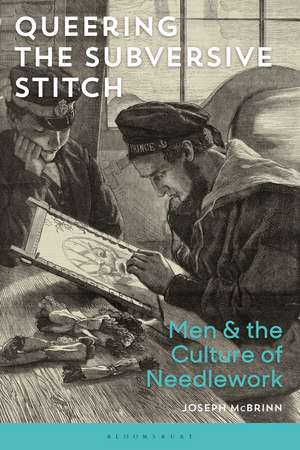
Queering the Subversive Stitch: Men and the Culture of Needlework
Autor Joseph McBrinnen Limba Engleză Paperback – 8 apr 2021
Observăm în Queering the Subversive Stitch o abordare academică riguroasă a unui subiect considerat mult timp tabu: contribuția bărbaților la istoria și cultura lucrului cu acul. Tematica centrală transcede simpla tehnică artizanală, concentrându-se pe intersecția dintre istoria artei, studiile de gen și cultura vizuală. Joseph McBrinn demonstrează că, deși ideologiile moderne din secolele XVIII și XIX au asociat strict cusutul cu feminitatea, realitatea istorică arată o participare masculină activă și diversă, de la croitori anonimi la soldați aflați în convalescență.
Structura cărții este organizată cronologic și tematic, începând cu deconstruirea mitului conform căruia „doar bătăușii și femeile cos”. Autorul analizează modul în care masculinitatea a fost negociată prin intermediul pânzei și al firului, trecând prin perioada victoriană și ajungând la arta postmodernă. Subliniem calitatea documentării, care extrage exemple din arhivele muzeelor, reviste uitate și literatură pentru copii, oferind o perspectivă nuanțată asupra modului în care bărbații au folosit acul pentru a subverti idealurile restrictive ale masculinității.
Ca alternativă la The Subversive Stitch de Rozsika Parker — lucrarea fundamentală care a stabilit legătura dintre broderie și feminitate — volumul lui McBrinn oferă avantajul unei perspective de gen complementare, mutând focusul pe identitatea masculină. În timp ce Stitching the Self de Johanna Amos oferă o colecție de eseuri despre identitate prin meșteșug, Queering the Subversive Stitch propune o monografie unitară și profundă, susținută de un aparat critic vast și ilustrații care validează argumentația istorică.
Preț: 188.78 lei
Preț vechi: 233.75 lei
-19%
Carte disponibilă
Livrare economică 29 octombrie-12 noiembrie
Livrare express 15-21 octombrie pentru 77.85 lei
Specificații
ISBN-10: 147257804X
Pagini: 272
Ilustrații: 16 colour and 71 bw illus
Dimensiuni: 156 x 232 x 20 mm
Greutate: 0.47 kg
Editura: Bloomsbury Publishing
Colecția Bloomsbury Visual Arts
Locul publicării:London, United Kingdom
V-ar putea interesa
-
 Punch NeedleCaroline ColamPreț: 116.39 lei
 -
 No Needles KnittingVickie Howell-17%Preț: 103.36 lei124.76 lei
 -
 Menswear Revolution: The Transformation of Contemporary Men’s FashionJay McCauley Bowstead-27%Preț: 207.83 lei284.03 lei
 -
 -30%Preț: 234.93 lei336.83 lei
 -
 A History of Male Photographers: Analyzing Men as Men in Scientific, Commercial, and Art Photography, 1870 to the PresentAssociate Professor Nicole Hudgins-32%Preț: 625.55 lei926.56 lei
 -
 Mining MenEmily P WebberPreț: 157.25 lei
 -
 Lost BoysJames BloodworthPreț: 108.23 lei
 -
 The Point of the Needle: Why Sewing MattersBarbara BurmanPreț: 111.92 lei
 -
 Transfer & StitchCarina Envoldsen-HarrisPreț: 110.40 lei
 -
 Layer, Paint and StitchWendy DolanPreț: 109.98 lei
 -
 Sewing: Just What You NeedMarie-Noelle Bayard-19%Preț: 56.87 lei70.54 lei
 -
 Visible MendingArounna Khounnoraj-25%Preț: 93.64 lei124.30 lei
 -
 Punch Needle FashionMicah Clasper TorchPreț: 123.14 lei
 -
 ThreadsMadeleine KemsleyPreț: 131.96 lei
 -
 Fashioning MasculinitiesClaire Wilcox-14%Preț: 300.44 lei348.16 lei
 -
 The Art of Couture EmbroideryJessica PilePreț: 233.93 lei
 -
 Quilts 1700-2010Sue PrichardPreț: 169.45 lei
 -
 Really Cross StitchRayna Fahey-24%Preț: 61.33 lei80.46 lei
 -
 Fashion Patternmaking for MenswearAntonio DonnannoPreț: 283.77 lei
De ce să citești această carte
Această carte este esențială pentru cercetătorii în istoria artei, design textil sau studii de gen, oferind o perspectivă documentată asupra unui segment ignorat al culturii materiale. Cititorul câștigă o înțelegere profundă a modului în care gestul de a coase a fost folosit ca instrument de rezistență și auto-exprimare masculină. Este o recomandare excelentă pentru cei care doresc să exploreze evoluția conceptului de masculinitate prin prisma obiectelor lucrate manual.
Despre autor
Joseph McBrinn este conferențiar (Reader) în Istoria Artei și Designului la Belfast School of Art, din cadrul Ulster University, Irlanda de Nord. Expertiza sa se concentrează pe istoria artelor vizuale și a culturii materiale, cu un interes deosebit pentru studiile de gen și identitate. Prin această lucrare publicată la Bloomsbury Publishing, McBrinn își consolidează poziția de cercetător de vârf în domeniul istoriei textilelor, reușind să îmbine rigoarea academică cu o analiză critică a reprezentărilor culturale ale bărbaților în artele domestice.
Descriere
In this groundbreaking study Joseph McBrinn argues that needlework by male artists as well as anonymous tailors, sailors, soldiers, convalescents, paupers, prisoners, hobbyists and a multitude of other men and boys deserves to be looked at again. Drawing on a wealth of examples of men's needlework, as well as visual representations of the male needleworker, in museum collections, from artist's papers and archives, in forgotten magazines and specialist publications, popular novels and children's literature, and even in the history of photography, film and television, he surveys and analyses many of the instances in which "needlemen" have contested, resisted and subverted the constrictive ideals of modern masculinity.
This audacious, original, carefully researched and often amusing study, demonstrates the significance of needlework by men in understanding their feelings, agency, identity and history.
Cuprins
Preface
Acknowledgements
1. "Only sissies and women sew": an introduction
2. Needlework and the creation of masculinities: "the prick" of patriarchy
3. "Killing the angel in the house": Victorian manliness, domestic handicrafts and homosexual panic
4. "The mesh canvas": amateur needlecrafts, masculinity and modernism
5. Masculinity and "the politics of cloth": from the "bad boys" of postmodern art to the "the boys that sew club" of the new millennium
6. Conclusion: "Men who Embroider"
Notes
Select Bibliography
Index
Recenzii
A comprehensive study of men who turned to needlework ... [McBrinn's] present-day analyses are the liveliest, unpicking long-held notions of femininity and masculinity within the field of cultural production.
An insightful, humorous, yet poignant and empathetic exploration of the history of men in the field of embroidery.
McBrinn's book marks an urgent intervention in the field of craft studies and it will be an essential text for those interested in the history of needlework and masculinity ... it will also become an important starting point for scholars looking to explore much wider, more diverse and inclusive approaches to investigations of queerness and craft in the future.
I devoured this in one sitting ... McBrinn has drawn together such a readable history of this hitherto overlooked subject, which not only demands to be recognised alongside Rozsika Parker's, but prompts fresh discourse on men's history in needlework.
McBrinn's sensitive, enlightening and expansive consideration of the relationship between masculinities and embroidery is a great success in its own right. In bringing to light the work and experiences of marginalised male needleworkers he surely achieves his aim, not just to be 'amusing and interesting', but also challenging and constructive.
[A] thoughtfully fluid theorization of masculinity, homosexuality and subcultures, as well as class and race, into a nuanced analysis grounded in fascinating textual and visual primary sources.
Joseph McBrinn adds immeasurably to [needlework] literature through an unprecedented focus on men who sew. His richly researched and engagingly written narrative shows how various formations of modern masculinity have found expression through this medium. Queering the Subversive Stitch is at once a major scholarly contribution and a moving story about men's lives.
But for the fact I couldn't put this book down, I would have taken up a needle and thread and started sewing. McBrinn takes us on an astonishing journey through the needlepoint and embroidery of nineteenth century sailors, Hollywood film idols, trade unionists and those in mourning at the height of the AIDS pandemic. Over 80 images show us men at work with their needles on deck, at home, in groups and in public; they illustrate the gamut of that work - from the floral and religious to the activist and tenderly homoerotic. This is very far from a niche history - it stiches together countercultures and elites, histories of masculinity and sexuality, and queer and gender theory. And McBrinn does this deftly - developing sophisticated, incisive arguments about the history, status and meaning of men sewing with wit and an enviable light touch.