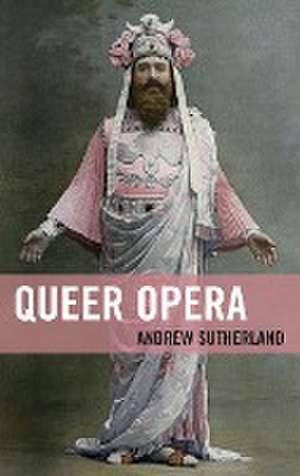
Queer Opera
Autor Andrew Sutherlanden Limba Engleză Hardback – 11 apr 2023
Preț: 596.94 lei
Preț vechi: 912.02 lei
-35%
Puncte Express: 895
Carte tipărită la comandă
Livrare economică 26 noiembrie-10 decembrie
Livrare prin curier în România Termenul estimat este afișat lângă disponibilitate.
Transport gratuit pentru acest produs Plată online sau ramburs, în funcție de opțiunile comenzii.
Retur gratuit în 14 zile Comandă securizată și suport în română.
Specificații
ISBN-13: 9781666906073
ISBN-10: 1666906077
Pagini: 310
Ilustrații: 8 b/w illustrations; 22 textboxes;
Dimensiuni: 158 x 237 x 23 mm
Greutate: 0.63 kg
Editura: Bloomsbury Publishing
Colecția Lexington Books
Locul publicării:New York, United States
ISBN-10: 1666906077
Pagini: 310
Ilustrații: 8 b/w illustrations; 22 textboxes;
Dimensiuni: 158 x 237 x 23 mm
Greutate: 0.63 kg
Editura: Bloomsbury Publishing
Colecția Lexington Books
Locul publicării:New York, United States
Cuprins
Introduction
Chapter 1: Antiquity
Chapter 2: Passing and Coding
Chapter 3: The Closet
Chapter 4: Hegemony
Chapter 5: Assimilation
Chapter 6: Killing Queers
Chapter 7: Homoerotic Awakening
Conclusion
References
About the Author
Chapter 1: Antiquity
Chapter 2: Passing and Coding
Chapter 3: The Closet
Chapter 4: Hegemony
Chapter 5: Assimilation
Chapter 6: Killing Queers
Chapter 7: Homoerotic Awakening
Conclusion
References
About the Author
Recenzii
In Queer Opera, Sutherland discusses a wide variety of niche operas that otherwise might be lost to obscurity. Sutherland's enthusiasm for the work of smaller opera houses that are more willing to platform queer stories is also commendable . Sutherland provides a fine contribution to the growing con-versation on the topic within musicological literature.
Queer Opera makes an important contribution to the evolving understanding of what opera can be for audiences today. It tackles complex issues of identity, behaviour, intention, and interpretation in operas both historic and contemporary. Acknowledging the complex relationship of opera and queerness throughout history, the book examines a wide range of works through a queer lens, and in doing so, offers up fresh insights into opera more generally.
Queer Opera is a meaningful and necessary text, providing perspectives worthy of consideration by all who love opera and wish to see it thrive.
Sutherland, [can] be commended on many fronts. He has certainly done his homework. He considers over fifty operas from the Baroque to the present day. He does not set his sights on just the big names but includes several operas by contemporary composers whose names are hardly household words. He is scrupulous about including lesbian composers and gives commendable attention to operas with lesbian, bisexual, and trans characters. Along the way, he peppers his discussions with fascinating tidbits of information. This is hardly the first book to examine queer opera. A check of my local university library under the subject heading "Homosexuality in opera" produced 153 hits-books, dissertations, articles. Still, Sutherland's study may be one of the first to embrace a wider, "queer" compass.
Queer Opera makes an important contribution to the evolving understanding of what opera can be for audiences today. It tackles complex issues of identity, behaviour, intention, and interpretation in operas both historic and contemporary. Acknowledging the complex relationship of opera and queerness throughout history, the book examines a wide range of works through a queer lens, and in doing so, offers up fresh insights into opera more generally.
Queer Opera is a meaningful and necessary text, providing perspectives worthy of consideration by all who love opera and wish to see it thrive.
Sutherland, [can] be commended on many fronts. He has certainly done his homework. He considers over fifty operas from the Baroque to the present day. He does not set his sights on just the big names but includes several operas by contemporary composers whose names are hardly household words. He is scrupulous about including lesbian composers and gives commendable attention to operas with lesbian, bisexual, and trans characters. Along the way, he peppers his discussions with fascinating tidbits of information. This is hardly the first book to examine queer opera. A check of my local university library under the subject heading "Homosexuality in opera" produced 153 hits-books, dissertations, articles. Still, Sutherland's study may be one of the first to embrace a wider, "queer" compass.