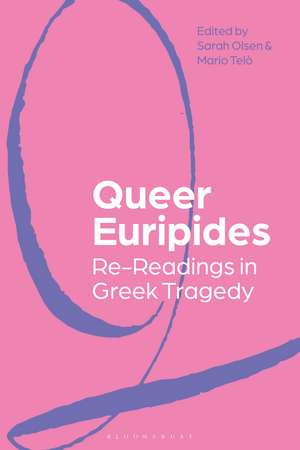
Queer Euripides: Re-Readings in Greek Tragedy
Editat de Dr Sarah Olsen, Professor Mario Telòen Limba Engleză Hardback – 5 mai 2022
Apreciem rigoarea cu care Queer Euripides, volum coordonat de Dr Sarah Olsen și Professor Mario Telò, reușește să recalibreze studiul tragediei antice. Autorii, nume de referință în cadrul Williams College și UC Berkeley, propun o cercetare interdisciplinară care nu se limitează doar la aspectele identității sexuale, ci extinde conceptul de „queerness” către analiza structurilor sociale normative și a formelor poetice. Considerăm că această lucrare reprezintă un punct de cotitură, fiind prima tentativă academică de a aplica aceste lentile critice asupra întregului corpus euripidian, un autor recunoscut istoric pentru modul în care a chestionat genul și alteritatea.
Lucrarea extinde cadrul propus de The Routledge Handbook of Classics and Queer Theory cu date noi din perspectiva aplicată a analizei literare, trecând de la teoretizarea generală la o examinare aplicată a fiecărei piese supraviețuitoare. Spre deosebire de abordarea din Euripides, Women and Sexuality, care se concentrează pe istoria socială și psihologia feminină, volumul de față utilizează euristicile teoriei queer dezvoltate în ultimele trei decenii pentru a explora „temporalitățile tragice” și „eșecul” ca instrumente de rezistență politică.
Structura volumului reflectă o progresie analitică complexă. Prima parte, dedicată temporalităților, reinterpretează piese precum Hippolytus sau Troienele prin conceptul de timp non-linear. Secțiunile ulterioare, axate pe „Evadare/Refuz” și „Eșec”, analizează piese mai puțin discutate, precum Copiii lui Heracles sau Femeile în rugăciune, oferind perspective noi asupra relațiilor de rudenie și a formelor de solidaritate marginală. Reținem faptul că volumul nu impune o singură școală de gândire, ci funcționează ca o colecție de lecturi incisive care demonstrează cum tragedia greacă poate deveni, în sine, o resursă pentru teoretizarea contemporană.
Preț: 539.40 lei
Preț vechi: 735.51 lei
-27%
Carte tipărită la comandă
Livrare economică 20 noiembrie-04 decembrie
Specificații
ISBN-10: 1350249629
Pagini: 288
Dimensiuni: 154 x 236 x 20 mm
Greutate: 0.58 kg
Editura: Bloomsbury Publishing
Colecția Bloomsbury Academic
Locul publicării:London, United Kingdom
De ce să citești această carte
Această lucrare este esențială pentru studenții și cercetătorii din domeniul studiilor clasice și al teoriei critice. Cititorul câștigă o înțelegere profundă a modului în care textele antice pot fi relevante pentru dezbaterile contemporane despre identitate și structuri sociale. Este un instrument academic valoros care oferă noi metode de interpretare pentru Euripide, transformând lectura tradițională într-un act de explorare a rezistenței și a formelor alternative de existență.
Descriere
Bringing together twenty-one chapters by experts in classical studies, English literature, performance and critical theory, this carefully curated collection of incisive and provocative readings of each surviving play draws upon queer models of temporality, subjectivity, feeling, relationality and poetic form to consider "queerness" both as and beyond sexuality. Rather than adhering to a single school of thought, these close readings showcase the multiple ways in which queer theory opens up new vantage points on the politics, aesthetics and performative force of Euripidean drama. They further demonstrate how the analytical frameworks developed by queer theorists in the last thirty years deeply resonate with the ways in which Euripides' plays twist poetic form in order to challenge well-established modes of the social. By establishing how Greek tragedy can itself be a resource for theorizing queerness, the book sets the stage for a new model of engaging with ancient literature, which challenges current interpretive methods, explores experimental paradigms, and reconceptualizes the practice of reading to place it firmly at the center of the interpretive act.
Cuprins
List of Contributors
Acknowledgments
Queer Euripides: An Introduction (Sarah Olsen, Williams College, USA and Mario Telò, University of California, Berkeley, USA)
Part I. Temporalities
1. Hippolytus: Euripides and Queer Theory at the Fin de Siècle and Now (Daniel Orrells, King's College, London, UK)
2. Rhesus: Tragic Wilderness in Queer Time (Oliver Baldwin, University of Reading, UK)
3. Trojan Women: No Futures (Carla Freccero, University of California, Santa Cruz, USA)
Part II. Escape/Refusal
4. Iphigenia in Aulis: Perhaps (Not) (Ella Haselswerdt, University of California, Los Angeles, USA)
5. Helen: Queering the Barbarian (Patrice Rankine, University of Richmond, USA)
6. Children of Heracles: Queer Kinship: Profit, Vivisection, Kitsch (Ben Radcliffe, University of North Carolina, Greensboro, USA)
7. Suppliant Women: Adrastus's Cute Lesbianism: Labor Irony Adhesion (Mario Telò, University of California, Berkeley, USA)
Part III: Failure
8. Medea: Failure and the Queer Escape (Sarah Nooter, University of Chicago, USA)
9. Alcestis: Impossible Performance (Sean Gurd, University of Missouri, USA)
10. Ion: Into the Queer Ionisphere (Kirk Ormand, Oberlin College, USA)
Part IV: Relations
11. Heracles: Homosexual Panic and Irresponsible Reading (Alastair Blanshard, University of Queensland, Australia)
12. Andromache: Catfight in Phthia (Sarah Olsen, Williams College, USA)
13. Orestes: Polymorphously Per-verse: On Queer Metrology (David Youd, University of California, Berkeley, USA)
Part V. Reproduction
14. Hecuba: The Dead Child or Queer for a Day (Karen Bassi, University of California, Santa Cruz, USA)
15. Phoenician Women: "Deviant" Thebans Out of Time (Rosa Andújar, Kings' College, London, UK)
16. Electra: Parapoetics and Paraontology (Melissa Mueller, University of Massachusetts at Amherst, USA)
Part VI: Encounters
17. Iphigenia in Tauris: Iphigenia and Artemis? Reading Queer/Performing Queer
(Nancy Sorkin Rabinowitz, Hamilton College, USA and David Bullen, Royal Holloway, UK)
18. Cyclops: A Philosopher Walks into a Satyr Play (Daniel Boyarin, University of California, Berkeley, USA)
Part VII: Transitions
19. Hippolytus: Queer Crossings: Following Anne Carson (Jonathan Goldberg, Emory University, USA)
20. Aristophanes' Women at the Thesmophoria: Reality and the Egg: An Oviparody of Euripides (L. Deihr, UC, Berkeley, USA)
21. Bacchae: "An Excessively High Price to Pay for Being Reluctant to Emerge from the Closet?" (Isabel Ruffell, University of Glasgow, UK)
Notes
Bibliography
Index
Recenzii
The surprise factors of these re-readings ... will constantly challenge our assumptions and force us to read the text with fresh eyes.
Full of innovative analyses of Euripides' plays, this ground-breaking volume is the first to employ queerness as a lens for examining the entire surviving corpus of an ancient Greek playwright. In both form and content it heralds a new approach to ancient texts that should have a deep impact on the field of Classics and reach many audiences beyond it.