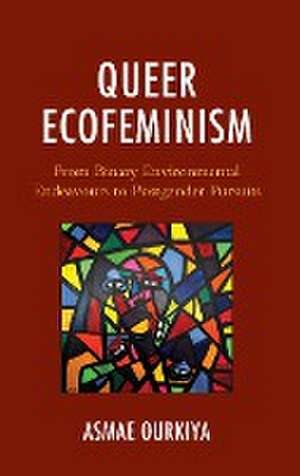
Queer Ecofeminism: From Binary Environmental Endeavours to Postgender Pursuits: Environment and Religion in Feminist-Womanist, Queer, and Indigenous Perspectives
Autor Asmae Ourkiyaen Limba Engleză Hardback – 8 aug 2023






Preț: 505.62 lei
Preț vechi: 733.73 lei
-31%
Puncte Express: 758
Carte tipărită la comandă
Livrare economică 08-22 decembrie
Livrare prin curier în România Termenul estimat este afișat lângă disponibilitate.
Transport gratuit pentru acest produs Plată online sau ramburs, în funcție de opțiunile comenzii.
Retur gratuit în 14 zile Comandă securizată și suport în română.
Specificații
ISBN-13: 9781793640215
ISBN-10: 1793640211
Pagini: 184
Ilustrații: 4 b/w illustrations;
Dimensiuni: 157 x 237 x 17 mm
Greutate: 0.44 kg
Editura: Bloomsbury Publishing
Colecția Lexington Books
Seria Environment and Religion in Feminist-Womanist, Queer, and Indigenous Perspectives
Locul publicării:New York, United States
ISBN-10: 1793640211
Pagini: 184
Ilustrații: 4 b/w illustrations;
Dimensiuni: 157 x 237 x 17 mm
Greutate: 0.44 kg
Editura: Bloomsbury Publishing
Colecția Lexington Books
Seria Environment and Religion in Feminist-Womanist, Queer, and Indigenous Perspectives
Locul publicării:New York, United States
Cuprins
Table of Contents
Preface
Acknowledgments
Introduction
Chapter 1: Ecofeminism: Inception, Development, and Challenges
Chapter 2: On De-essentializing Ecofeminism
Chapter 3: Gendered Climate Politics: Between the Far-Right and Social Justice
Chapter 4: Queering Ecofeminism: Challenging Heteronormative Far-Right Politics
Chapter 5: Postgender Semiotics
Conclusion
References
Preface
Acknowledgments
Introduction
Chapter 1: Ecofeminism: Inception, Development, and Challenges
Chapter 2: On De-essentializing Ecofeminism
Chapter 3: Gendered Climate Politics: Between the Far-Right and Social Justice
Chapter 4: Queering Ecofeminism: Challenging Heteronormative Far-Right Politics
Chapter 5: Postgender Semiotics
Conclusion
References
Recenzii
This is very much a book of the 21st century. Written through a broadly theoretical framework which privileges an ecofeminist perspective, it also looks at issues of climate change and climate politics through the autoethnographic experience of the author. This blend of quite complicated and contemporary theory with the lived experience of the author, offering a measured and wide-ranging critique of right-wing political ideologies on the issues of gender and climate, is an original and evocative credo, and one which will be both popular and significant. It is an important document describing the world in which we live.
Asmae Ourkiya has produced a compelling and persuasive work that re-fashions how we think and practice ecocritical theory. This is a seminal intervention that is replete with penetrating insights and analyses of a skein of visual and verbal texts, a study that is immersed in, and mobilizes, the most advanced theory available to contemporary ecocritics. Ourkiya urges the field to reflect on its origins, its current priorities and, most pressingly, its future prospects and trajectories.
In a time when both environmental and gender matters are at the forefront of global public debate, Asmae Ourkiya's Queer Ecofeminism provides the perfect reminder that these issues are deeply interconnected. Using both personal experience and scholarly research, Ourkiya successfully reimagines ecofeminism, freeing it from its historical essentialism in order to provide us with new ways of imagining the self and our material and emotional relationships to the more-than-human world.
Asmae Ourkiya has produced a compelling and persuasive work that re-fashions how we think and practice ecocritical theory. This is a seminal intervention that is replete with penetrating insights and analyses of a skein of visual and verbal texts, a study that is immersed in, and mobilizes, the most advanced theory available to contemporary ecocritics. Ourkiya urges the field to reflect on its origins, its current priorities and, most pressingly, its future prospects and trajectories.
In a time when both environmental and gender matters are at the forefront of global public debate, Asmae Ourkiya's Queer Ecofeminism provides the perfect reminder that these issues are deeply interconnected. Using both personal experience and scholarly research, Ourkiya successfully reimagines ecofeminism, freeing it from its historical essentialism in order to provide us with new ways of imagining the self and our material and emotional relationships to the more-than-human world.