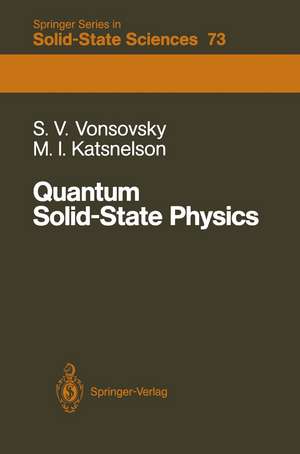
Quantum Solid-State Physics: Springer Series in Solid-State Sciences, cartea 73
Autor Serghey V. Vonsovsky, Mikhail I. Katsnelsonen Limba Engleză Paperback – 5 mai 2012
Din seria Springer Series in Solid-State Sciences
- 18%
 Preț: 1055.64 lei
 - 15%
 Preț: 551.07 lei
 - 18%
 Preț: 992.74 lei
 - 18%
 Preț: 865.62 lei
 - 18%
 Preț: 975.19 lei
 - 18%
 Preț: 1024.56 lei
 - 18%
 Preț: 1256.32 lei
 - 18%
 Preț: 958.47 lei
 - 18%
 Preț: 925.97 lei
 -
 Preț: 373.90 lei
 - 18%
 Preț: 1832.67 lei
 - 15%
 Preț: 666.60 lei
 -
 Preț: 378.19 lei
 - 15%
 Preț: 643.32 lei
 - 15%
 Preț: 637.96 lei
 - 18%
 Preț: 900.69 lei
 - 15%
 Preț: 651.89 lei
 - 15%
 Preț: 655.47 lei
 - 18%
 Preț: 894.17 lei
 - 15%
 Preț: 643.87 lei
 - 15%
 Preț: 654.12 lei
 - 15%
 Preț: 649.35 lei
 - 15%
 Preț: 647.87 lei
 - 15%
 Preț: 658.03 lei
 - 18%
 Preț: 961.62 lei
 - 15%
 Preț: 640.73 lei
 - 23%
 Preț: 1140.33 lei
 - 15%
 Preț: 642.16 lei
 - 15%
 Preț: 652.64 lei
 - 15%
 Preț: 640.49 lei
 - 15%
 Preț: 643.25 lei
 -
 Preț: 379.62 lei
 -
 Preț: 385.99 lei
 -
 Preț: 376.01 lei
 - 15%
 Preț: 641.76 lei
 - 18%
 Preț: 966.98 lei
 - 18%
 Preț: 706.78 lei
 - 15%
 Preț: 643.63 lei
 - 15%
 Preț: 626.68 lei
 - 18%
 Preț: 1269.64 lei
 - 18%
 Preț: 1272.76 lei
 - 18%
 Preț: 983.00 lei
Preț: 404.89 lei
Puncte Express: 607
Carte tipărită la comandă
Livrare economică 28 noiembrie-12 decembrie
Livrare prin curier în România Termenul estimat este afișat lângă disponibilitate.
Transport gratuit pentru acest produs Plată online sau ramburs, în funcție de opțiunile comenzii.
Retur gratuit în 14 zile Comandă securizată și suport în română.
Specificații
ISBN-13: 9783642501661
ISBN-10: 3642501664
Pagini: 520
Ilustrații: XII, 505 p. 60 illus.
Dimensiuni: 155 x 235 x 28 mm
Greutate: 0.78 kg
Ediția:1989
Editura: Springer
Colecția Springer Series in Solid-State Sciences
Seria Springer Series in Solid-State Sciences
Locul publicării:Berlin, Heidelberg, Germany
ISBN-10: 3642501664
Pagini: 520
Ilustrații: XII, 505 p. 60 illus.
Dimensiuni: 155 x 235 x 28 mm
Greutate: 0.78 kg
Ediția:1989
Editura: Springer
Colecția Springer Series in Solid-State Sciences
Seria Springer Series in Solid-State Sciences
Locul publicării:Berlin, Heidelberg, Germany
V-ar putea interesa
-
 Physics of Condensed MatterPrasanta Misra-8%Preț: 523.81 lei569.35 lei
 -
 Time-Dependent Density-Functional Theory: Concepts and ApplicationsCarsten A. Ullrich-20%Preț: 538.18 lei675.95 lei
 -
 The Physics of CloudsB. J. Mason-24%Preț: 609.30 lei805.11 lei
 -
 -30%Preț: 656.49 lei938.37 lei
 -
 Layered Superconductors: Volume 1Richard A. Klemm-31%Preț: 972.93 lei1407.22 lei
 -
 Molecular NanomagnetsDante Gatteschi-12%Preț: 361.32 lei409.88 lei
 -
 Electronic Processes in Non-Crystalline MaterialsNevill Francis Mott-25%Preț: 533.69 lei708.02 lei
 -
 Electricity and Magnetism, Volume 1B. I. Bleaney-11%Preț: 362.38 lei407.28 lei
 -
 Electricity and Magnetism, Volume 2B. I. Bleaney-21%Preț: 470.50 lei594.96 lei
 -
 An Introduction to Statistical Mechanics and ThermodynamicsRobert H. Swendsen-19%Preț: 541.22 lei670.31 lei
 -
 -23%Preț: 675.69 lei882.79 lei
 -
 Molecular Relaxation in LiquidsBiman Bagchi-31%Preț: 742.45 lei1077.37 lei
 -
 Elements of Modern X-Ray PhysicsDes McmorrowPreț: 495.19 lei
 -
 Quantum Phase TransitionsSubir Sachdev-8%Preț: 610.90 lei664.02 lei
 -
 Graphene: Synthesis and ApplicationsWonbong Choi-18%Preț: 1475.35 lei1799.20 lei
 -
 -9%Preț: 1241.77 lei1364.58 lei
 -
 Physics of Surfaces and InterfacesHarald Ibach-15%Preț: 748.11 lei880.12 lei
 -
 The Glass TransitionE. Donth-18%Preț: 1038.26 lei1266.18 lei
 -
 Solid-State PhysicsHarald Ibach-17%Preț: 410.54 lei494.64 lei
Public țintă
ResearchCuprins
1. Introduction. General Properties of the Solid State of Matter.- 1.1 General Thermodynamic Description of the Solid State.- 1.2 Crystal Structure of Solids.- 1.3 Reciprocal Lattice.- 1.4 Examples of Simple Crystal Structures.- 1.5 Experimental Techniques for Determining the Periodic Atomic Structure of Solids.- 1.6 Qualitative Concepts of the Electronic and Nuclear Crystal Structure.- 1.7 Fundamental Concepts of the Chemical Bonding in Solids.- 1.8 Types of Crystalline Solids.- 1.9 Formulation of the General Quantum-Mechanical Problem of the Crystal.- 1.10 Properties of Disordered Condensed Systems.- 2. Dynamic Properties of the Crystal Lattice.- 2.1 The Dynamics of the Ionic Lattice.- 2.2 The Specific-Heat Capacity of the Lattice.- 2.3 Allowance for Anharmonic Terms.- 2.4 Localization of Phonons on Point Defects.- 2.5 Heat Capacity of Glasses at Low Temperatures.- 2.6 High-Frequency Permittivity of Ionic Crystals.- 2.7 Lattice Scattering and the Mössbauer Effect.- 2.8 Conclusion.- 3. Simple Metals: The Free Electron-Gas Model.- 3.1 Types of Metals.- 3.2 Physical Properties of the Metallic State. Conduction Electrons.- 3.3 Classical Conduction-Electron Theory (Drude-Lorentz Theory).- 3.4 Itinerant Electron Theory According to Frenkel.- 3.5 Application of Fermi-Dirac Quantum Statistics to the Conduction-Electron Gas.- 3.6 Transport Phenomena.- 3.7 High-Frequency Properties.- 3.8 Conclusions.- 4. Band Theory.- 4.1 Preliminary Observations and the One-Dimensional Model.- 4.2 General Theory of the Electron Motion in a Three-Dimensional Crystal.- 4.3 Nearly-Free-Electron Approximation.- 4.4 Effect of an Electric Field on Electronic States.- 4.5 The Metal-Semiconductor Criterion.- 4.6 Computing the Electron Energy Spectrum of Crystals.- 4.7 Band Electrons in a Magnetic Field.- 4.8 Impurity States.- 4.9 The Electronic Structure of Disordered Systems.- 4.10 Conclusion. The Role of Many-Particle Effects.- 5. Many-Particle Effects.- 5.1 Plasma Phenomena. Screening.- 5.2 TheFermi-Liquid Theory.- 5.3 Electron-Phonon Interaction.- 5.4 Superconductivity.- 5.5 Excitons.- 5.6 Transition Metals and Their Compounds.- 5.7 Anderson’s Orthogonality Catastrophe.- 5.8 Conclusion.- Addenda (Recent Developments).- References.