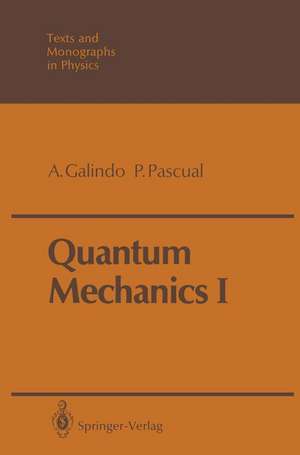
Quantum Mechanics I: Theoretical and Mathematical Physics
Autor Alberto Galindo, Pedro Pascual Traducere de J. D. Garcia, L. Alvarez-Gaumeen Limba Engleză Paperback – 11 ian 2012
Din seria Theoretical and Mathematical Physics
- 15%
 Preț: 509.55 lei
 - 15%
 Preț: 627.93 lei
 - 18%
 Preț: 935.59 lei
 -
 Preț: 380.24 lei
 -
 Preț: 381.19 lei
 - 18%
 Preț: 1081.04 lei
 -
 Preț: 474.49 lei
 - 18%
 Preț: 878.33 lei
 -
 Preț: 375.07 lei
 - 15%
 Preț: 614.60 lei
 - 15%
 Preț: 638.68 lei
 -
 Preț: 384.40 lei
 - 19%
 Preț: 587.38 lei
 - 15%
 Preț: 489.05 lei
 - 15%
 Preț: 679.66 lei
 - 18%
 Preț: 919.64 lei
 - 15%
 Preț: 632.98 lei
 - 15%
 Preț: 627.79 lei
 -
 Preț: 388.04 lei
 - 18%
 Preț: 1072.55 lei
 - 18%
 Preț: 1645.28 lei
 - 15%
 Preț: 634.70 lei
 -
 Preț: 385.68 lei
 - 15%
 Preț: 568.05 lei
 - 18%
 Preț: 923.48 lei
 - 15%
 Preț: 530.30 lei
 - 18%
 Preț: 1078.91 lei
 - 15%
 Preț: 580.94 lei
 - 15%
 Preț: 621.80 lei
 - 18%
 Preț: 753.04 lei
 - 18%
 Preț: 963.80 lei
 - 15%
 Preț: 623.84 lei
 - 15%
 Preț: 628.83 lei
 - 18%
 Preț: 922.72 lei
 -
 Preț: 397.88 lei
 - 18%
 Preț: 850.37 lei
 -
 Preț: 390.61 lei
 - 15%
 Preț: 634.02 lei
 - 15%
 Preț: 570.53 lei
 -
 Preț: 381.51 lei
 - 20%
 Preț: 627.33 lei
 - 15%
 Preț: 620.38 lei
Preț: 571.95 lei
Preț vechi: 672.88 lei
-15%
Puncte Express: 858
Carte tipărită la comandă
Livrare economică 29 mai-12 iunie
Specificații
ISBN-13: 9783642838569
ISBN-10: 3642838561
Pagini: 436
Ilustrații: XVI, 417 p.
Dimensiuni: 155 x 235 x 24 mm
Greutate: 0.66 kg
Ediția:1990
Editura: Springer
Colecția Theoretical and Mathematical Physics
Seria Theoretical and Mathematical Physics
Locul publicării:Berlin, Heidelberg, Germany
ISBN-10: 3642838561
Pagini: 436
Ilustrații: XVI, 417 p.
Dimensiuni: 155 x 235 x 24 mm
Greutate: 0.66 kg
Ediția:1990
Editura: Springer
Colecția Theoretical and Mathematical Physics
Seria Theoretical and Mathematical Physics
Locul publicării:Berlin, Heidelberg, Germany
V-ar putea interesa
-
 Aqa a Level Chemistry Year 1 & as Paper 1Colin ChambersPreț: 80.36 lei
 -
 Quantum Theory: A Very Short IntroductionJohn Polkinghorne-22%Preț: 52.49 lei67.19 lei
 -
 Bonding and Structure of Molecules and SolidsD. G. Pettifor-24%Preț: 355.67 lei466.31 lei
 -
 -27%Preț: 513.67 lei698.89 lei
 -
 Molecular Quantum MechanicsPeter W. Atkins-19%Preț: 472.94 lei583.87 lei
 -
 Quantum Mechanics: Theory and ExperimentMark Beck-25%Preț: 846.72 lei1135.90 lei
 -
 Molecular Symmetry and Group TheoryAlan VincentPreț: 297.15 lei
 -
 Unimolecular ReactionsWendell Forst-9%Preț: 777.10 lei853.96 lei
 -
 Discovering ChemistryFrank Weinhold-8%Preț: 548.67 lei596.38 lei
 -
 Molecular Electronic-Structure TheoryTrygve Helgaker-19%Preț: 525.86 lei649.22 lei
 -
 Ionic and Electrochemical EquilibriaM Soustelle-9%Preț: 945.98 lei1039.54 lei
Public țintă
ResearchCuprins
1. The Physical Basis of Quantum Mechanics.- 1.1 Introduction.- 1.2 The Blackbody.- 1.3 The Photoelectric Effect.- 1.4 The Compton Effect.- 1.5 Light: Particle or Wave?.- 1.6 Atomic Structure.- 1.7 The Sommerfeld-Wilson-Ishiwara (SWI) Quantization Rules.- 1.8 Fine Structure.- 1.9 The Zeeman Effect.- 1.10 Successes and Failures of the Old Quantum Theory.- 1.11 Matter Waves.- 1.12 Wave Packets.- 1.13 Uncertainty Relations.- 2. The Postulates of Quantum Mechanics.- 2.1 Introduction.- 2.2 Pure States.- 2.3 Observables.- 2.4 Results of Measurements.- 2.5 Uncertainty Relations.- 2.6 Complete Sets of Compatible Observables.- 2.7 Density Matrix.- 2.8 Preparations and Measurements.- 2.9 Schrodinger Equation.- 2.10 Stationary States and Constants of the Motion.- 2.11 The Time-Energy Uncertainty Relation.- 2.12 Quantization Rules.- 2.13 The Spectra of the Operators X and P.- 2.14 Time Evolution Pictures.- 2.15 Superselection Rules.- 3. The Wave Function.- 3.1 Introduction.- 3.2 Wave Functions.- 3.3 Position and Momentum Representations.- 3.4 Position-Momentum Uncertainty Relations.- 3.5 Probability Density and Probability Current Density.- 3.6 Ehrenfest’s Theorem.- 3.7 Propagation of Wave Packets (I).- 3.8 Wave Packet Propagation (II).- 3.9 The Classical Limit of the Schrödinger Equation.- 3.10 The Virial Theorem.- 3.11 Path Integration.- 4. One-Dimensional Problems.- 4.1 Introduction.- 4.2 The Spectrum of H.- 4.3 Square Wells.- 4.4 The Harmonic Oscillator.- 4.5 Transmission and Reflection Coefficients.- 4.6 Delta Function Potentials.- 4.7 Square Potentials.- 4.8 Periodic Potentials.- 4.9 Inverse Spectral Problem.- 4.10 Mathematical Conditions.- 5. Angular Momentum.- 5.1 Introduction.- 5.2 The Definition of Angular Momentum.- 5.3 Eigenvalues of Angular Momentum Operators.- 5.4Orbital Angular Momentum.- 5.5 Angular Momentum Uncertainty Relations.- 5.6Matrix Representations of the Rotation Operators.- 5.7 Addition of Angular Momenta.- 5.8 Clebsch-Gordan Coefficients.- 5.9 Irreducible Tensors Under Rotations.- 5.10 Helicity.- 6. Two-Particle Systems: Central Potentials.- 6.1 Introduction.- 6.2 The Radial Equation.- 6.3 Square Wells.- 6.4 The Three-Dimensional Harmonic Oscillator.- 6.5 The Hydrogen Atom.- 6.6 The Hydrogen Atom: Corrections.- 6.7 Accidental Degeneracy.- 6.8 The Hydrogen Atom: Parabolic Coordinates.- 6.9 Exactly Solvable Potentials for s-Waves.- 7. Symmetry Transformations.- 7.1 Introduction.- 7.2 Symmetry Transformations: Wigner’s Theorem.- 7.3 Transformation Properties of Operators.- 7.4 Symmetry Groups.- 7.5 Space Translations.- 7.6 Rotations.- 7.7 Parity.- 7.8 Time Reversal.- 7.9 Invariances and Conservation Laws.- 7.10 Invariance Under Translations.- 7.11 Invariance Under Rotations.- 7.12 Invariance Under Parity.- 7.13 Invariance Under Time Reversal.- 7.14 Galilean Transformations.- 7.15 Isospin.- Appendix A: Special Functions.- A.1 Legendre Polynomials.- A.2 Associated Legendre Functions.- A.3 Spherical Harmonics.- A.4 Hermite Polynomials.- A.5 Laguerre Polynomials.- A.6 Generalized Laguerre Polynomials.- A.7 The Euler Gamma Function.- A.8 Bessel Functions.- A.9 Spherical Bessel Functions.- A.10 Confluent Hypergeometric Functions.- A.11 Coulomb Wave Functions.- Appendix B: Angular Momentum.- B.1 Angular Momentum.- B.2 Matrix Representation of the Rotation Operators.- B.3 Clebsch-Gordan Coefficients.- B.4 Racah Coefficients.- B.5 Irreducible Tensors.- B.6 Irreducible Vector Tensors.- B.7 Tables of Clebsch-Gordan and Racah Coefficients.- Appendix C: Summary of Operator Theory.- C.1 Notation and Basic Definitions.- C.2Symmetric, Self-Adjoint, and Essentially Self-Adjoint Operators.- C.3 Spectral Theory of Self-Adjoint Operators.- C.4 The Spectrum of a Self-Adjoint Operator.- C.5 One-Parameter Unitary Groups.- C.6 Quadratic Forms.- C.7 Perturbation of Self-Adjoint Operators.- C.8 Perturbation of Semi-Bounded Self-Adjoint Forms.- C.9 Min-Max Principle.- C.10 Direct Integrals in Hilbert Spaces.- Appendix D: Elements of the Theory of Distributions.- D.1 Spaces of Test Functions.- D.2 Concept of a Distribution or Generalized Function.- D.3 Operations with Distributions..- D.4 Examples of Distributions.- D.5 Fourier Transformation.- Appendix E: On the Measurement Problem Quantum Mechanics.- E.1 Types of Evolution.- E.2 Sketch of a Measurement Process.- E.3 Solutions to the Dilemma.- Appendix F: Models for Hidden Variables. (A Summary.- F.1 Motivation.- F.2 Impossibility Theorems.- F.3 Hidden Variables of the First Kind and of the Second Kind (or Local Hidden Variables).- F.4 Conclusions.- Appendix G: Properties of Certain Antiunitary Operators.- G.1 Definitions and Basic Properties.- of Quantum Mechanics II.