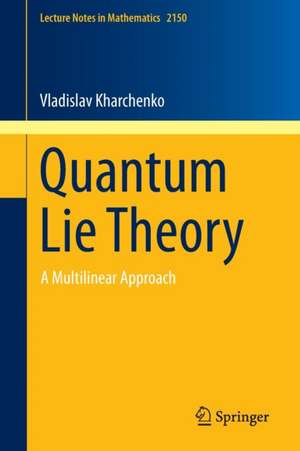
Quantum Lie Theory: Lecture Notes in Mathematics, cartea 2150
Autor Vladislav Kharchenkoen Limba Engleză Paperback – 25 dec 2015
Recomandăm Quantum Lie Theory ca o resursă esențială de nivel masterat și doctorat, fiind totodată o lucrare de referință fundamentală pentru cercetătorii în matematică și fizică teoretică. Volumul semnat de Vladislav Kharchenko și publicat în prestigioasa serie Lecture Notes in Mathematics de la Springer tratează o problemă persistentă a ultimelor decenii: dificultatea definirii unei algebre Lie cuantice ca obiect algebric elegant prin bracket-uri cuantice binare. Autorul propune o schimbare de paradigmă, dezvoltând o teorie bazată pe operații multiliniare.
Considerăm că structura logică a cărții facilitează tranziția de la concepte fundamentale la cercetare avansată. Primul capitol oferă baza necesară din algebra necomutativă, pentru ca ulterior textul să exploreze terenuri complexe precum cuantificările algebrelor Kac–Moody, algebrele Nichols și operațiile Shestakov–Umirbaev. Un punct forte al acestei ediții este rigoarea cu care este demonstrată teorema de tip PBW în context cuantic, un element crucial pentru stabilitatea structurală a noilor modele propuse.
Acoperă aceeași arie tematică precum Introduction to Quantum Groups de George Lusztig, dar cu o abordare care se distanțează de definițiile clasice de tip Hopf ale lui Drinfeld și Jimbo, preferând o explorare a structurilor non-asociative și a elementelor skew-primitive. Față de volumele de conferință, precum Algebra, Geometry and Mathematical Physics, lucrarea lui Kharchenko oferă o viziune unitară și coerentă, fiind rezultatul unor ani de cercetare individuală integrată într-un sistem teoretic complet.
Din seria Lecture Notes in Mathematics
-
 Preț: 340.60 lei
 -
 Preț: 429.99 lei
 - 17%
 Preț: 404.51 lei
 -
 Preț: 443.63 lei
 - 17%
 Preț: 409.79 lei
 -
 Preț: 500.22 lei
 - 17%
 Preț: 411.47 lei
 - 17%
 Preț: 485.70 lei
 - 17%
 Preț: 486.79 lei
 -
 Preț: 404.87 lei
 -
 Preț: 392.84 lei
 -
 Preț: 335.43 lei
 -
 Preț: 464.87 lei
 -
 Preț: 262.16 lei
 -
 Preț: 468.94 lei
 -
 Preț: 318.08 lei
 -
 Preț: 322.53 lei
 -
 Preț: 410.84 lei
 -
 Preț: 411.74 lei
 -
 Preț: 313.64 lei
 -
 Preț: 400.49 lei
 -
 Preț: 262.84 lei
 -
 Preț: 313.49 lei
 -
 Preț: 350.23 lei
 -
 Preț: 360.44 lei
 -
 Preț: 405.97 lei
 - 20%
 Preț: 471.32 lei
 -
 Preț: 266.56 lei
 -
 Preț: 408.44 lei
 - 15%
 Preț: 481.85 lei
 -
 Preț: 464.67 lei
 -
 Preț: 337.06 lei
 -
 Preț: 315.67 lei
 -
 Preț: 327.35 lei
 -
 Preț: 410.48 lei
 -
 Preț: 405.97 lei
 -
 Preț: 453.73 lei
 -
 Preț: 500.82 lei
 -
 Preț: 217.70 lei
 -
 Preț: 373.93 lei
 -
 Preț: 315.87 lei
 - 15%
 Preț: 573.68 lei
 -
 Preț: 407.65 lei
 -
 Preț: 386.51 lei
 -
 Preț: 468.94 lei
 -
 Preț: 390.96 lei
 -
 Preț: 262.10 lei
 -
 Preț: 267.53 lei
 -
 Preț: 485.67 lei
 -
 Preț: 389.30 lei
Preț: 405.85 lei
Carte tipărită la comandă
Livrare economică 05-19 decembrie
Specificații
ISBN-10: 3319227033
Pagini: 320
Ilustrații: XIII, 302 p.
Dimensiuni: 155 x 235 x 18 mm
Greutate: 0.49 kg
Ediția:1st edition 2015
Editura: Springer
Colecția Lecture Notes in Mathematics
Seria Lecture Notes in Mathematics
Locul publicării:Cham, Switzerland
V-ar putea interesa
-
 An Introduction to the Theory of NumbersG. H. Hardy-19%Preț: 443.26 lei548.81 lei
 -
 Mathematics as Problem SolvingAlexander SoiferPreț: 413.85 lei
 -
 Analysis in Vector SpacesMustafa A Akcoglu-9%Preț: 1087.57 lei1195.13 lei
 -
 Linear Algebra For DummiesMary Jane SterlingPreț: 136.70 lei
 -
 Book of Abstract AlgebraCharles C. Pinter-24%Preț: 145.43 lei191.28 lei
 -
 Introduction to Graph TheoryRichard J. Trudeau-19%Preț: 84.10 lei103.54 lei
 -
 Galois Groups and Fundamental GroupsTamás Szamuely-11%Preț: 516.41 lei580.23 lei
 -
 The Symmetric GroupBruce E. SaganPreț: 422.07 lei
 -
 -15%Preț: 535.43 lei629.91 lei
 -
 InequalitiesRadmila Bulajich ManfrinoPreț: 454.59 lei
 -
 Risk and Asset AllocationAttilio Meucci-15%Preț: 595.39 lei700.47 lei
 -
 Cohomology of Finite GroupsAlejandro Adem-15%Preț: 645.99 lei759.98 lei
 -
 Methods of Homological AlgebraSergei I. Gelfand-18%Preț: 752.62 lei917.84 lei
 -
 Profinite GroupsLuis Ribes-18%Preț: 1121.78 lei1368.02 lei
 -
 Algebra for Symbolic ComputationAntonio MachiPreț: 384.50 lei
 -
 Preț: 112.54 lei
Public țintă
ResearchDe ce să citești această carte
Această lucrare este indispensabilă pentru cercetătorii care studiază deformările cuantice și algebrele Hopf. Cititorul câștigă acces la o teorie originală, bine documentată, care rezolvă inconsecvențele modelelor binare tradiționale. Este o investiție valoroasă pentru cei care doresc să stăpânească bazele Poincaré-Birkhoff-Witt și algebrele de elemente primitive într-un context matematic modern și riguros.