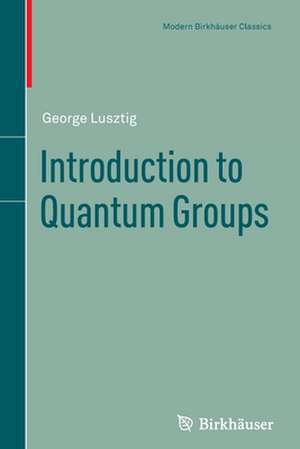
Introduction to Quantum Groups
Autor George Lusztigen Limba Engleză Paperback – 2 noi 2010
Ne-a atras atenția modul în care Introduction to Quantum Groups abordează subiectul dintr-o perspectivă pur matematică, integrându-l organic în teoria Lie. Capitolul dedicat realizării geometrice a algebrei f marchează un punct de cotitură în text, unde George Lusztig utilizează teoria fasciculelor perverse și a varietăților quiver pentru a fundamenta structurile algebrice discutate. Această abordare riguroasă transformă deformările algebrelor Hopf, introduse inițial de Drinfeld și Jimbo, într-un studiu profund al simetriilor și reprezentărilor. Structura volumului este una progresivă, debutând cu algebra Drinfeld-Jimbo, explorând matricea quasi-R și teoremele de reductibilitate completă, pentru ca în final să detalieze construcția bazelor canonice. Cititorii familiarizați cu A Guide to Quantum Groups de Vyjayanthi Chari vor aprecia aici accentul pus pe metodele geometrice și pe baza canonică, un element central al cercetărilor lui Lusztig, care oferă o profunzime tehnică superioară tratatelor introductive generale. În contextul operei sale, această lucrare consolidează temele explorate în Characters of Reductive Groups over a Finite Field, extinzând utilizarea cohomologiei etale și a intersecției către domeniul grupurilor cuantice. Dacă în lucrările anterioare autorul se concentra pe clasificarea reprezentărilor ireductibile, aici el redefinește fundamentul algebric al acestora prin prisma deformărilor cu parametrul v. Ritmul este dens, specific unui curs de nivel postuniversitar, iar corecțiile aduse în reeditările succesive fac din acest volum un text de referință pentru orice cercetător în algebră.
Preț: 533.67 lei
Preț vechi: 627.84 lei
-15%
Carte tipărită la comandă
Livrare economică 16-30 noiembrie
Specificații
ISBN-10: 0817647163
Pagini: 352
Ilustrații: XIV, 352 p.
Dimensiuni: 159 x 233 x 25 mm
Greutate: 0.54 kg
Ediția:1st ed. 1993. Corr. 2nd printing 1994. 3rd. printing 2010
Editura: BIRKHAUSER BOSTON INC
Locul publicării:Boston, MA, United States
V-ar putea interesa
-
 Guide to Quantum GroupsVyjayanthi Chari-14%Preț: 684.13 lei795.49 lei
 -
 Learning Web App DevelopmentSemmy Purewal-20%Preț: 245.17 lei306.46 lei
 -
 Datenbanksysteme: Eine EinführungAlfons Kemper-20%Preț: 363.31 lei454.15 lei
 -
 Differentialgleichungen und Mathematische ModellbildungNail H. Ibragimov-8%Preț: 393.16 lei427.35 lei
 -
 Protocol EngineeringHartmut König-20%Preț: 292.82 lei366.02 lei
 -
 Logik für InformatikerJürgen Dassow-20%Preț: 228.62 lei285.77 lei
 -
 Preț: 193.07 lei
 -
 Vorlesungen über InformatikGerhard Goos-20%Preț: 163.17 lei203.96 lei
 -
 Funktionale und Applikative ProgrammierungWolfram-Manfred Lippe-20%Preț: 308.65 lei385.81 lei
 -
 -20%Preț: 231.42 lei289.28 lei
 -
 Aufbaukurs Funktionalanalysis und OperatortheorieWinfried KaballoPreț: 341.01 lei
 -
 Aufgabensammlung Analysis 2, Funktionalanalysis und DifferentialgleichungenHans-Jürgen ReinhardtPreț: 289.79 lei
 -
 Aufgabensammlung NumerikHans-Jürgen ReinhardtPreț: 288.98 lei
 -
 Preț: 142.34 lei
 -
 The Art of Unit TestingRoy Osherove-20%Preț: 231.67 lei289.59 lei
 -
 Information Retrieval und künstliche IntelligenzHelmut JaroschPreț: 487.62 lei
Public țintă
GraduateDe ce să citești această carte
Recomandăm această carte matematicienilor care doresc să înțeleagă grupurile cuantice dincolo de aplicațiile lor în fizică. Cititorul câștigă acces la tehnici geometrice avansate, precum fasciculele perverse, aplicate direct în teoria reprezentării. Este o resursă esențială pentru doctoranzi, oferind o fundamentare teoretică pe care s-a construit o mare parte din algebra modernă post-1990.
Despre autor
George Lusztig este profesor de matematică la Massachusetts Institute of Technology (MIT) și unul dintre cei mai influenți teoreticieni în domeniul teoriei reprezentării. Opera sa este marcată de utilizarea inovatoare a metodelor geometrice în algebră, fiind recunoscut pentru contribuțiile sale fundamentale la studiul grupurilor reductive și al algebrelor Hecke. Lucrările sale, precum Iwahori-Hecke Algebras and their Representation Theory, au pus bazele multor direcții de cercetare actuale în matematică, transformând radical modul în care sunt înțelese simetriile algebrice complexe.
Descriere scurtă
Cuprins
Recenzii
—Bulletin of the London Mathematical Society
"This book is an important contribution to the field and can be recommended especially to mathematicians working in the field."
—EMS Newsletter
"The present book gives a very efficient presentation of an important part of quantum group theory. It is a valuable contribution to the literature."
—Mededelingen van het Wiskundig
"Lusztig's book is very well written and seems to be flawless...Obviously, this will be the standard reference book for the material presented and anyone interested in the Drinfeld–Jimbo algebras will have to study it very carefully."
—ZAA
"[T]his book is much more than an 'introduction to quantum groups.' It contains a wealth of material. In addition to the many important results (of which several are new–at least in the generality presented here), there are plenty of useful calculations (commutator formulas, generalized quantum Serre relations, etc.)."
—Zentralblatt MATH
“George Lusztig lays out the large scale structure of the discussion that follows in the 348 pages of his Introduction to Quantum Groups. … A significant and important work. … it’s terrific stuff, elegant and deep, and Lusztig presents it very well indeed, of course.” (Michael Berg, The Mathematical Association of America, January, 2011)
Textul de pe ultima copertă
Introduction to Quantum Groups will be of interest to mathematicians working in the representation theory of Lie groups and Lie algebras, knot theorists, theoretical physicists, and graduate students. Since large parts of the book are independent of the theory of perverse sheaves, the work may also be used as a textbook.
****************************************
There is no doubt that this volume is a very remarkable piece of work...Its appearance represents a landmark in the mathematical literature.
—Bulletin of the London Mathematical Society
This book is an important contribution to the field and can be recommended especially to mathematicians working in the field.
—EMS Newsletter
The present book gives a very efficient presentation of an important part of quantum group theory. It is a valuable contribution to the literature.
—Mededelingen van het Wiskundig
Lusztig's book is very well written and seems to be flawless...Obviously, this will be the standard reference book for the material presented and anyone interested in the Drinfeld–Jimboalgebras will have to study it very carefully.
—ZAA
[T]his book is much more than an 'introduction to quantum groups.' It contains a wealth of material. In addition to the many important results (of which several are new–at least in the generality presented here), there are plenty of useful calculations (commutator formulas, generalized quantum Serre relations, etc.).
—Zentralblatt MATH