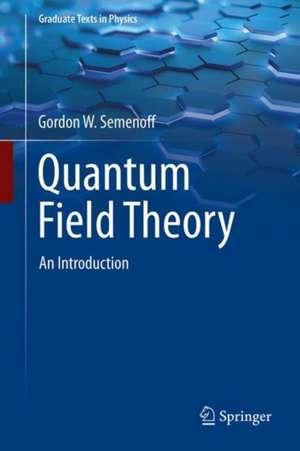
Quantum Field Theory: An Introduction: Graduate Texts in Physics
Autor Gordon Walter Semenoffen Limba Engleză Hardback – 15 noi 2023
Din seria Graduate Texts in Physics
- 15%
 Preț: 464.28 lei
 - 17%
 Preț: 395.90 lei
 - 15%
 Preț: 578.40 lei
 - 22%
 Preț: 435.13 lei
 - 15%
 Preț: 631.96 lei
 - 20%
 Preț: 617.08 lei
 - 15%
 Preț: 497.17 lei
 - 15%
 Preț: 597.58 lei
 - 15%
 Preț: 500.10 lei
 -
 Preț: 442.61 lei
 - 18%
 Preț: 758.15 lei
 - 15%
 Preț: 618.91 lei
 - 15%
 Preț: 498.31 lei
 -
 Preț: 482.44 lei
 -
 Preț: 376.27 lei
 -
 Preț: 443.01 lei
 - 15%
 Preț: 647.74 lei
 - 15%
 Preț: 461.63 lei
 -
 Preț: 385.10 lei
 - 15%
 Preț: 512.42 lei
 - 15%
 Preț: 598.20 lei
 -
 Preț: 489.97 lei
 - 15%
 Preț: 578.83 lei
 - 15%
 Preț: 627.48 lei
 - 15%
 Preț: 700.04 lei
 -
 Preț: 388.40 lei
 - 15%
 Preț: 533.03 lei
 -
 Preț: 438.52 lei
 - 18%
 Preț: 718.59 lei
 - 15%
 Preț: 589.17 lei
 - 19%
 Preț: 556.67 lei
 - 15%
 Preț: 464.25 lei
 - 18%
 Preț: 725.13 lei
 -
 Preț: 435.08 lei
 -
 Preț: 442.28 lei
 - 15%
 Preț: 422.03 lei
 -
 Preț: 387.82 lei
 - 15%
 Preț: 463.67 lei
 - 19%
 Preț: 406.98 lei
 -
 Preț: 372.67 lei
 - 15%
 Preț: 701.26 lei
 - 15%
 Preț: 579.12 lei
Preț: 570.73 lei
Preț vechi: 704.61 lei
-19%
Puncte Express: 856
Carte tipărită la comandă
Livrare economică 18-25 mai
Specificații
ISBN-13: 9789819954094
ISBN-10: 9819954096
Pagini: 403
Ilustrații: X, 403 p. 40 illus., 5 illus. in color.
Dimensiuni: 155 x 235 x 25 mm
Greutate: 0.84 kg
Ediția:2023
Editura: Springer Nature Singapore
Colecția Springer
Seria Graduate Texts in Physics
Locul publicării:Singapore, Singapore
ISBN-10: 9819954096
Pagini: 403
Ilustrații: X, 403 p. 40 illus., 5 illus. in color.
Dimensiuni: 155 x 235 x 25 mm
Greutate: 0.84 kg
Ediția:2023
Editura: Springer Nature Singapore
Colecția Springer
Seria Graduate Texts in Physics
Locul publicării:Singapore, Singapore
Cuprins
1. Prologue.- 2. Many particle physics as a quantum field theory.- 3. Degenerate Fermi and Bose gases.- 4. The action principle and Noether’s theorem.- 5. Non-relativistic space-time symmetries.- 6. Space-time symmetry and relativistic field theory.- 7. The real scalar quantum field theory.- 8. Emergent relativistic symmetry.- 9. The Dirac field theory.- 10. Photons.
Notă biografică
Gordon W. Semenoff is Professor at The University of British Columbia in Vancouver, Canada. His research examines the nature at its most fundamental level. His recent interests have been in superstring theory and duality of string theories with strongly coupled gauge field theories and in quantum gravity. He is also interested in quantum information theoretic questions in quantum field theory.
Textul de pe ultima copertă
This textbook is intended to be used in an introductory course in quantum field theory. It assumes the standard undergraduate education of a physics major and it is designed to appeal to a wide array of physics graduate students, from those studying theoretical and experimental high energy physics to those interested in condensed matter, optical, atomic, nuclear and astrophysicists. It includes a thorough development of the field theoretic approach to nonrelativistic many-body physics as a step in developing a broad-based working knowledge of some of the basic aspects of quantum field theory. It presents a logical, step by step systematic development of relativistic field theory and of functional techniques and their applications to perturbation theory with Feynman diagrams, renormalization, and basic computations in quantum electrodynamics.
Caracteristici
A modern, accessible, inclusive, first principles introduction to quantum field theory Provides a basic working knowledge of field theory, functional methods and Feynman diagrams Introduces renormalization, the renormalization group and the basics of quantum electrodynamics
Descriere
Descriere de la o altă ediție sau format:
It includes a thorough development of second quantization and the field theoretic approach to nonrelativistic many-body physics as a step in developing a broad-based working knowledge of the basic aspects of quantum field theory.
It includes a thorough development of second quantization and the field theoretic approach to nonrelativistic many-body physics as a step in developing a broad-based working knowledge of the basic aspects of quantum field theory.