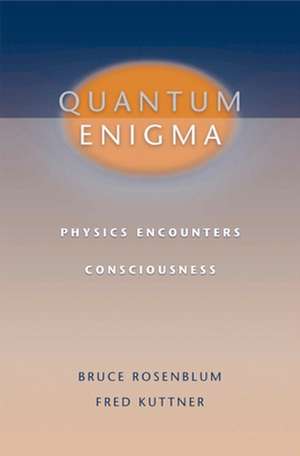
Quantum Enigma
Autor Bruce Rosenblum, Fred Kuttneren Limba Engleză Hardback – 29 iun 2006
Structura volumului Quantum Enigma este riguros organizată pentru a ghida cititorul de la certitudinile laboratorului către dilemele filosofice ale fizicii moderne. Metodologia autorilor, Bruce Rosenblum și Fred Kuttner, se bazează pe o demarcație clară: prezentarea faptelor experimentale indiscutabile ale mecanicii cuantice, urmată de o examinare critică a interpretărilor acestora. Notăm cu interes modul în care aceștia „deschid dulapul” pentru a analiza scheletul teoriei — conexiunea stânjenitoare, dar inevitabilă, dintre observator și realitatea fizică. Găsim în această carte o abordare onestă a modului în care succesul tehnologic al teoriei, care susține o treime din economia modernă, coexistă cu implicații care par să sfideze logica cotidiană. Subliniem faptul că autorii evită jargonul matematic excesiv, optând pentru narațiuni și analogii care fac accesibile concepte precum Teorema lui Bell sau inseparabilitatea cuantică. Cititorii familiarizați cu The Mystery of the Quantum World de Euan J. Squires vor aprecia modul în care Quantum Enigma aduce discuția în zona conștiinței umane și a liberului arbitru, oferind o perspectivă mai aplicată asupra modului în care fizica se intersectează cu cosmologia. Spre deosebire de alte lucrări care tratează subiectul pur teoretic, acest volum publicat de Oxford University Press menține un echilibru între rigoarea academică și curiozitatea speculativă. Această lucrare ocupă un loc central în opera autorilor, fiind o dezvoltare logică a cercetărilor lor despre rolul observatorului, temă explorată și în contribuțiile lor din Quantum Physics of Consciousness. Dacă în lucrările colective aceștia se concentrează pe date tehnice, aici Bruce Rosenblum și Fred Kuttner își permit să exploreze granița unde expertiza fizicianului întâlnește interogația filosofică, invitând cititorul să își formuleze propriile concluzii despre natura realității.
Preț: 777.91 lei
Preț vechi: 1010.28 lei
-23%
Carte tipărită la comandă
Livrare economică 30 noiembrie-14 decembrie
Specificații
ISBN-10: 019517559X
Pagini: 224
Dimensiuni: 162 x 235 x 23 mm
Greutate: 0.49 kg
Editura: Oxford University Press
V-ar putea interesa
-
 Quaternionic Quantum Mechanics and Quantum FieldsStephen L. Adler-32%Preț: 1594.81 lei2355.63 lei
 -
 How is Quantum Field Theory Possible?Sunny Y. Auyang-20%Preț: 349.44 lei438.66 lei
 -
 Elements of Quantum MechanicsMichael D. Fayer-33%Preț: 1699.70 lei2533.80 lei
 -
 The Quantum Classical TheoryGert D. Billing-30%Preț: 538.85 lei769.69 lei
 -
 Quantum Monte Carlo: Origins, Development, ApplicationsJames B. Anderson-31%Preț: 599.38 lei871.15 lei
 -
 Statistical Mechanics: A Survival GuideA.M. Glazer-33%Preț: 816.96 lei1217.31 lei
 -
 Quantum Chaos and Quantum DotsKatsuhiro Nakamura-33%Preț: 977.49 lei1455.69 lei
 -
 Essential Quantum MechanicsGary Bowman-13%Preț: 362.13 lei414.92 lei
 -
 The Quantum Mechanics of Minds and WorldsJeffrey A. Barrett-28%Preț: 390.94 lei546.71 lei
 -
 Quantum Mechanics: Theory and ExperimentMark Beck-23%Preț: 956.43 lei1242.11 lei
 -
 -9%Preț: 910.97 lei1001.06 lei
 -
 Preț: 113.40 lei
 -
 Quantum Mechanics Upon TheoremsFu-sui Liu-26%Preț: 1641.50 lei2232.71 lei
 -
 Contemporary Research in Quantum SystemsZoheir Ezziane-26%Preț: 1338.04 lei1817.87 lei
 -
 QUANTUM FIELD THEORY & ITS MACOSCOPIC...Blasone Massimo-18%Preț: 1107.35 lei1350.43 lei
 -
 QUANTUM MECHANICS (2ND EDITION)Steward Edward GPreț: 502.64 lei
 -
 Portrait of Gunnar KällénCecilia JarlskogPreț: 437.70 lei
 -
 The Discrete Nonlinear Schrödinger EquationPanayotis G. Kevrekidis-18%Preț: 1228.76 lei1498.49 lei
 -
 -15%Preț: 666.33 lei783.92 lei
 -
 PROBING THE MEANING OF QUANTUM MECHANICSRonde Christian de-18%Preț: 845.64 lei1031.27 lei
De ce să citești această carte
Recomandăm această carte celor care doresc să înțeleagă de ce mecanica cuantică rămâne cea mai bizară și totodată cea mai precisă teorie științifică. Cititorul câștigă o perspectivă clară asupra experimentelor care au forțat fizicienii să accepte că observarea influențează realitatea. Este o lectură esențială pentru pasionații de știință care vor să exploreze legătura dintre minte și materie fără a sacrifica rigoarea factuală.
Despre autor
Bruce Rosenblum este profesor de fizică și fost președinte al Departamentului de Fizică din cadrul University of California, Santa Cruz. Experiența sa academică îndelungată este completată de colaborarea cu Fred Kuttner, de asemenea profesor la aceeași universitate și fost fizician în sectorul industrial. Împreună, cei doi autori și-au dedicat cariera predării și cercetării fundamentelor mecanicii cuantice, fiind recunoscuți pentru capacitatea de a traduce concepte complexe în limbaj accesibil, menținând totodată standardele riguroase ale comunității științifice.
Descriere scurtă
they observed in their laboratories.
Trying to understand the atom, physicists built quantum mechanics and found, to their embarrassment, that their theory intimately connects consciousness with the physical world. Quantum Enigma explores what that implies and why some founders of the theory became the foremost objectors to it.
Schrodinger showed that it "absurdly" allowed a cat to be in a "superposition" simultaneously dead and alive. Einstein derided the theory's "spooky interactions." With Bell's Theorem, we now know Schrodinger's superpositions and Einstein's spooky interactions indeed exist.
Authors Bruce Rosenblum and Fred Kuttner explain all of this in non-technical terms with help from some fanciful stories and bits about the theory's developers. They present the quantum mystery honestly, with an emphasis on what is and what is not speculation.
Physics' encounter with consciousness is its skeleton in the closet. Because the authors open the closet and examine the skeleton, theirs is a controversial book. Quantum Enigma's description of the experimental quantum facts, and the quantum theory explaining them, is undisputed. Interpreting what
it all means, however, is controversial.
Every interpretation of quantum physics encounters consciousness. Rosenblum and Kuttner therefore turn to exploring consciousness itself--and encounter quantum physics. Free will and anthropic principles become crucial issues, and the connection of consciousness with the cosmos suggested by some
leading quantum cosmologists is mind-blowing.
Readers are brought to a boundary where the particular expertise of physicists is no longer a sure guide. They will find, instead, the facts and hints provided by quantum mechanics and the ability to speculate for themselves. The most successful theory in all of science--and the basis of one third of our economy--says the strangest things about the world and about us. Can you believe that physical reality is created by our observation of it? Physicists were forced to this conclusion, the quantum enigma, by what
they observed in their laboratories.
Trying to understand the atom, physicists built quantum mechanics and found, to their embarrassment, that their theory intimately connects consciousness with the physical world. Quantum Enigma explores what that implies and why some founders of the theory became the foremost objectors to it.
Schrodinger showed that it "absurdly" allowed a cat to be in a "superposition" simultaneously dead and alive. Einstein derided the theory's "spooky interactions." With Bell's Theorem, we now know Schrodinger's superpositions and Einstein's spooky interactions indeed exist.
Authors Bruce Rosenblum and Fred Kuttner explain all of this in non-technical terms with help from some fanciful stories and bits about the theory's developers. They present the quantum mystery honestly, with an emphasis on what is and what is not speculation.
Physics' encounter with consciousness is its skeleton in the closet. Because the authors open the closet and examine the skeleton, theirs is a controversial book. Quantum Enigma's description of the experimental quantum facts, and the quantum theory explaining them, is undisputed. Interpreting what
it all means, however, is controversial.
Every interpretation of quantum physics encounters consciousness. Rosenblum and Kuttner therefore turn to exploring consciousness itself--and encounter quantum physics. Free will and anthropic principles become crucial issues, and the connection of consciousness with the cosmos suggested by some
leading quantum cosmologists is mind-blowing.
Readers are brought to a boundary where the particular expertise of physicists is no longer a sure guide. They will find, instead, the facts and hints provided by quantum mechanics and the ability to speculate for themselves.
Notă biografică
Bruce Rosenblum is Professor of Physics and former Chairperson of the Physics Department at the University of California, Santa Cruz. He has also consulted extensively for government and industry on technical and policy issues. His research has moved from molecular physics to condensed matter physics and, after a foray into biophysics, has focused on fundamental issues in quantum mechanics. After a career in industry that included two technology startups, and following a second career in academic administration, Fred Kuttner now devotes most of his time to teaching physics at the University of California, Santa Cruz. His research interests have centered on the low temperature properties of solids and the thermal properties of magnets. For the last several years, Kuttner has worked on the foundations of quantum mechanics and the implications of the quantum theory.