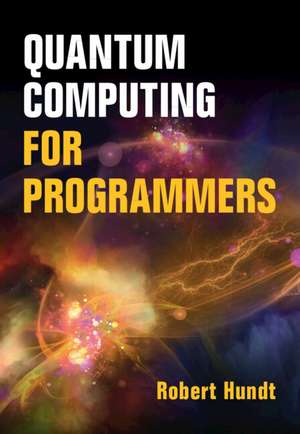
Quantum Computing for Programmers
Autor Robert Hundten Limba Engleză Hardback – 31 mar 2022
Remarcăm în Quantum Computing for Programmers o abordare riguroasă, dar accesibilă, dedicată programatorului clasic care dorește să înțeleagă mecanica din spatele porților cuantice. Volumul debutează cu capitolul „The mathematical minimum”, esențial pentru ancorarea cititorului în formalismul necesar, înainte de a trece la implementări concrete. Ceea ce distinge această lucrare de alte introduceri este focalizarea pe infrastructura de simulare; autorul Robert Hundt nu oferă doar teorie, ci și cod în Python și C++ pentru peste 25 de algoritmi, de la teleportare cuantică la algoritmul lui Shor și Grover. Structura cărții este construită pentru a asigura o progresie logică: primele capitole stabilesc fundamentele, în timp ce secțiunile de mijloc explorează simularea scalabilă și algoritmii care depășesc capacitățile clasice. Spre final, Cambridge University Press propune o analiză detaliată a productivității programatorului, discutând limbajele de programare cuantică și tehnicile de compilare, un aspect adesea ignorat în textele introductive. Apreciem în mod deosebit includerea algoritmului Solovay–Kitaev pentru aproximarea porților, oferind astfel o perspectivă completă asupra stivei de software cuantic. Această lucrare completează perspectiva oferită de Quantum Computing Algorithms de Barry Burd. În timp ce volumul lui Burd se concentrează pe o abordare intuitivă cu minim de matematică și utilizarea Qiskit, cartea lui Robert Hundt adaugă profunzime prin derivări matematice complete și dezvoltarea unui simulator de la zero. Astfel, cititorul nu doar folosește instrumente existente, ci înțelege arhitectura internă a sistemelor de calcul cuantic, fiind o resursă superioară pentru cei care vizează optimizarea și dezvoltarea de compilatoare cuantice.
Preț: 443.25 lei
Carte disponibilă
Livrare economică 20 august-03 septembrie
Specificații
ISBN-10: 1009098179
Pagini: 376
Dimensiuni: 175 x 250 x 25 mm
Greutate: 0.83 kg
Ediția:Nouă
Editura: Cambridge University Press
Locul publicării:New York, United States
V-ar putea interesa
-
 -31%Preț: 268.63 lei388.03 lei
 -
 -18%Preț: 1433.29 lei1747.91 lei
 -
 Computers in the Public ServiceG. M. Lamb-18%Preț: 1112.48 lei1356.68 lei
 -
 -18%Preț: 1003.26 lei1223.49 lei
 -
 -18%Preț: 1119.00 lei1364.63 lei
 -
 Digital ContagionsJussi Parikka-20%Preț: 413.62 lei517.03 lei
 -
 Handbook of Research on Discrete Event Simulation EnvironmentsEvon M. O. Abu-Taieh-20%Preț: 1789.63 lei2237.04 lei
 -
 Handbook of Artificial Intelligence in Biomedical EngineeringSaravanan Krishnan-20%Preț: 1418.78 lei1773.48 lei
 -
 Change ManagerTracey Torble-20%Preț: 142.59 lei178.23 lei
 -
 Research in Computational Molecular BiologyHaixu Tang-20%Preț: 267.51 lei334.39 lei
 -
 Enhanced Building Information ModelsUmit Isikdag-20%Preț: 309.76 lei387.19 lei
 -
 -20%Preț: 317.05 lei396.31 lei
 -
 Technological Innovation for Cyber-Physical SystemsLuis M. Camarinha-Matos-20%Preț: 638.93 lei798.66 lei
 -
 Mehrzielorientiertes strategisches ControllingWolfgang Ossadnik-20%Preț: 296.23 lei370.28 lei
 -
 Datamining und Computational FinanceGeorg Bol-20%Preț: 295.83 lei369.79 lei
 -
 Prognozirovanie ob"emov prodazh v telekommunikatsionnoy otrasliRachenko Tat'yana-20%Preț: 371.74 lei464.68 lei
 -
 Bazy dannykhD'yakov Igor'-20%Preț: 321.18 lei401.48 lei
 -
 -20%Preț: 265.81 lei332.27 lei
 -
 -20%Preț: 267.24 lei334.05 lei
 -
 A generic architecture for e─Government and e─DemocracyCarlos Grima-Izquierdo-20%Preț: 435.36 lei544.20 lei
 -
 Kognitivno- kontekstnoe proektirovanie programmnykh sistemRazumovskiy Aleksey-20%Preț: 265.32 lei331.66 lei
 -
 Novel Approach Of Edge Detection In Mammographic ImagesPankaj Bhambri-20%Preț: 266.46 lei333.07 lei
 -
 -20%Preț: 268.19 lei335.23 lei
 -
 Modification in kNNSidana Eena-20%Preț: 265.81 lei332.27 lei
 -
 Parallelizm v protsessakh i programmakhCheremisinov Dmitriy-20%Preț: 434.08 lei542.59 lei
 -
 -18%Preț: 1069.36 lei1304.11 lei
 -
 -18%Preț: 1340.86 lei1635.20 lei
De ce să citești această carte
Această carte este ideală pentru programatorii experimentați și studenții la informatică ce doresc să treacă de la utilizarea unor biblioteci „black box” la înțelegerea profundă a algoritmilor cuantici. Prin combinarea codului C++ și Python cu rigoarea matematică, cititorul câștigă abilitatea de a simula și implementa soluții complexe, pregătindu-se pentru provocările reale ale ingineriei software cuantice și corecției erorilor.
Descriere scurtă
Cuprins
Recenzii
'There is a critical need for quantum software engineers in the emerging quantum computing industry. Robert Hundt is a classical software engineer who presents quantum computing as simply as possible to others with a similar background. This book could be the perfect vehicle for many interested in this emerging area.' Fred Chong, Seymour Goodman Professor, University of Chicago
'Quantum mechanics, the century old theory underlying modern physics and chemistry, has a reputation for being incomprehensible. Professional physicists have a standard approach to this conundrum: 'Shut up and calculate!'. This book provides an alternative much better suited to the programmers of the XXI century interested in quantum computing: 'Shut up and program!'.' Sergio Boixo, Google
'This book strikes just the right balance between theory and practice. Exploring quantum computing from the perspective of a classical programmer, using software and simulators to explain all concepts and algorithms, leads to an intuitive, accessible, yet deep learning experience. I highly recommend this book!' Kunle Olukotun, Cadence Design Professor, Stanford University
'This book takes a unique approach of introducing quantum computing with a combination of precise but manageable mathematics, open-source code, and detailed derivations of many core quantum algorithms, which makes it an ideal learning resource for the community of software programmers, including both students and professionals, to explore the fascinating land of quantum computing.' Jason Cong, Volgenau Chair for Engineering Excellence, UCLA