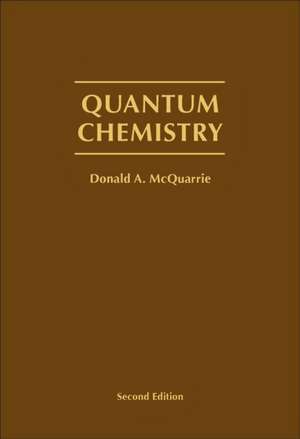
Quantum Chemistry
Autor Donald A. McQuarrie Ilustrat de Mervin Hansonen Limba Engleză Hardback – 30 sep 2007
Considerăm că a doua ediție a lucrării Quantum Chemistry de Donald A. McQuarrie reprezintă o actualizare esențială pentru curriculumul de chimie fizică, adaptând un text clasic la realitățile cercetării moderne. Elementul de noutate absolută față de prima ediție este accentul pus pe chimia computațională. În timp ce literatura anterioară se concentra masiv pe soluții analitice, McQuarrie introduce acum algoritmi pas-cu-pas pentru calcule SCF (Self-Consistent Field) și explică utilizarea orbitalilor de tip Gaussian, deveniți standard în industrie prin pachete software precum Gaussian și WebMo.
Apreciem în mod deosebit structura pedagogică inovatoare: autorul a inserat „MathChapters” — secțiuni matematice intermediare care permit studenților să își consolideze aparatul de calcul fără a fragmenta fluxul logic al principiilor fizice. Această abordare transformă o disciplină adesea intimidantă într-una accesibilă, menținând în același timp rigoarea necesară pentru înțelegerea metodelor Hartree-Fock și a teoriei funcționale de densitate (DFT). Experiența de lectură este una ghidată, în care teoria este imediat validată prin corelarea cu datele experimentale din baza de date NIST.
Această ediție completează perspectiva oferită de Fundamentals of Quantum Chemistry de James E. House, adăugând o componentă practică mult mai robustă în ceea ce privește simulările pe computer și terminologia specifică (CISD, CCSD, BLPY). Dacă lucrarea lui House pune bazele teoretice, volumul de față face trecerea către aplicarea acestora în laboratorul virtual. Comparativ cu Elementary Quantum Chemistry, Second Edition de Frank L Pilar, care analizează istoric comportamentul atomilor individuali, Quantum Chemistry se concentrează pe sistemele multielectronice și pe tehnicile moderne de predicție a proprietăților moleculare, fiind un instrument de lucru indispensabil pentru chimistul contemporan.
Preț: 747.23 lei
Preț vechi: 911.25 lei
-18%
Carte disponibilă
Livrare economică 08-22 mai
Specificații
ISBN-10: 1891389505
Pagini: 690
Dimensiuni: 175 x 262 x 36 mm
Greutate: 1.32 kg
Ediția:Revizuită
Editura: University Science Books
Locul publicării:Sausalito, United States
V-ar putea interesa
-
 Spectra of Atoms and MoleculesPeter F. Bernath-33%Preț: 613.36 lei909.78 lei
 -
 -9%Preț: 390.72 lei431.38 lei
 -
 Problems in Structural Inorganic ChemistryWai-Kee Li-21%Preț: 366.03 lei465.16 lei
 -
 Molecular Quantum MechanicsPeter W. Atkins-19%Preț: 472.94 lei583.87 lei
 -
 Advanced Organic ChemistryFrancis A. Carey-17%Preț: 413.21 lei497.85 lei
 -
 Theoretical Foundations of Quantum ComputingDaowen Qiu-33%Preț: 448.55 lei674.38 lei
 -
 Preț: 397.04 lei
 -
 -18%Preț: 97.92 lei119.48 lei
 -
 General ChemistryLinus Pauling-20%Preț: 202.55 lei254.72 lei
 -
 Quantum TheoryDavid Bohm-21%Preț: 198.36 lei252.18 lei
 -
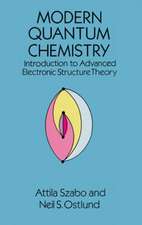 Modern Quantum ChemistryAttila Szabó-25%Preț: 160.97 lei215.38 lei
 -
 Physics of Atoms and MoleculesBrian H. Bransden-13%Preț: 564.32 lei648.65 lei
 -
 Quantum Mechanics: Volume 3David TongPreț: 307.86 lei
 -
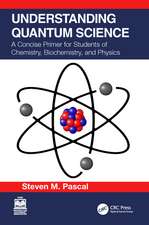 Preț: 415.85 lei
 -
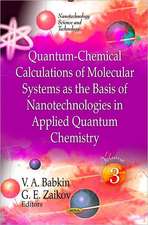 -30%Preț: 921.97 lei1319.05 lei
 -
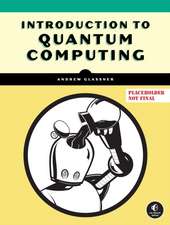 Quantum Computing: From Concepts to CodeAndrew Glassner-36%Preț: 226.11 lei353.98 lei
 -
 General ChemistryDonald McQuarrie-8%Preț: 568.16 lei617.57 lei
 -
 Magnetic Interactions in Molecules and SolidsCoen De GraafPreț: 382.85 lei
 -
 Introductory Quantum Mechanics with MATLABJames R. Chelikowsky-11%Preț: 475.22 lei533.95 lei
 -
 Quantum Computational ChemistryTaku Onishi-18%Preț: 1070.95 lei1306.04 lei
De ce să citești această carte
Recomandăm această carte studenților și cercetătorilor care doresc să stăpânească nu doar teoria mecanicii cuantice, ci și aplicarea ei practică prin software-uri moderne. Prin integrarea unică a secțiunilor de matematică și a exercițiilor computaționale, cititorul câștigă abilitatea de a rula și interpreta calcule complexe de structură electronică, o competență critică în chimia farmaceutică și a materialelor de astăzi.
Despre autor
Donald A. McQuarrie a fost un autor de prestigiu și profesor emerit la University of California, Davis, recunoscut la nivel mondial pentru abilitatea sa de a scrie manuale de referință în domeniul chimiei fizice și matematice. Lucrările sale sunt celebre pentru claritatea pedagogică și pentru modul în care reușesc să facă subiectele abstracte accesibile studenților. Colaborarea cu ilustratorul Mervin Hanson pentru această ediție a Quantum Chemistry subliniază importanța vizualizării în înțelegerea fenomenelor cuantice, reflectând dedicarea autorului pentru educația științifică de înalt nivel.
Cuprins
The Classical Wave Equation
The Schrödinger Equation and a Particle in a Box
The Postulates and General Principles of Quantum Mechanics
The Harmonic Oscillator and Vibrational Spectroscopy
The Rigid Rotator and Rotational Spectroscopy
The Hydrogen Atom
Approximation Methods
Many-Electron Atoms
The Chemical Bond: One-and-Two-Electron Molecules
Qualitative Theory of Chemical Bonding
Appendices
Solutions of Problems
Index
Notă biografică
Caracteristici
2 A series of short interchapters called MathChapters have been placed throughout the book to help students focus on the physical principles
3 Each chapter incorporates a broad range of problems and exercises, with answers to numerical problems at the back of the book