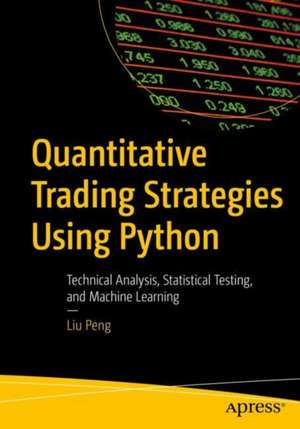
Quantitative Trading Strategies Using Python
Autor Peng Liuen Limba Engleză Paperback – 10 sep 2023
Descoperim în Quantitative Trading Strategies Using Python un ecosistem tehnic complet, centrat pe utilizarea limbajului Python și a bibliotecilor sale specializate pentru analiza datelor, vizualizare și execuție algoritmică. Notăm cu interes faptul că autorul nu se limitează la teorie, ci propune o incursiune practică în infrastructura piețelor electronice, oferind instrumentele necesare pentru a construi modele de tranzacționare de la zero. Structura volumului reflectă o progresie logică, de la conceptele de bază ale riscului și contractelor futures, către strategii consacrate de tip trend-following și momentum. Putem afirma că valoarea adăugată rezidă în partea finală, unde Peng Liu introduce metode avansate de optimizare. Pe linia practică a lucrării Python for Algorithmic Trading, dar cu un focus specific pe optimizarea Bayesiană și utilizarea testelor de ipoteze în arbitrajul statistic, această carte transformă conceptele matematice complexe în cod executabil. În contextul operei sale, lucrarea reprezintă o evoluție firească a expertizei autorului din titlul anterior, Bayesian Optimization, aplicând acele tehnici de reglare a hiperparametrilor direct în ecosistemul financiar. Fiecare capitol este conceput ca un modul de învățare, de la înțelegerea pieței până la generarea de semnale prin machine learning. Abordarea este una riguroasă, punând un accent deosebit pe validarea strategiilor prin backtesting și măsuri de performanță științifice, esențiale pentru orice analist cantitativ care dorește să automatizeze procesul decizional.
Preț: 269.00 lei
Preț vechi: 336.24 lei
-20%
Carte disponibilă
Livrare economică 07-21 noiembrie
Specificații
ISBN-10: 1484296745
Pagini: 352
Ilustrații: XI, 337 p. 102 illus., 90 illus. in color.
Dimensiuni: 178 x 254 x 20 mm
Greutate: 0.61 kg
Ediția:First Edition
Editura: Apress
Locul publicării:Berkeley, CA, United States
V-ar putea interesa
-
 Trade Your Way to Financial FreedomVan Tharp-15%Preț: 234.78 lei276.35 lei
 -
 -17%Preț: 162.86 lei196.40 lei
 -
 -17%Preț: 597.83 lei720.47 lei
 -
 Machine Learning for Factor Investing: Python VersionGuillaume Coqueret-15%Preț: 569.15 lei669.60 lei
 -
 Paul Wilmott on Quantitative Finance 2e +CD 3V SetPaul Wilmott-23%Preț: 1407.02 lei1827.30 lei
 -
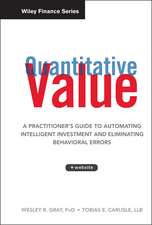 Quantitative ValueTobias E. Carlisle-8%Preț: 437.84 lei475.91 lei
 -
 The New Trading for a LivingAlexander Elder-8%Preț: 450.86 lei490.07 lei
 -
 -8%Preț: 418.96 lei455.39 lei
 -
 Advanced Portfolio Management - A Quant¿s Guide for Fundamental InvestorsGiuseppe A. PaleologoPreț: 249.07 lei
 -
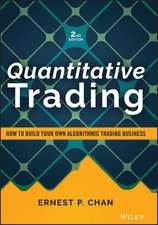 Preț: 300.57 lei
 -
 Quantitative Portfolio ManagementMichael IsichenkoPreț: 325.01 lei
 -
 Trading ThalesiansS. Amen-15%Preț: 521.11 lei613.08 lei
 -
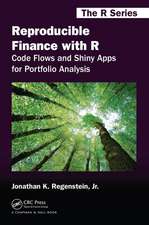 Reproducible Finance with R: Code Flows and Shiny Apps for Portfolio AnalysisJonathan K. Regenstein, Jr.-8%Preț: 585.26 lei636.15 lei
 -
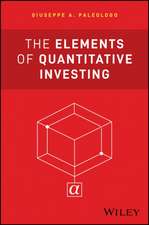 The Elements of Quantitative InvestingGiuseppe A. Paleologo-8%Preț: 450.09 lei489.23 lei
 -
 Generative AI for Trading and Asset ManagementHamlet Jesse Medina RuizPreț: 326.12 lei
 -
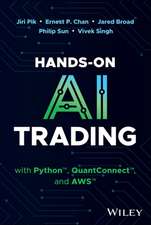 Hands-On AI Trading with Python, QuantConnect and AWSErnest P. ChanPreț: 330.07 lei
 -
 Quantitative Portfolio OptimizationAlberto Bueno Guerrero-8%Preț: 479.41 lei521.10 lei
 -
 -17%Preț: 66.97 lei80.66 leiRecomandat
 -
 Experimentation for EngineersDavid Sweet-20%Preț: 336.76 lei420.96 lei
 -
 -20%Preț: 249.86 lei312.33 lei
De ce să citești această carte
Recomandăm această carte specialiștilor în data science și traderilor care vor să treacă de la execuția manuală la cea algoritmică. Cititorul câștigă o metodologie clară pentru implementarea strategiilor de momentum și arbitraj, beneficiind de expertiza autorului în optimizarea bayesiană. Este un ghid tehnic esențial pentru construirea unui sistem de tranzacționare robust, bazat pe date și validat prin backtesting riguros.
Despre autor
Peng Liu este un autor cu o expertiză diversificată în domenii tehnice și analitice, fiind recunoscut în special pentru lucrările sale despre optimizarea globală și algoritmi de calcul. În cadrul portofoliului său, titlul Bayesian Optimization evidențiază capacitatea sa de a explica metode matematice avansate într-un mod intuitiv, competență pe care o transferă acum în domeniul finanțelor cantitative. Deși a explorat și teme de branding sau leadership educațional, contribuția sa principală rămâne în zona programării și a analizei de date, unde reușește să sintetizeze teoria complexă în soluții practice de implementare.
Descriere scurtă
Part one of Quantitative Trading Strategies with Python covers the fundamentals of trading strategies, including an introduction to quantitative trading, the electronic market, risk and return, and forward and futures contracts. Part two introduces common trading strategies, including trend-following, momentum trading, and evaluation process via backtesting. Part three covers more advanced topics, including statistical arbitrage using hypothesistesting, optimizing trading parameters using Bayesian optimization, and generating trading signals using a machine learning approach.
Whether you're an experienced trader looking to automate your trading strategies or a beginner interested in learning quantitative trading, this book will be a valuable resource. Written in a clear and concise style that makes complex topics easy to understand, and chock full of examples and exercises to help reinforce the key concepts, you’ll come away from it with a firm understanding of core trading strategies and how to use Python to implement them.
What You Will Learn
- Master the fundamental concepts of quantitative trading
- Use Python and its popular libraries to build trading models and strategies from scratch
- Perform data analysis and visualization, algorithmic trading, backtesting, risk management, optimization, and machine learning for trading strategies using Python
- Utilize common trading strategies such as trend-following, momentum trading, and pairs trading
- Evaluate different quantitative trading strategies by applying the relevant performance measures and statistics in a scientific manner during backtesting
Aspiring quantitative traders and analysts, data scientists interested in finance, and researchers or students studying quantitative finance, financial engineering, or related fields.