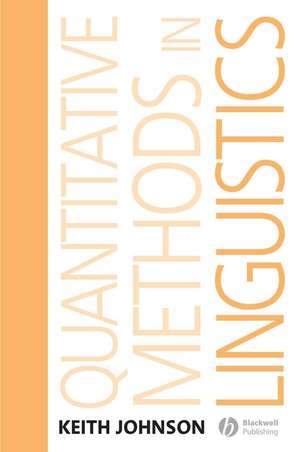
Quantitative Methods Linguistics
Autor Johnsonen Limba Engleză Paperback – 7 mar 2008
Manualul Quantitative Methods In Linguistics semnat de K Johnson se constituie ca un instrument de lucru esențial pentru studenții avansați și cercetătorii aflați la început de drum în domeniul lingvisticii. Ne-a atras atenția structura riguroasă a volumului, care nu se limitează la o prezentare teoretică a statisticii, ci dedică secțiuni aplicative unor ramuri specifice: fonetică, sociolingvistică, psiholingvistică, lingvistică istorică și sintaxă. Observăm o ancorare puternică în realitatea cercetării contemporane prin utilizarea unor seturi de date reale, oferite de specialiști din domeniu, ceea ce transformă învățarea într-un proces autentic. Această lucrare acoperă aceeași arie tematică precum Analyzing Linguistic Data de R. H. Baayen, însă abordarea lui K Johnson este marcată de o segmentare mai clară pe subdisciplinele lingvisticii, facilitând înțelegerea modului în care metodele cantitative se adaptează nevoilor specifice ale fiecărei ramuri. Autorul, cunoscut pentru expertiza sa în Acoustic and Auditory Phonetics și contribuția la Encyclopedic Dictionary of Applied Linguistics, își menține stilul didactic precis și claritatea conceptuală, oferind instrucțiuni detaliate pentru utilizarea pachetului statistic R. Recomandăm acest volum pentru echilibrul dintre teorie și practică. Prezența tabelelor alb-negru, a figurilor explicative și a temelor de control de la finalul fiecărui capitol asigură o experiență de studiu structurată. Față de alte titluri de profil, lucrarea de față reușește să demistifice utilizarea software-ului R, ghidând cititorul de la înțelegerea distribuțiilor de probabilitate până la testarea propriilor ipoteze lingvistice.
Preț: 541.51 lei
Carte tipărită la comandă
Livrare economică 27 noiembrie-11 decembrie
Specificații
ISBN-10: 1405144254
Pagini: 296
Ilustrații: black & white illustrations, black & white tables, figures
Dimensiuni: 152 x 229 x 16 mm
Greutate: 0.43 kg
Editura: Wiley
Locul publicării:Chichester, United Kingdom
V-ar putea interesa
-
 Linguistics: A Very Short IntroductionP. H. Matthews-21%Preț: 55.39 lei69.91 lei
 -
 Psycholinguistics: A Very Short IntroductionFernanda Ferreira-19%Preț: 57.65 lei71.42 lei
 -
 Preț: 435.30 lei
 -
 Sonderegger, M: Regression Modeling for Linguistic DataMorgan SondereggerPreț: 484.64 lei
 -
 Introducing PsycholinguisticsPaul WarrenPreț: 324.06 lei
 -
 Research Methods and Statistics in PsychologyHugh Coolican-8%Preț: 466.30 lei506.85 lei
 -
 Preț: 382.00 leiRecomandat
 -
 R-ticulateMartin Bader-23%Preț: 655.33 lei851.08 lei
 -
 Preț: 423.09 lei
 -
 -14%Preț: 425.74 lei495.71 leiNou
 -
 -32%Preț: 1193.38 lei1755.38 lei
 -
 Research Methods in LinguisticsDr. Lia Litosseliti-16%Preț: 213.58 lei252.95 lei
 -
 Statistical Analysis with R For DummiesJoseph Schmuller-20%Preț: 143.17 lei178.95 lei
 -
 Statistical Analysis with Python For DummiesJoseph SchmullerPreț: 197.44 lei
 -
 Contemporary LinguisticsFrancis Katamba-13%Preț: 632.06 lei726.50 lei
 -
 Linguistics: A Complete Introduction: Teach YourselfDavid Hornsby-44%Preț: 88.38 lei157.66 lei
 -
 Research Methods in Clinical Linguistics and PhoneticsNicole MüllerPreț: 388.56 lei
 -
 -26%Preț: 652.72 lei882.06 lei
 -
 The Art of R ProgrammingNorman Matloff-35%Preț: 253.50 lei392.87 lei
 -
 Statistics for ScientistsUmberto Michelucci-20%Preț: 275.88 lei344.84 lei
Public țintă
Advanced undergraduate and early graduate students in linguistics.De ce să citești această carte
Recomandăm acest manual studenților la litere și limbi străine care doresc să stăpânească analiza datelor. Câștigul principal este dobândirea competențelor practice în mediul statistic R, aplicate direct pe studii de caz din fonetică sau sintaxă. Este resursa ideală pentru a trece de la o abordare pur calitativă la o cercetare lingvistică modernă, bazată pe dovezi cantitative și rigoare metodologică.
Descriere scurtă
- Provides balanced treatment of the practical aspects of handling quantitative linguistic data
- Includes sample datasets contributed by researchers working in a variety of sub-disciplines of linguistics
- Uses R, the statistical software package most commonly used by linguists, to discover patterns in quantitative data and to test linguistic hypotheses
- Includes student-friendly end-of-chapter assignments and is accompanied by online resources at available in the 'Downloads' section, below
Notă biografică
Cuprins
1. Fundamentals of Quantitative Analysis.
1.1 What We Accomplish in Quantitative Analysis.
1.2 How to Describe an Observation.
1.3 Frequency Distributions: A Fundamental Building Block of Quantitative Analysis.
1.4 Types of Distributions.
1.5 Is Normal Data, Well, Normal?.
1.6 Measures of Central Tendency.
1.7 Measures of Dispersion.
1.8 Standard Deviation of the Normal Distribution.
Exercises.
2. Patterns and Tests.
2.1 Sampling.
2.2 Data.
2.3 Hypothesis Testing.
2.3.1 The Central Limit Theorem.
2.3.2 Score Keeping.
2.3.3 H0: µ = 100.
2.3.4 Type I and Type II Error.
2.4 Correlation.
2.4.1 Covariance and Correlation.
2.4.2 The Regression Line.
2.4.3 Amount of Variance Accounted For.
Exercises.
3. Phonetics.
3.1 Comparing Mean Values.
3.1.1 Cherokee Voice Onset Time: µ1971=µ2001.
3.1.2 Samples Have Equal Variance.
3.1.3 If the Samples Do Not Have Equal Variance.
3.1.4 Paired t Test: Are Men Different from Women?.
3.1.5 The Sign Test.
3.2 Predicting the Back of the Tongue from the Front: Multiple Regression.
3.2.1 The Covariance Matrix.
3.2.2 More than One slope: The bi.
3.2.3 Selecting a Model.
3.3 Tongue Shape Factors: Principal Components Analysis.
Exercises.
4. Psycholinguistics.
4.1 Analysis of Variance: One Factor, More than Two Levels.
4.2 Two Factors: Interaction.
4.3 Repeated Measures.
4.3.1 An Example of Repeated Measures ANOVA.
4.3.2 Repeated Measures ANOVA with a Between-Subjects Factor.
4.4 The "Language as Fixed Effect" Fallacy.
4.5 Exercises.
5. Sociolinguistics.
5.1 When the Data are Counts - Contingency Tables.
5.1.1 Frequency in a Contingency Table.
5.2 Working with Probabilities: The Binomial Distribution.
5.2.1 Bush or Kerry?.
5.3 An Aside about Maximum Likelihood Estimation.
5.4 Logistic Regression.
5.5 An Example from the [¿]treets of Columbus.
5.5.1 On the Relationship between x2 and G2.
5.5.2 More than One Predictor.
5.6 Logistic Regression as Regression: An Ordinal Effect - Age.
5.7 Varbrul/R Comparison.
Exercises.
6. Historical Linguistics.
6.1 Cladistics: Where Linguistics and Evolutionary Biology Meet.
6.2 Clustering on the Basis of Shared Vocabulary.
6.3 Cladistic Analysis: Combining Character-Based Subtrees.
6.4 Clustering on the Basis of Spelling Similarity.
6.5 Multidimensional Scaling: A Language Similarity Space.
Exercises.
7. Syntax.
7.1 Measuring Sentence Acceptability.
7.2 A Psychogrammatical Law?.
7.3 Linear Mixed Effects in the Syntactic Expression of Agents in English.
7.3.1 Linear Regression: Overall, and Separately by Verbs.
7.3.2 Fitting a Linear Mixed-Effects Model: Fixed and Random Effects.
7.3.3 Fitting Five More Mixed-Effects Models: Finding the Best Model.
7.4 Predicting the Dative Alternation: Logistic Modeling of Syntactic Corpora Data.
7.4.1 Logistic Model of Dative Alternation.
7.4.2 Evaluating the Fit of the Model.
7.4.3 Adding a Random Factor: Mixed Effects Logistic Regression.
Exercises.
Appendix 7A.
References.
Index