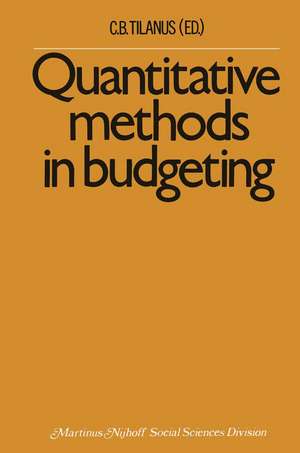
Quantitative methods in budgeting
Editat de C. B. Tilanusen Limba Engleză Paperback – 8 noi 2011
Preț: 369.32 lei
Puncte Express: 554
Carte tipărită la comandă
Livrare economică 07-21 decembrie
Livrare prin curier în România Termenul estimat este afișat lângă disponibilitate.
Transport gratuit de la 400.00 lei Plată online sau ramburs, în funcție de opțiunile comenzii.
Retur gratuit în 14 zile Comandă securizată și suport în română.
Specificații
ISBN-13: 9781461343752
ISBN-10: 1461343755
Pagini: 188
Ilustrații: 182 p.
Dimensiuni: 152 x 229 x 11 mm
Greutate: 0.28 kg
Ediția:Softcover reprint of the original 1st ed. 1976
Editura: Springer
Locul publicării:New York, NY, United States
ISBN-10: 1461343755
Pagini: 188
Ilustrații: 182 p.
Dimensiuni: 152 x 229 x 11 mm
Greutate: 0.28 kg
Ediția:Softcover reprint of the original 1st ed. 1976
Editura: Springer
Locul publicării:New York, NY, United States
V-ar putea interesa
-
 -33%Preț: 639.20 lei961.12 lei
 -
 The Scope of GovernmentOle Borre-33%Preț: 622.69 lei934.00 lei
 -
 Public Procurement Reforms in Africa: Challenges in Institutions and GovernanceChristine Léon de Mariz-31%Preț: 787.86 lei1145.69 lei
 -
 Development Policy as Public FinanceClive Bell-27%Preț: 411.42 lei560.57 lei
 -
 The Economics of Public SpendingDavid Miles-27%Preț: 362.73 lei493.79 lei
 -
 Welfare, Incentives, and TaxationJames A. Mirrlees-26%Preț: 448.76 lei609.75 lei
 -
 -30%Preț: 833.49 lei1191.11 lei
 -
 The Economic ConstitutionTony Prosser-30%Preț: 930.96 lei1332.19 lei
 -
 Governance Challenges and Innovations: Financial and Fiscal GovernanceHelmut K. Anheier-31%Preț: 826.04 lei1191.14 lei
 -
 Preț: 581.03 lei
 -
 EndgameJohn MauldinPreț: 103.24 lei
 -
 Doing More with LessB. MarrPreț: 344.07 lei
 -
 Preț: 84.69 lei
 -
 The European Debt Crisis: A PrimerRobert GodbyPreț: 138.65 lei
 -
 Local MoneyJohn RogersPreț: 139.25 lei
Public țintă
ResearchCuprins
1. Introduction.- 2. People and Techniques in Budgeting.- 2.1. The effectiveness of budget control systems.- 2.2. The wood and the trees.- 2.3. Potential psychological gains in using quantitative methods.- 2.4. Quantitative methods in assessing the social aspects of a control system.- 2.5. Conclusion.- 3. Balanced Transfer Values in Scheduling, Costing and Recompensing.- 3.1. Extended introduction and summary.- 3.2. Linear programming and accountancy.- 3.3. Models of the values as well as the measures of flows.- 3.4. Linking objects: transferrers of value.- 3.5. Balancing procedures: evaluation of intracompany trade.- 3.6. Degrees of freedom and channels of valuation.- 3.7. Ancillary interrelations in costing and recompensing.- 3.8. Recapitulation.- 4. Ratio Network Models and their Application in Budgeting.- 4.1. Ratio network models.- 4.2. Budgeting with the help of the ratio network method.- 5. The Development of a Budgeting Model.- 5.1. Introduction.- 5.2. The preliminary phase.- 5.3. The conceptual side.- 5.4. The general model.- 5.5. The first phase.- 5.6. The second phase.- 5.7. Conclusions with respect to the implementation.- Appendix 5.1. Mathematical description of the generalized model.- 6. Cost Accounting, Planning and Budgeting.- 6.1. Cost functions and product costing.- 6.2. The relations between production centres.- 6.3. Alternative production methods of economically homogeneous products.- 6.4. Planning, linear programming and unit costs.- 6.5. Planning, budgeting and costs.- 6.6. Example.- 7. Stochastic Budgeting.- 7.1. Introduction.- 7.2. Probability distributions.- 7.3. Some specific distributions.- 7.4. Relations between the variables.- 7.5. Computer program.- 7.6. Interval boundaries and policy.- 7.7. Concluding remarks.- Appendix 7.1. Flow-chart ofcomputer program.- Appendix 7.2. Interval exploitation budget.- Appendix 7.3. A definition of subjective probability.- 8. Variance Analysis, Flexible Budgeting and Responsibility Accounting.- 8.1. Classical variance analysis.- 8.2. The flexible-budgeting approach to variance analysis.- 8.3. Multi-stage, multidimensional variance analysis.- Appendix 8.1. Two-stage, two-dimensional variance analysis with flexible budgeting.- Appendix 8.2. Algebra and numerical example of two-stage, three-dimensional variance analysis with flexible budgeting.- 9. Where Short-Term Budget Meets Long-Term Plan.- 9.1. Next year’s budget in conflict with first year of long-term plan.- 9.2. Using budget pattern for disaggregation of long-term plan.- 9.3. The multiproportional RAS algorithm.- 9.4. Taking account of prior information.